







International Relations
Ramaphosa Calls for Deeper SA-Zimbabwe Economic Integration as BNC Opens in Pretoria


Published
2 months agoon

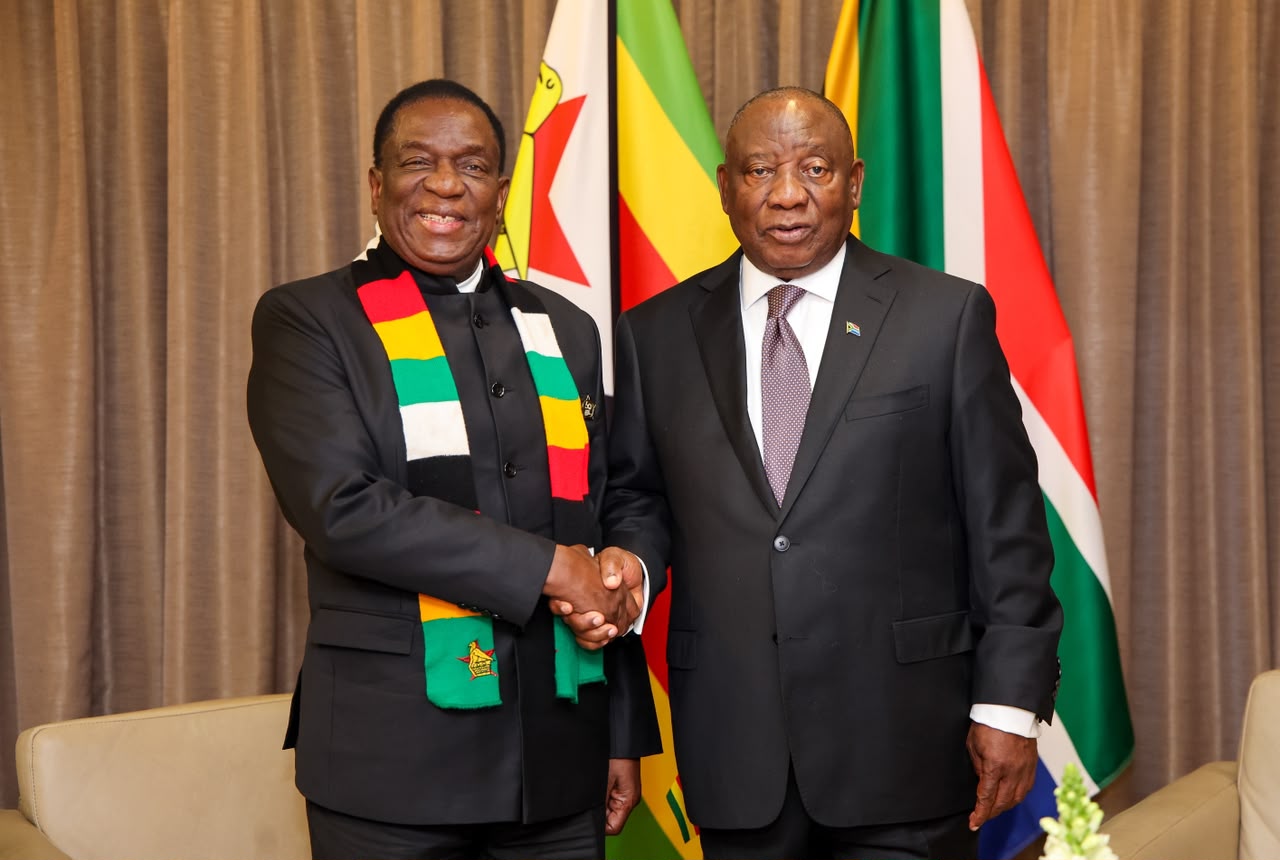
PRETORIA, 21 August 2026 — South African President Cyril Ramaphosa has called for South Africa and Zimbabwe to translate their historic political relationship into deeper economic integration, increased infrastructure investment and more balanced bilateral trade.
Opening the Fourth Session of the South Africa–Zimbabwe Bi-National Commission (BNC) at the OR Tambo Building in Pretoria on Friday, Ramaphosa said the two neighbouring countries should intensify cooperation across mining, energy, agriculture, transport, logistics, water management and border infrastructure.
Zimbabwean President Emmerson Mnangagwa is leading his country’s delegation to the high-level commission, which brings together ministers and senior officials from both governments.
Ramaphosa began his remarks by expressing condolences to Mnangagwa, the people of Zimbabwe and families affected by the Lake Kariba ferry tragedy, which he said had claimed close to 100 lives. Delegates observed a moment of silence.
“We are one people. Our spirits are inseparable,” Ramaphosa said, pointing to the two countries’ shared culture, history and liberation struggles.
He acknowledged Zimbabwe’s support for South Africa’s liberation movement during the struggle against apartheid, saying Pretoria would continue to remember the shelter, protection and assistance provided by Zimbabweans.
Bilateral trade has almost doubled
Economic cooperation featured prominently in Ramaphosa’s address, with the South African leader noting that Zimbabwe remains one of South Africa’s largest trading partners.
He said the value of bilateral trade had almost doubled over the past four years but warned that the relationship remained significantly imbalanced, with South Africa exporting substantially more goods to Zimbabwe than it imports.
Ramaphosa said the two countries should use mechanisms such as the Memorandum of Understanding on Economic Cooperation to address the deficit while taking advantage of the African Continental Free Trade Area to increase trade volumes and improve the composition of bilateral commerce.
A central objective, he said, should be expanding both countries’ capacity to manufacture and export higher-value products derived from their natural resources.
The BNC’s ministerial report is expected to assess progress and identify further opportunities in mining, energy, agriculture, transport, logistics and water management.
Infrastructure investment takes centre stage
Ramaphosa identified infrastructure as a critical foundation for expanding trade and economic growth, calling for greater cooperation in the construction and development of roads, bridges, dams, airports, health facilities and schools.
He said South African development finance institutions, including the Development Bank of Southern Africa and Industrial Development Corporation, were ready to invest in high-impact projects in Zimbabwe.
Such investments, he said, should connect farms and factories to markets, power stations to businesses and households, water infrastructure to communities, and countries to their neighbours.
Mining and mineral beneficiation were also identified as major areas for expanded cooperation.
Ramaphosa noted Zimbabwe’s increasing mining revenues and growing production of gold, platinum and critical minerals such as lithium, describing the country as an emerging global participant in the minerals sector.
South Africa, meanwhile, is seeking to increase investment in exploration and beneficiation.
“We have said for many years that our minerals should be processed at home, that we should export finished products,” Ramaphosa said, adding that the two countries now needed to turn that ambition into practice.
Energy, water and agriculture
Ramaphosa called for deeper energy cooperation through the Southern African Power Pool, arguing that the regional electricity market could help position Southern Africa as a leader in clean, affordable and reliable energy generation.
He also highlighted the agreement to supply water from Zimbabwe’s Beitbridge Water Works to Musina in South Africa as an example of practical cross-border cooperation that could improve climate resilience and address communities’ basic needs.
Agriculture was identified as another priority.
Ramaphosa recalled his visit to the 115th Zimbabwe Agricultural Show in 2025, saying he had been impressed by the technologies, equipment and services available to industrialise agricultural production.
He called for intensified use of the two countries’ arable land and greater support for communal and commercial farmers, particularly as climate change and recurring El Niño-induced droughts place increasing pressure on water resources and grazing land.
Borders and migration
With significant movements of people and goods between South Africa and Zimbabwe, Ramaphosa said migration and border management required continued cooperation.
He called for modernisation of border facilities and systems to facilitate legitimate movement and trade while strengthening joint efforts against trans-border crime.
The Beitbridge border crossing, which links Zimbabwe and South Africa, is one of Southern Africa’s most important commercial and migration corridors.
Regional security remains a concern
Ramaphosa also used the BNC to address regional and continental security challenges, warning that economic development depended on peace and stability.
He expressed concern over conflict and instability in the eastern Democratic Republic of the Congo and Mozambique’s Cabo Delgado province, as well as developments in Madagascar.
Beyond Southern Africa, he cited the war in Sudan, political and security challenges in South Sudan and armed insurgencies across the Sahel.
Against an increasingly fractured geopolitical environment, Ramaphosa called for greater reliance on mediation, dialogue and the peaceful settlement of disputes.
He congratulated Zimbabwe on its election as a non-permanent member of the United Nations Security Council for the 2027–2028 term, saying South Africa expected Harare to use the platform to draw international attention to conflicts constraining Africa’s development and mobilise support for African-led solutions.
From historic ties to measurable outcomes
Ramaphosa framed the Fourth BNC as an opportunity to move the South Africa-Zimbabwe relationship beyond historic solidarity towards measurable economic and developmental outcomes.
“South Africa and Zimbabwe stand together,” he said. “We are two countries with a common history and a common destiny.”
He said citizens of both countries expected the commission to produce concrete results, particularly in building inclusive economies capable of creating employment and sustainable livelihoods.
The BNC brings together the political leadership of the two neighbouring states to review bilateral cooperation, resolve outstanding challenges and establish priorities for the next phase of relations.
Ramaphosa formally declared the Fourth Session open ahead of the presentation of the ministers’ report, which is expected to provide a detailed assessment of progress across the bilateral cooperation framework.

Over the years, I have found it challenging to define myself solely by an academic qualification, trade, or occupation. My eagerness to learn, especially about how to build and deploy capital, has allowed me to accumulate diverse experiences in a short span of time. Through this journey, I have discovered that at my core, I am a storyteller. I tell the stories of corporations, their heritage, and the individuals who act in their name. I explore the role of these institutions in fulfilling the promise of a better Africa, and, most importantly, the causal link between the rule of law and economic development. As a fellow believer in Africa’s potential, can I count on you to be a point of light in securing our continent’s future?




