





Agriculture
“Your Questions Made Me Think”: Nine Years Later, a Conversation with ZZ2’s Tommie Van Zyl Still Has Lessons for Enterprise Agriculture


Published
2 months agoon

Banking on Africa’s Future | Corporate Heritage Series
By Tinashe T. T. Mpasiri | 19 August 2026
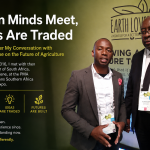
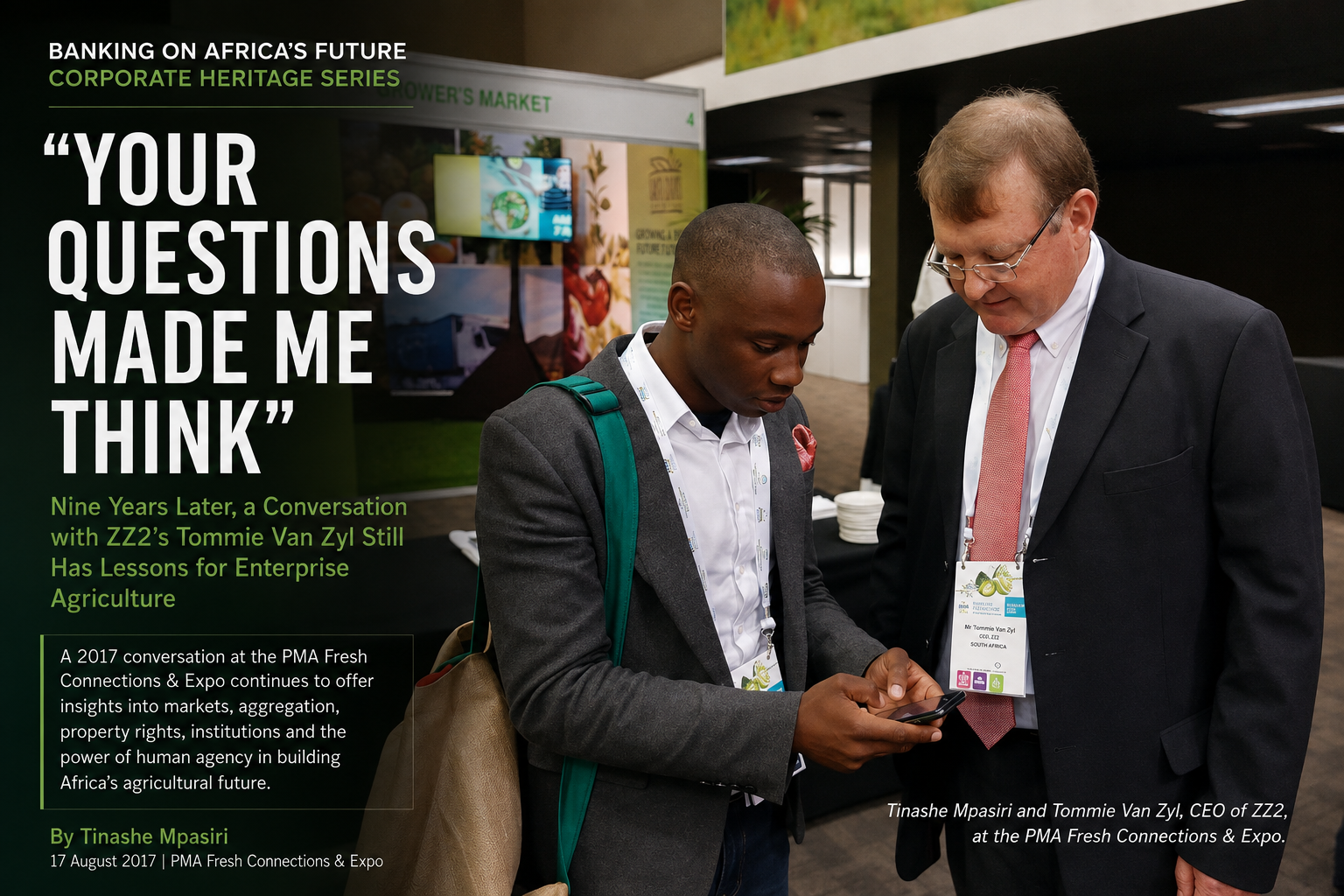
On 17 August 2017, I shared a conversation I had with Tommie Van Zyl, CEO of ZZ2, at the PMA Fresh Connections & Expo.
I captioned the Facebook post:
“Chairman of ZZ2 Mr Tommie Van Zyl. In his words, ‘Tinashe, your questions have made me start to think.’”
I was 30 years old.
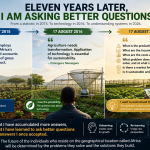
Nine years later, I returned to the conversation and discovered something interesting: some questions improve with age.
Not necessarily because the original answers were right or wrong, but because experience changes the questions one is capable of asking of an answer.
In 2017, we spoke about tomatoes, emerging farmers, exports, property rights, markets, government, knowledge and the kind of Africa Van Zyl wanted to see.
In 2026, I hear something more fundamental in that conversation.
I hear the architecture of enterprise agriculture.
More Than Tomatoes
My opening question was simple:
“What is ZZ2’s main business?”
Van Zyl replied:
“ZZ2’s main business is tomatoes.”
Then he immediately complicated his own answer:
“More than tomatoes, it’s creating a home for all its people.”
That distinction matters.
A tomato is a product. ZZ2 is an enterprise.
The product may be visible on the supermarket shelf, but behind it sits an organisation of people, knowledge, land, capital, technology, biological systems, infrastructure, logistics and markets.
This is where the understanding of agriculture must begin to expand.
Agriculture is frequently discussed as though the farm were the entire economy surrounding food. Yet the farm is one point within a much larger commercial system.
A seed requires knowledge before it becomes a crop. A crop requires production systems before it reaches maturity. Harvested produce requires aggregation, storage, logistics and market access before it can become revenue.
And revenue requires a customer willing to exchange money for value.
The economic story of a tomato therefore does not end when it is harvested.
In many respects, that is where another story begins.
Producing More Is Not Enough
Van Zyl made an observation in 2017 that remains important to any discussion about increasing agricultural production.
Too much production directed into a constrained market can diminish value.
He explained that producers competing within a congested domestic market can eventually reach a point where prices become commercially unsustainable.
Then came the line that deserves greater attention:
“To just produce and compete locally is not going to work. We must take our products to where there’s a shortage so that the price can be remunerated properly.”
That shifts agricultural thinking from production to enterprise.
The question cannot end with:
What can be grown?
It must continue:
Who needs it? Who will buy it? At what price? How will it reach them? What standards must it satisfy? And can the producer still earn an adequate return after the costs of getting it there?
A successful harvest is a biological achievement.
A successful agricultural enterprise must also be a commercial achievement.
The distinction is critical.
A farmer can produce more and become poorer if the additional production cannot reach a viable market.
The Power of Aggregation
Van Zyl’s proposed response was aggregation.
“Small farmers need to work together. Small and big farmers need to work together.”
There is considerable economic logic packed into those two sentences.
Agricultural discourse often divides participants into categories: small-scale and commercial, emerging and established, communal and private.
Those distinctions can be useful for policy analysis.
They can also become barriers to economic imagination.
The market ultimately encounters products, volumes, quality, reliability, standards, prices and delivery capability.
A small producer who cannot individually supply sufficient volume for a major buyer may become commercially significant when production is aggregated with that of others.
An established producer may possess technical expertise, infrastructure, market relationships and institutional knowledge accumulated over decades. An emerging producer may bring additional productive capacity, entrepreneurial ambition, local knowledge and access to opportunities that the larger enterprise does not possess.
The relevant question therefore becomes less about small versus large and more about how different capabilities can be connected.
That is ecosystem thinking.
It also changes the objective of agricultural development.
The aim should not necessarily be to turn every producer into a vertically integrated agricultural conglomerate.
It should be to ensure that producers can participate in functioning value chains.
Market Access Is Infrastructure
Van Zyl described fresh produce markets, commission agents and aggregation mechanisms that could enable even relatively small growers to reach buyers.
This deserves to be understood as infrastructure.
A road is infrastructure because it connects two physical points.
A functioning market is economic infrastructure because it connects production with demand.
Standards are infrastructure.
Reliable logistics are infrastructure.
Payment systems are infrastructure.
Commercial relationships are infrastructure.
Market information is infrastructure.
Without these connections, productive capacity can remain economically stranded.
This is particularly important when discussing rural development.
If production increases in a village while access to viable markets remains unchanged, the additional output may simply intensify competition among producers selling to the same limited pool of buyers.
Van Zyl’s proposition was different: connect production to places where demand exists.
That is how agricultural activity can begin translating into income.
Land Matters. Knowledge Determines What Happens on It.
When I asked what ZZ2 was doing to assist small and emerging farmers, Van Zyl did not begin by talking about distributing land.
He spoke about demonstrating what successful farming requires.
He spoke about internships.
He spoke about networks.
He spoke about young and new farmers spending time inside the enterprise and observing how it works.
He discussed ZZ2’s Natuurboerdery approach, which emphasises working in harmony with nature and understanding the biological dimensions of agricultural production.
Then he described:
“Building a community of engineers, agronomists, all specialists, technicians in the field. Slowly, slowly building the ecosystem.”
There is an important lesson here.
Land is indispensable to land-based agriculture.
But land and agricultural capability are not synonymous.
A productive agricultural enterprise requires accumulated knowledge: agronomy, soil science, engineering, financial management, procurement, logistics, technology, labour management, governance and market intelligence.
That knowledge frequently resides across multiple people and institutions rather than inside one individual.
The challenge of agricultural transformation therefore extends beyond access to productive assets.
It includes building the capability to use those assets productively.
This is why knowledge itself should be understood as productive infrastructure.
Property Rights: From Possession to Productive Agency
Our conversation eventually moved into the politically difficult territory of land reform.
I asked Van Zyl about proposals to transfer farms from established producers to aspiring farmers and what he believed the economic consequences might be.
He initially resisted being drawn into partisan politics:
“Politics is not our terrain. We know farming, and we know the agricultural value chain.”
But he also recognised that no enterprise operates on an island.
Technology, economics, climate, politics, trade relationships and public policy all affect agricultural production.
When Van Zyl subsequently spoke about respect, I asked:
“Is it respect for property rights?”
His answer was not simply that private ownership must exist.
He connected property rights to productive activity.
“The one I know is to have a private title. But that private title should not give you the right to live on an island on your own. It should give you the right to work the land, or to work the resources, to the benefit of the whole society.”
Whether one agrees with every part of that formulation or not, it raises a valuable corporate-literacy question:
What is the economic function of a property right?
A title deed is not a crop.
Possession is not production.
Ownership is not automatically productivity.
Secure and legally enforceable rights can, however, provide the certainty within which people invest, contract, lease, finance, develop, transfer and plan.
The right itself does not create the enterprise.
It establishes part of the institutional architecture within which enterprise becomes possible.
That distinction matters enormously in any serious conversation about land reform.
The objective cannot merely be to alter who possesses an asset.
The deeper question is whether the institutional arrangement enables that asset to remain—or become—productive.
The Institution and the Human Being
Near the end of our conversation, Van Zyl said:
“Instead of waiting for the government, or the politicians, to tell us what to do, we should do it ourselves.”
Then:
“We shouldn’t wait for the government alone. We should also do our thing.”
This is where the conversation intersects with a principle that has increasingly shaped my thinking:
Motion requires causation.
Africa is geography; agency belongs to the human beings who organise resources, build enterprises, develop technology, allocate capital and govern institutions within it.
The condition of that geography is therefore an outcome of human action interacting with institutional design.
Government matters enormously.
So do companies.
So do markets.
So do universities, banks, research institutions, commodity organisations and producer associations.
But institutions ultimately operate through people.
This leads to a more useful question than repeatedly asking what “Africa” should do:
What outcome is required, who must act to produce it, and through which institution can that action be organised?
That question converts aspiration into architecture.
Government Is Part of the Ecosystem, Not the Entire Ecosystem
Van Zyl was not arguing for the absence of government.
Earlier in the same conversation he had explicitly said:
“We need to cooperate with governments and make sure the logistic lines and institutional barriers are overcome.”
That qualification is important.
The argument is not government versus enterprise.
It is about recognising different functions within an economic system.
Public institutions establish laws, administer regulation, protect rights, develop and maintain certain forms of infrastructure, negotiate trade relationships and create conditions that can either enable or inhibit productive activity.
Businesses organise resources to produce and exchange value.
Financial institutions allocate capital.
Researchers develop knowledge.
Engineers solve technical problems.
Producers grow crops.
Logistics enterprises connect locations.
Markets connect supply with demand.
The strength of the system depends not on pretending that one actor can perform every function, but on whether these functions connect effectively.
This is why Van Zyl’s language of an ecosystem was so important.
Agriculture Is a Network of Human Capability
Look at a tomato differently.
Behind that tomato may sit genetics and seed development, irrigation engineering, soil management, biological knowledge, machinery, energy, labour, finance, insurance, packaging, cold-chain infrastructure, transportation, wholesale markets, retailers and ultimately a consumer.
Each stage creates opportunities for enterprise.
This is why the future of agriculture cannot be presented to young people merely as an invitation to become farmers.
One person may become an agronomist.
Another may build agricultural software.
Another may manufacture greenhouse structures.
Another may finance production.
Another may develop biological inputs.
Another may operate cold-chain logistics.
Another may aggregate produce.
Another may establish processing capacity.
Another may build export markets.
Agriculture becomes aspirational when people can see the breadth of human possibility contained within its value chain.
The farm remains fundamental.
But the opportunity is much larger than the farm.
The Africa We Want Is an Outcome
I eventually asked Van Zyl:
“Without taking much of your time, what kind of Africa would you want to see, and how best can it be secured?”
He spoke about hard work, innovation, co-creation, respect, talent development, freedom of movement and people learning from one another.
He spoke about people enabling themselves and enabling each other.
Nine years later, I interpret the underlying proposition somewhat differently.
The Africa one wants is not an actor waiting somewhere in the future.
It is an outcome.
And outcomes require causes.
Prosperity requires productive capability.
Productive capability requires knowledge.
Enterprise requires markets.
Markets require institutions.
Investment requires sufficient confidence in the rules governing capital and property.
Trade requires infrastructure and relationships.
Innovation requires people capable of identifying problems and developing solutions.
None of these elements operates effectively in permanent isolation from the others.
The task, therefore, is not merely to imagine a prosperous future.
It is to identify and organise its causes.
From Conversation to Institutional Knowledge
At the end of the interview, I reflected that Van Zyl and I appeared to share certain values and suggested that, through The 1873 Network and its radio platform, experiences within the agricultural sector could be shared to inspire new thinking, innovation and possibilities.
Van Zyl responded:
“I appreciate your questions. It made me think a lot as well this morning. Thank you, Tinashe.”
That was 2017.
There is something instructive about encountering those words again in 2026.
At 30, I was asking questions about the Africa I wanted to see.
Nine years later, experience has changed how I understand some of the answers.
That is not inconsistency.
It is learning.
Corporate heritage should therefore be more than nostalgia about founders, companies, dates and achievements.
Its greater value lies in preserving experiences that can later be interrogated for institutional knowledge.
What worked?
Why did it work?
What assumptions proved wrong?
What changed?
What remains useful?
What can another entrepreneur, farmer, policymaker, investor or young person learn from the experience?
That is how history becomes economically useful.
The purpose is not to preserve the past unchanged.
It is to observe, unlearn, re-learn and learn from it so that knowledge accumulated through experience does not disappear with the people who acquired it.
Tommie Van Zyl told me that my questions made him think.
Nine years later, his answers have made me think again.
Perhaps that is the real return on a good conversation:
the answer does not end the question. It improves the next one.
#CorporateHeritage #CorporateLiteracy #TheAfricaIWant #BOAF

Over the years, I have found it challenging to define myself solely by an academic qualification, trade, or occupation. My eagerness to learn, especially about how to build and deploy capital, has allowed me to accumulate diverse experiences in a short span of time. Through this journey, I have discovered that at my core, I am a storyteller. I tell the stories of corporations, their heritage, and the individuals who act in their name. I explore the role of these institutions in fulfilling the promise of a better Africa, and, most importantly, the causal link between the rule of law and economic development. As a fellow believer in Africa’s potential, can I count on you to be a point of light in securing our continent’s future?




