







Business & Economy
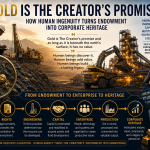
Gold Is The Creator’s Promise: How Human Ingenuity Turns Endowment into Corporate Heritage


Published
2 months agoon

Banking On Africa’s Future | Corporate Heritage Series
By Tinashe T. T. Mpasiri | 20 August 2026
On 20 August 2021, I wrote:
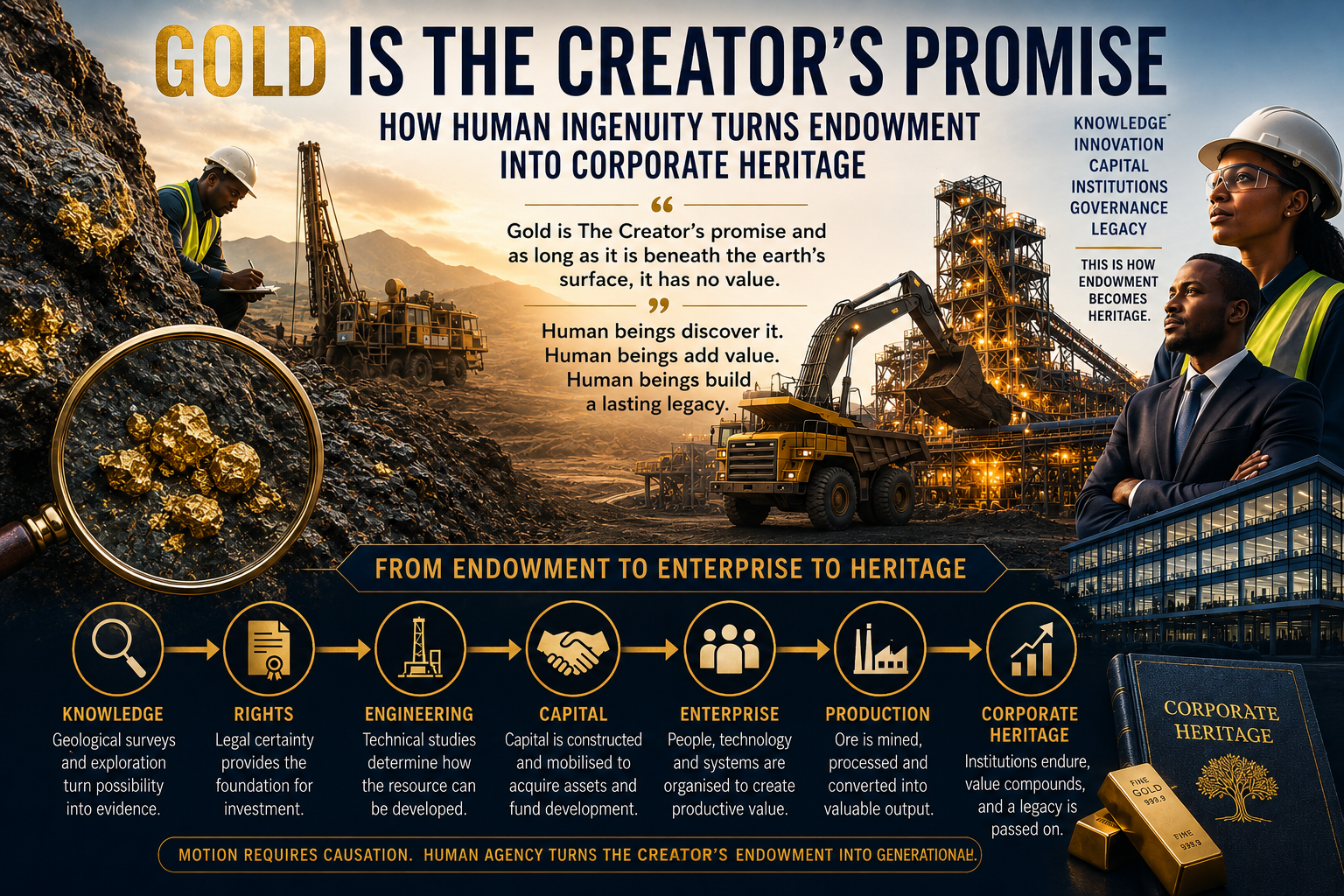
“Gold is The Creator’s promise and as long as it is beneath the earth’s surface, it has no value.”
Five years later, I still stand by that proposition.
Gold has existed beneath the earth for millennia. Long before mining companies, banks, stock exchanges, governments or monetary systems existed, the gold was there.
And left undisturbed, it could remain there for another thousand years.
For that natural endowment to become economically productive, something has to happen.
A human being must first discover it.
That requires knowledge.
Geological formations must be studied. Surveys must be undertaken. Exploration must occur. Samples must be collected and analysed. A mineral resource must be identified and understood before engineers can determine how it might be extracted.
Only then can another set of human actions begin: securing rights, mobilising capital, acquiring machinery, satisfying regulatory requirements, organising labour, developing the mine, processing the ore and ultimately bringing the gold to market.
The gold does none of this for itself.
Human beings do.
That is what I meant in 2021.
It was not a technical proposition about whether an identified mineral resource can carry a financial valuation before extraction. It was a proposition about human agency and the creation of productive economic value.
The Creator provides the natural endowment.
The Creator also endowed human beings with the ingenuity to discover its possibilities.
My Introduction to the Gold Value Chain
My relationship with this question did not begin in a classroom.
It began with my father.
When I was 19 years old, my uncle had sourced mining equipment from the United States to expand his mining operations. My father presented me with a challenge: secure an import-duty exemption for the equipment.
I wrote to the Minister responsible for mines and engaged the revenue authority.
The exemption was granted.
At 19, I probably saw the assignment principally as a problem that needed solving.
Today I see the economic education embedded within it.
The gold was beneath the ground, but elsewhere human beings had designed and manufactured equipment capable of extracting it. My uncle had identified and sourced that equipment. It had to cross an international border governed by laws and regulations, and a public authority possessed the power to grant an exemption.
Someone had to understand and navigate that institutional process.
Without consciously knowing it, I was being introduced not simply to mining, but to the interconnected architecture required to convert natural endowment into productive enterprise.
Then Came Capital
In 2016, my father gave me another challenge.
Secure investment for the mine.
That assignment changed the nature of the inquiry.
Knowing that gold existed was no longer enough.
An investor would need to know what existed beneath the ground, how confidently it had been identified, what rights governed access to it, what it would cost to extract, what equipment would be required, how the operation would be managed, where the output would be sold and how capital would generate a return.
I began to appreciate an important distinction:
Having access to gold is not the same as having an investable gold enterprise.
The mineral may provide the opportunity.
The enterprise must be constructed around it.
The First Value Added Is Knowledge
This is perhaps where the economics of natural resources should begin.
Not with extraction.
With knowledge.
Before machinery can excavate the earth, human beings must first understand what lies beneath it.
The geologist reads formations. Exploration converts possibility into evidence. Assays convert samples into information. Resource modelling begins converting geological knowledge into an economic proposition. Engineering asks whether what has been discovered can practically and economically be extracted.
Each stage adds something that did not previously exist:
knowledge.
The gold itself may have been there since creation.
The knowledge that it is there is a human achievement.
And knowledge changes what becomes possible.
Once the resource is known and sufficiently understood, rights can be organised around it, engineering solutions can be designed, risks can be evaluated and capital can begin considering whether to participate.
The journey from natural endowment to enterprise therefore begins long before the first ounce of gold leaves the ground.
It begins when human ingenuity turns the unknown into the known.
Perhaps the Problem Is Not Simply Access to Capital
By 2021, a number of individuals involved in gold mining had approached our offices seeking assistance.
Their recurring challenge was capital.
But their requests caused me to question the conventional formulation of the problem.
The question usually sounds like this:
Where can I find an investor?
My 2021 reflection asked something different:
“How best can capital be constructed to scale up the production of gold ore when the majority of individuals in the value chain operate in silos?”
Five years later, I believe the word constructed is the most important word in that question.
Capital does not simply arrive because a mineral exists.
Before asking an investor to provide money, there must be clarity about what the investor is being invited to finance.
What rights exist? Who holds them? What has geological work established? What capital is required? What productive assets will that capital acquire? What are the risks? What revenues might be generated? Who governs the enterprise? How will financial flows be controlled? How does the provider of capital participate in the economic outcome?
These questions transform the conversation from finding money to constructing an investable enterprise.
That is a fundamentally different discipline.
Capital Can Be Constructed
Capital is not synonymous with finding one wealthy individual willing to write a cheque.
Different stages of an enterprise carry different risks, and different forms of capital can potentially respond to those risks.
Early-stage risk may require equity. Equipment may, under appropriate circumstances, be financed against productive use. A joint venture may combine mineral rights, technical capability and capital. An offtake arrangement may create greater certainty around future production and markets. More developed operations may become capable of supporting debt or other structured financing instruments.
The appropriate mechanism will always depend on the economics and risk profile of the particular project.
But the underlying principle is important:
The entrepreneur’s task is not merely to search for capital. It is to construct an enterprise into which capital can rationally enter.
That is corporate literacy applied to natural resources.
From Silos to Institutions
The mining operators approaching us in 2021 revealed another challenge.
They largely operated in silos.
One participant may possess mineral rights but lack equipment. Another may have machinery but no sufficiently attractive resource. Elsewhere in the value chain sit geological expertise, processing capability, access to markets and capital.
Individually, each participant may remain constrained.
The opportunity therefore may not lie in financing every participant separately. It may lie in constructing the institutional architecture through which complementary capabilities can work together.
But cooperation is not created merely by putting people into the same room.
An institution requires defined rights and responsibilities, governance, enforceable agreements, financial controls, aligned commercial incentives, accountability and mechanisms for resolving disputes.
These are not administrative decorations around an enterprise.
They are part of what makes the enterprise investable.
Fragmented capabilities begin becoming economically consequential when human beings construct institutions capable of organising them towards a common productive purpose.
From Natural Endowment to Corporate Heritage
This brings the argument beyond gold.
The geographical location called Africa contains extraordinary natural endowments: gold, platinum, copper, diamonds, lithium, cobalt, arable land, water, sunlight and wind.
But the existence of resources does not predetermine the economic condition of the human beings living around them.
The more consequential question is:
What have human beings built around those endowments?
A mineral deposit may survive underground for millions of years.
A productive institution can transfer knowledge across generations.
A mine can develop engineering capability. A company can accumulate intellectual property. A processing operation can create industrial capacity. A financial structure can mobilise savings into productive assets. A well-governed corporation can survive its founders.
A generation can therefore inherit more than access to natural resources.
It can inherit enterprises.
Knowledge.
Technology.
Productive capacity.
Governance systems.
Capital.
That is the transition from natural endowment to corporate heritage.
The distinction is profound.
Natural endowment is inherited from creation.
Corporate heritage is inherited from human action.
Motion Requires Causation
Looking back, the lesson my father was teaching me was bigger than gold.
At 19, the problem was getting productive equipment into the country.
In 2016, the problem became mobilising investment.
By 2021, the question had evolved into how capital could be constructed when participants across the value chain remained fragmented.
Today, I see the connecting thread.
Motion requires causation.
The question is therefore not merely what lies beneath the ground.
It is:
What are human beings building above the ground to make what lies beneath it productive?
Gold may be The Creator’s promise.
Human ingenuity discovers it.
Knowledge reveals its possibilities.
Enterprise organises those possibilities.
Capital enables productive capacity.
Institutions give that productive capacity the possibility of enduring beyond the individuals who created it.
The gold may have existed since creation.
Corporate heritage must be built.
Observe. Learn. Serve. Earn.
#CorporateHeritage #CorporateLiteracy #TheAfricaIWant #BOAF

Over the years, I have found it challenging to define myself solely by an academic qualification, trade, or occupation. My eagerness to learn, especially about how to build and deploy capital, has allowed me to accumulate diverse experiences in a short span of time. Through this journey, I have discovered that at my core, I am a storyteller. I tell the stories of corporations, their heritage, and the individuals who act in their name. I explore the role of these institutions in fulfilling the promise of a better Africa, and, most importantly, the causal link between the rule of law and economic development. As a fellow believer in Africa’s potential, can I count on you to be a point of light in securing our continent’s future?




