







Agriculture
Eleven Years Later: A Young Population Is Not a Demographic Dividend


Published
2 months agoon

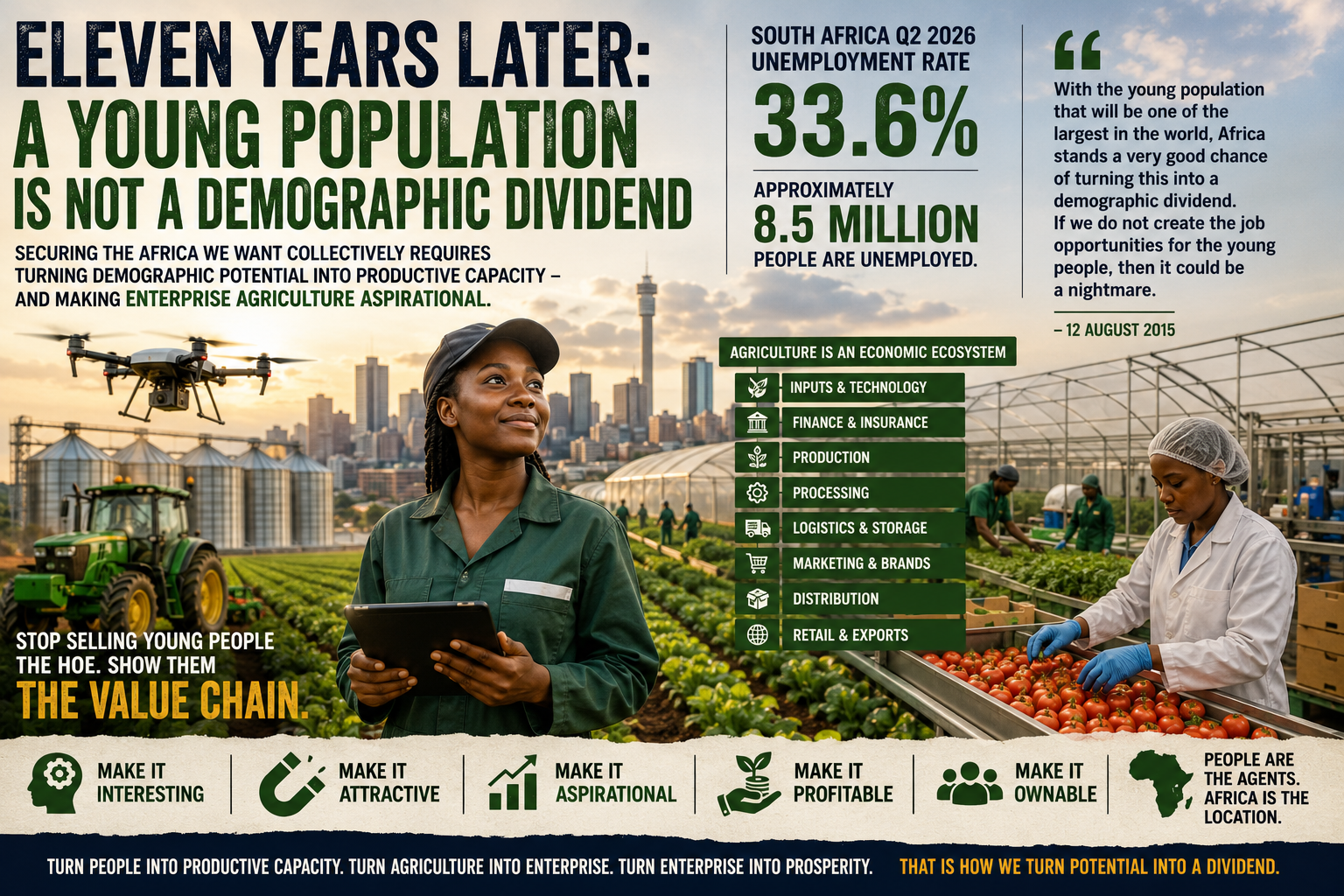
Securing the Africa we want collectively requires turning demographic potential into productive capacity — and making enterprise agriculture aspirational.
By Tinashe T. T. Mpasiri | 12 August 2026
On 12 August 2015, I wrote:
“With the young population that will be one of the largest in the world, Africa stands a very good chance of turning this into a demographic dividend. If we do not create the job opportunities for the young people, then it could be a nightmare.”
I argued that we needed to increase productivity and deliberately develop sectors capable of absorbing young people into productive economic activity.
I singled out agriculture.
And I ended with a proposition:
We needed to change the concept of agriculture into one of a business.
Today, exactly eleven years later, that Facebook memory has returned.
But memories should not merely remind us of what we said. They should allow us to measure what happened.
So, eleven years later:
Where is the demographic dividend?
The numbers are answering us
Yesterday, South Africa received another uncomfortable measurement.
Statistics South Africa’s Quarterly Labour Force Survey for the second quarter of 2026 put the official unemployment rate at 33.6%, up from 32.7% in the previous quarter. Approximately 8.5 million people are unemployed.
Those numbers represent more than a labour-market statistic.
They represent productive capacity sitting idle: people with intelligence, energy, skills and ambitions whose economic potential has not been sufficiently activated.
And therein lies the distinction we too often overlook:
A young population is not a demographic dividend.
It is demographic potential.
A dividend is a return.
And returns must be earned.
Demography gives us people. Enterprise gives them productive purpose.
There has been a tendency to speak of Africa’s youthful population almost as though demographics automatically confer an economic advantage.
They do not.
A young population becomes advantageous when people are skilled, productive and economically engaged.
The chain is straightforward:
People → Skills → Productivity → Enterprise → Employment → Income → Markets → Capital Formation → Prosperity.
If millions remain outside productive economic activity, the chain breaks.
This is why unemployment cannot be understood only as a shortage of jobs. It is also evidence of insufficient productive enterprise capacity.
Before there can be sustainable employment, there must ultimately be productive economic activity capable of sustaining it.
Someone must organise land, labour, knowledge, technology and capital around solving a problem or satisfying demand.
Someone must take the risk.
Someone must find the market.
Someone must build the enterprise.
Where will the enterprises come from?
Every economy eventually has to answer a basic question:
What are its people producing?
Social protection can protect people from destitution. Public employment programmes can provide income. Governments can redistribute resources.
All may have legitimate roles.
But none eliminates the necessity for production.
Someone must grow, manufacture, process, transport, finance, invent, sell or build something.
And somebody must organise those activities into enterprises capable of surviving, reinvesting and scaling.
So instead of asking only:
Where will the jobs come from?
We should simultaneously ask:
Where will the enterprises that create and sustain those jobs come from?
Agriculture may be hiding in plain sight
This brings me back to what I wrote eleven years ago.
Agriculture.
But not agriculture understood narrowly as subsistence farming.
Enterprise agriculture.
The World Bank projected in 2013 that Africa’s farmers and agribusinesses could create a US$1 trillion food market by 2030, provided constraints including access to capital, electricity, technology, irrigation and markets were addressed.
2030 is now four years away.
We have discussed potential for long enough.
The question is:
Who is building the enterprises that will capture that opportunity?
Because agriculture is not merely what happens on a farm.
Agriculture is an economic ecosystem.
Stop selling young people the hoe
Perhaps one reason agriculture struggles to attract ambitious young people is that we continue marketing it through its oldest image.
The hoe.
Tell a young person to enter agriculture and too often the mental picture is manual labour under the sun.
Then we wonder why agriculture struggles to compete for ambition.
Stop selling young people the hoe.
Show them the value chain.
Show them drones monitoring crop health, precision irrigation, laboratories developing seed varieties and artificial intelligence analysing weather, soil and yields.
Show them agricultural machinery, veterinary science, cold-chain infrastructure, commodity exchanges and agricultural finance.
Show them warehouses, processing plants, logistics platforms, supermarkets and export markets.
Show them brands.
Show them balance sheets.
Show them equity.
Show them ownership.
Then ask whether agriculture is still simply about farming.
Follow the tomato
Take something as ordinary as a tomato.
Someone develops the seed. Someone supplies the inputs. Someone finances production. Someone provides irrigation and agronomic expertise.
Someone grows it.
Someone grades, packages, refrigerates and transports it.
Someone processes some of it into sauce or paste.
Someone manufactures the packaging.
Someone finances the processor.
Someone builds the brand.
Someone distributes the finished product.
Someone places it on a supermarket shelf.
Someone exports it.
At virtually every point there is an opportunity for enterprise, employment and value addition.
And wherever value is added, there is an opportunity for income, profit, taxation, investment and capital formation.
That tomato is not merely a crop. It is a value chain.
And a functioning value chain is an economy in miniature.
Make enterprise agriculture aspirational
We do not merely need more young people in agriculture.
We need young people who want to build enterprises throughout agricultural value chains.
That requires making enterprise agriculture aspirational.
An ambitious young African should be able to look at agriculture and see a credible pathway towards knowledge, technology, innovation, ownership and wealth creation.
The ambition need not merely be:
I want to farm tomatoes.
It can also be:
I want to build the company that processes tomatoes.
I want to finance 10,000 growers.
I want to manufacture irrigation systems.
I want to build the cold-chain network connecting farmers to cities.
I want to develop agricultural software.
I want to build an African food brand that sells across the continent.
I want to build an agribusiness that eventually lists on a stock exchange.
Now we are no longer discussing farming merely as an occupation.
We are discussing enterprise agriculture as an industrial system.
Where are the heroes of production?
There is also a cultural challenge.
Societies communicate their priorities partly through the people they celebrate.
We know our politicians, footballers, musicians and entertainers.
But how many young people can name the entrepreneurs building food-processing companies, seed businesses, irrigation enterprises, logistics networks or agricultural technology companies?
Where are our heroes of production?
Where is the prestige attached to building a company that employs 5,000 people?
Where is the fascination with the entrepreneur who transforms milk into a continental dairy brand?
People tend to aspire towards what society teaches them to admire.
If we want production, then production itself must become aspirational.
None of this means every young African must become an entrepreneur. Enterprises need engineers, accountants, scientists, lawyers, technicians, drivers, managers, marketers, software developers and artisans.
But somebody must establish and scale the enterprises that employ them.
Entrepreneurship and employment are therefore not competing ideas.
Enterprise creates the productive architecture within which employment becomes possible.
The African Development Bank’s ENABLE Youth programme offers a glimpse of the possibilities. By 2025, the Bank reported that investments of approximately US$669 million across 18 countries had helped create more than 237,000 jobs, while supporting young Africans to develop agribusiness enterprises.
The objective was not simply to send young people onto farms.
It was to develop agripreneurs.
But who owns the value chain?
There is another question we cannot avoid.
If agriculture becomes a trillion-dollar market but Africans remain concentrated at the lowest-margin end of the chain, have we transformed agriculture?
Who owns the processors?
Who owns the warehouses?
Who finances production?
Who manufactures the machinery?
Who develops the technology?
Who controls distribution?
Who owns the brands?
Who captures the margin between the farm gate and the consumer?
These are questions of enterprise, capital and ownership.
Producing more raw commodities while importing increasingly sophisticated finished products cannot be the ultimate ambition.
The greater prize is building enterprises that capture value throughout the chain.
Securing the Africa we want collectively
If we genuinely seek to secure the Africa we want collectively, we must recognise a fundamental truth:
Africa is a location. People are the agents.
The continent does not farm. People farm.
Africa does not establish companies. People establish companies.
Africa does not innovate. People innovate.
Africa does not manufacture. People manufacture.
The future therefore cannot be secured simply by repeatedly describing what the continent possesses.
Arable land is potential.
Minerals are potential.
A youthful population is potential.
Markets are potential.
Human agency converts potential into value.
The real question is what people build with what is available to them.
Eleven years later
The 2015 post carried a hashtag:
#TurningPotentialIntoProfit
Eleven years later, that proposition has become even clearer.
Profit, legitimately earned by solving problems and creating value, is not the enemy of development.
Profit allows an enterprise to survive and reinvest.
Reinvestment expands productive capacity.
Productive capacity creates employment.
Employment generates income.
Income expands markets.
Markets attract capital.
Capital finances more enterprise.
And enterprise gives human potential somewhere productive to go.
That is how demographic potential begins to produce a demographic dividend.
So perhaps the most important question raised by this eleven-year-old memory is not:
What will Africa’s young population become?
It is:
What are we building around them?
We have the people.
We have the land.
We have the demand.
We have the market.
We have the technology.
We have the warning.
Now we must build.
Make enterprise agriculture interesting, attractive and aspirational.
Make it technologically sophisticated.
Make it investable.
Make it profitable.
Make ownership possible.
Build the farms.
Build the processors.
Build the cold chains.
Build the brands.
Build the markets.
Build the enterprises.
Because a young population is not a demographic dividend.
It is a demographic promise.
And promises are not self-executing.
People must act.
Equip people. Build productive capacity. Transform agriculture into enterprise. Transform enterprise into prosperity.
That is how we begin securing the Africa we want collectively.
And that is how we turn potential into a dividend.

Over the years, I have found it challenging to define myself solely by an academic qualification, trade, or occupation. My eagerness to learn, especially about how to build and deploy capital, has allowed me to accumulate diverse experiences in a short span of time. Through this journey, I have discovered that at my core, I am a storyteller. I tell the stories of corporations, their heritage, and the individuals who act in their name. I explore the role of these institutions in fulfilling the promise of a better Africa, and, most importantly, the causal link between the rule of law and economic development. As a fellow believer in Africa’s potential, can I count on you to be a point of light in securing our continent’s future?




