











Business & Economy
Ten Years Later: The Unemployment Time Bomb We Failed to Defuse


Published
2 months agoon

By Tinashe T. T. Mpasiri | 11 August 2026
Sometimes history does not announce itself. It simply places two dates beside each other and asks us whether we have learned anything.
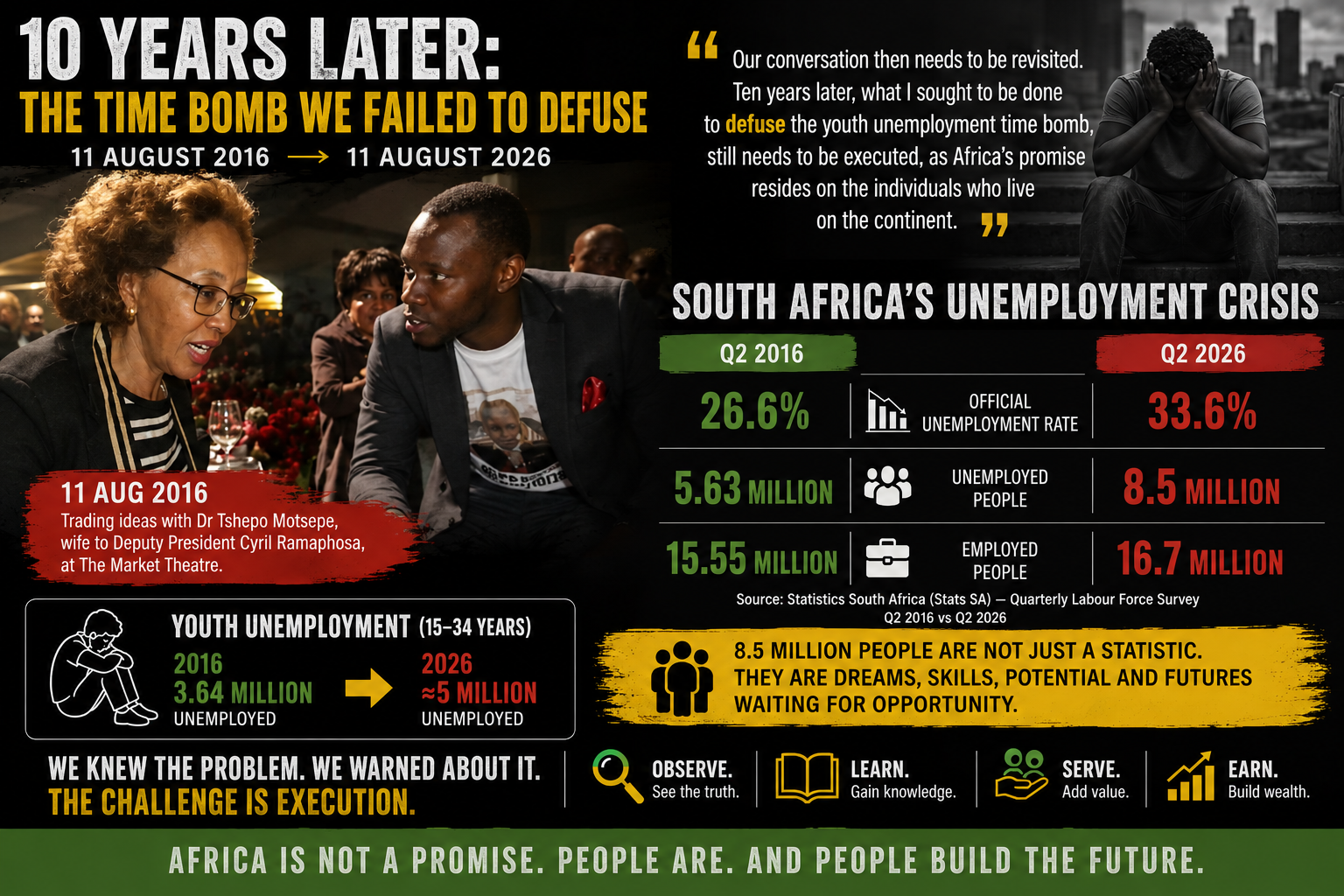
On 11 August 2016, I shared a moment from Johannesburg’s Market Theatre where I had been in conversation with Dr Tshepo Motsepe, trading ideas about one of the questions that concerned me deeply: what could be done about South Africa’s growing youth unemployment problem?
Today, 11 August 2026, Facebook reminded me of that conversation.
I shared the memory with these words:
“Our conversation then needs to be revisited. 10 years later, what I sought to be done to diffuse the youth unemployment time bomb, still needs to be executed, as Africa’s promise resides on the individuals who live on the continent.”
At the time I posted those words today, I had not heard South Africa’s latest unemployment figures.
Then the numbers arrived.
And suddenly a Facebook memory became something much more uncomfortable.
2016: The warning was already there
When that conversation took place in August 2016, South Africa’s latest Quarterly Labour Force Survey showed an official unemployment rate of 26.6%.
There were approximately 5.63 million unemployed people. About 15.55 million people were employed. (Statistics South Africa)
The youth numbers were already troubling.
Among South Africans aged 15–34, approximately 6.05 million were employed while 3.64 million were unemployed. Another 1.65 million were classified as discouraged work-seekers. Stats SA noted that youth employment had actually declined compared with 2008 while the numbers of unemployed and economically inactive young people had increased. (Statistics South Africa)
That was the environment in which we were talking.
The time bomb was not theoretical.
We could see it.
2026: The warning became a national emergency
Exactly ten years later, Stats SA released its Q2 2026 Quarterly Labour Force Survey.
The official unemployment rate has risen to 33.6%.
The number of unemployed people has reached approximately 8.5 million.
Compared with the previous quarter alone, another 345,000 people became unemployed, while employment decreased by 16,000 to approximately 16.7 million. (Statistics South Africa)
Put 2016 and 2026 beside each other:
| Q2 2016 | Q2 2026 | |
|---|---|---|
| Official unemployment rate | 26.6% | 33.6% |
| Unemployed people | 5.63m | 8.5m |
| Employed people | 15.55m | 16.7m |
In a decade, therefore, the number of officially unemployed South Africans has increased by roughly 2.9 million, or about 51%.
Employment, meanwhile, has increased by only about 1.2 million.
That is the story we must confront.
We cannot say we did not know
Perhaps this is what troubles me most about today’s coincidence.
The problem was being discussed ten years ago.
Economists knew it. Government knew it. Universities knew it. Business leaders knew it. Young people certainly knew it because they were living it.
So the question in 2026 cannot simply be:
What is the unemployment rate?
We know the unemployment rate.
The harder question is:
What did we fail to execute during the ten years between the warning and today?
South Africa has produced strategies, summits, commissions, programmes, incentives and policy documents.
Yet millions more people are unemployed.
That should force us to interrogate the underlying philosophy.
Jobs are an outcome of productive activity
We frequently speak about “job creation” as though jobs can somehow be manufactured independently of productive enterprise.
They cannot.
A sustainable job exists because someone has organised capital, labour, knowledge and resources around solving a problem for which somebody else is prepared to pay.
Before there is an employee, therefore, there ordinarily has to be an enterprise.
Before the enterprise can employ its hundredth person, someone has to establish the enterprise that employs its first.
This distinction matters enormously.
If our economic conversation concentrates overwhelmingly on distributing existing economic opportunities while insufficient attention is paid to creating new productive enterprises, unemployment eventually becomes a mathematical consequence.
The economy needs more builders.
More manufacturers.
More farmers producing commercially.
More processors turning agricultural output into finished products.
More engineers commercialising solutions.
More logistics businesses moving goods.
More technology companies solving African problems.
More entrepreneurs graduating from survivalist activity into institutions capable of employing ten, one hundred and eventually thousands of people.
A demographic dividend is not automatic
Africa is frequently described as possessing a demographic dividend because of its youthful population.
But youthfulness by itself is not a dividend.
A young person without education, productive skills, access to markets or economic opportunity does not automatically become an economic asset simply because they are young.
The dividend must be built.
Human beings must acquire capabilities.
Capital must meet enterprise.
Infrastructure must enable production.
Markets must become accessible.
Institutions must protect property and contracts.
And people must be able to transform ideas into productive organisations.
Otherwise the demographic dividend we celebrate in speeches can become precisely the demographic pressure we fear in unemployment statistics.
8.5 million is not merely a statistic
This is where economics can become dangerously abstract.
8.5 million unemployed people are 8.5 million individual human beings.
Each has ambitions.
Each consumes food, requires shelter and wants dignity.
Many support or belong to households depending on incomes that may not exist.
And millions of young people are watching an economy in which education does not necessarily lead to employment and entrepreneurship often encounters formidable barriers to capital, markets and scale.
The cost cannot therefore be measured only in GDP.
Persistent mass unemployment eventually affects social cohesion, household formation, crime, public finances, migration, political stability and confidence in institutions.
That is why unemployment is not merely a labour-market statistic.
It is an enterprise-development problem, a human-development problem and ultimately a national stability problem.
Africa cannot fulfil a promise
There is another reason I chose my words carefully when sharing that memory.
We often say “Africa has promise.”
But Africa is a geographical location.
A continent cannot wake up tomorrow morning and establish a factory.
It cannot register a company.
It cannot invent a product.
It cannot employ somebody.
It cannot honour a contract.
It cannot invest capital.
People do those things.
Africa’s promise therefore resides in the individuals who inhabit the continent and in the institutions those individuals choose to build.
Governments themselves do not innovate. People acting through governments can create conditions in which innovation flourishes.
Companies do not possess courage. People acting through companies make courageous investment decisions.
Universities do not create knowledge independently of human agency. Researchers, lecturers and students do.
Once we understand this, responsibility becomes difficult to outsource.
Ten years later
I could easily look at that photograph from 2016 as nostalgia.
I don’t.
I see an unfinished conversation.
On 11 August 2016, I was trading ideas about confronting youth unemployment.
On 11 August 2026, South Africa was told that 8.5 million of its people are officially unemployed and its unemployment rate has reached 33.6%. (Statistics South Africa)
I did not know those figures had been released when I reposted that ten-year-old memory.
But perhaps that coincidence gives today’s memory its real meaning.
The problem was identified.
The warning was given.
Ten years passed.
The question now is not whether another ten-year strategy can be written.
The question is what we are prepared to build.
Because by 11 August 2036, another Facebook memory will appear.
And when it does, the measure of our generation should not be how eloquently we described South Africa’s unemployment crisis.
It should be whether we did something about it.
Observe. Learn. Serve. Earn.
The clock is already running.

Over the years, I have found it challenging to define myself solely by an academic qualification, trade, or occupation. My eagerness to learn, especially about how to build and deploy capital, has allowed me to accumulate diverse experiences in a short span of time. Through this journey, I have discovered that at my core, I am a storyteller. I tell the stories of corporations, their heritage, and the individuals who act in their name. I explore the role of these institutions in fulfilling the promise of a better Africa, and, most importantly, the causal link between the rule of law and economic development. As a fellow believer in Africa’s potential, can I count on you to be a point of light in securing our continent’s future?




