



Aviation
1 August 2026: The Exhibition That Envisioned a Connected World


By Tinashe T. T. Mpasiri | 1 August 2026
Some of history’s most consequential journeys do not begin in the air.
They begin with a conversation.

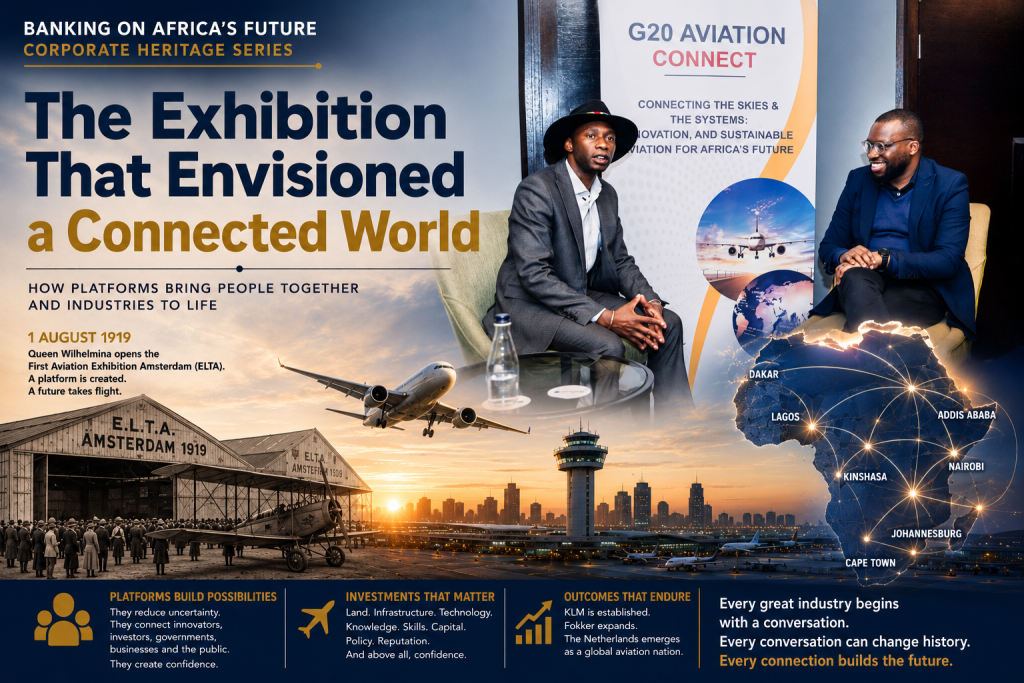
Just a week before South Africa hosted the G20 Leaders’ Summit, I found myself in discussion with two colleagues in Johannesburg. One had travelled from West Africa to attend the summit.
His journey, however, revealed a paradox.
To travel from one part of Africa to another, he first had to connect through France before returning to the African continent.
The irony was difficult to ignore.
Africa was speaking confidently about integration, trade and shared prosperity.
Yet its own skies remained fragmented.
As preparations for the G20 gathered momentum, another question surfaced.
Business had its platform.
Youth had its platform.
Women had their platform.
Think tanks had their platform.
Civil society had its platform.
Finance, infrastructure, energy and digital transformation all featured prominently in the conversation.
But where was aviation?
Where was the platform dedicated to discussing the sector that physically connects markets, investors, entrepreneurs, tourists, supply chains and people?
That simple question became the catalyst for G20 Aviation Connect.
Not merely another conference.
Not another organisation.
A platform.
A place where airlines, airports, regulators, policymakers, financiers, manufacturers, technology companies, logistics providers, development finance institutions and entrepreneurs could begin asking one strategic question,
How do we connect African skies to accelerate the African Continental Free Trade Area?
Yet as I reflected on that conversation, I realised history had asked the same question before.
Not in Johannesburg.
But in Amsterdam.
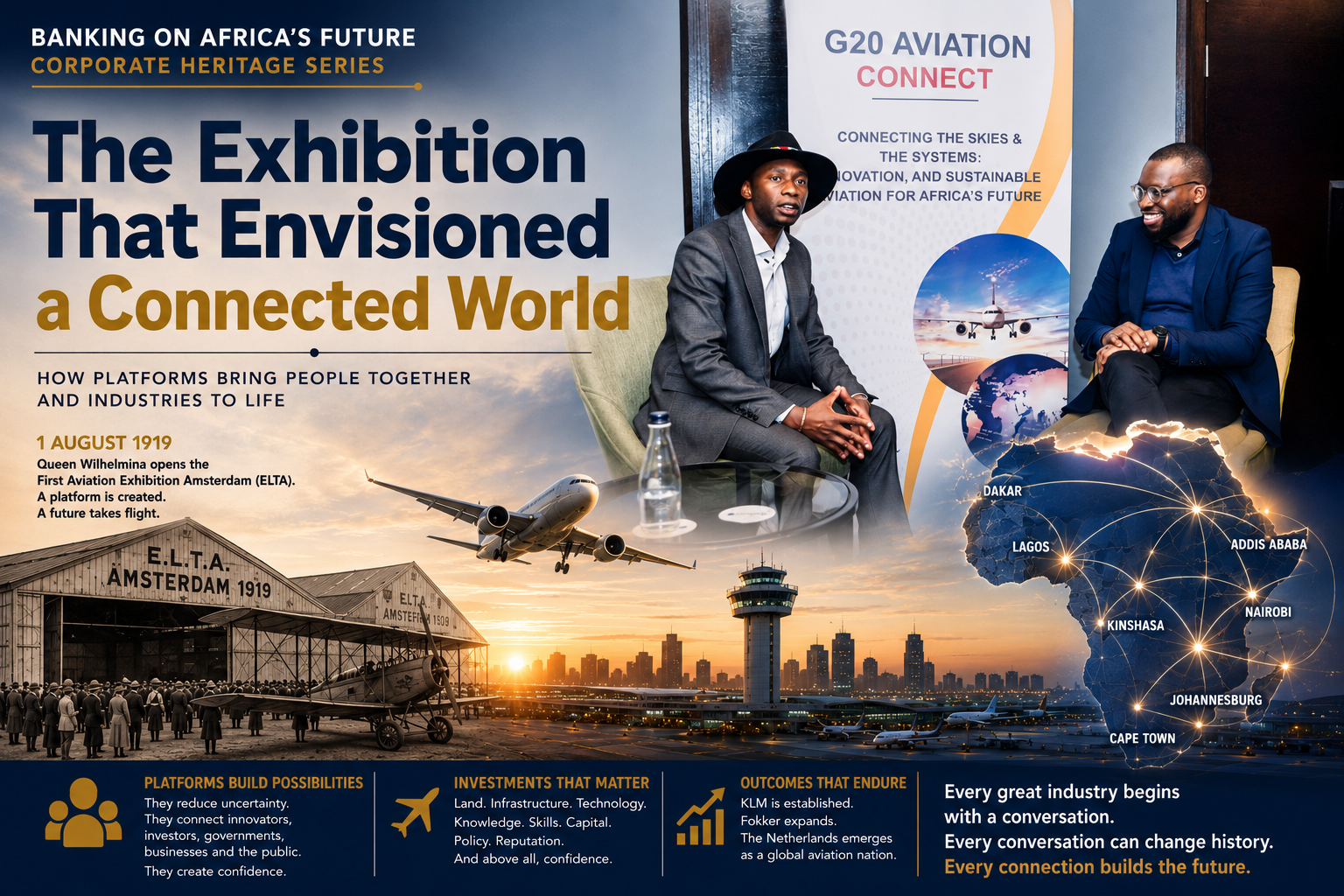
On 1 August 1919, Queen Wilhelmina officially opened the First Aviation Exhibition Amsterdam (ELTA).
To many, it appeared to be an exhibition of aircraft.
History reveals something much more profound.
It was an exhibition of possibility.
The First World War had ended only months earlier.
Aircraft had proved themselves in conflict.
What remained uncertain was whether they could become instruments of commerce, communication and peace.
Could people be persuaded to fly?
Would businesses trust aircraft to move goods?
Would governments invest in airports?
Could aviation become an industry rather than merely a military capability?
No single inventor could answer those questions.
No engineer could answer them alone.
No government ministry could answer them in isolation.
The answers required people to meet.
That vision belonged to Lieutenant Albert Plesman, Lieutenant M. J. L. Hofstee, supported by General Cornelis Jacobus Snijders and the Dutch aviation community.
They understood something that remains true today.
Industries are not built only in factories.
They are built where people gather around a shared vision.
The exhibition became that gathering place.
Aircraft manufacturers displayed their latest designs.
Engine builders showcased new technology.
Pilots demonstrated the possibilities of flight.
Engineers explained innovation.
Government officials explored policy implications.
Businesses searched for commercial opportunity.
Investors evaluated emerging markets.
Journalists carried the story to the wider public.
Hundreds of thousands of visitors came not simply to admire machines.
They came to witness the future.
This raises a deeper question.
Why do exhibitions exist?
Many assume exhibitions are places where organisations display products.
History suggests otherwise.
The greatest exhibitions perform a far more important function.
They reduce uncertainty.
They allow ideas to be tested in public.
They connect innovators with investors.
They connect manufacturers with customers.
They connect policymakers with industry.
They connect entrepreneurs with opportunity.
Above all, they create confidence.
Confidence is often the first investment.
Before financial capital moves, confidence must exist.
Before factories are built, confidence must exist.
Before airlines are launched, confidence must exist.
Before governments adopt new policies, confidence must exist.
Confidence is the bridge between imagination and investment.
That was ELTA’s greatest achievement.
The investments made in Amsterdam extended far beyond money.
The City of Amsterdam invested land.
Infrastructure was built.
Exhibition halls and aviation facilities were constructed.
Manufacturers invested aircraft.
Engineers invested knowledge.
Pilots invested skill.
Governments invested credibility.
Businesses invested reputation.
The public invested attention.
Each contribution strengthened the ecosystem.
The exhibition demonstrated that aviation was no longer a curiosity.
It was becoming an industry.
The outcomes soon followed.
Thousands experienced flight for the first time.
Public confidence in civil aviation increased dramatically.
Within weeks, KLM Royal Dutch Airlines was established under Albert Plesman’s leadership.
Anthony Fokker expanded his aircraft manufacturing operations in the Netherlands.
What began as an exhibition evolved into one of the foundations of Dutch aviation.
The exhibition had not simply displayed an industry.
It had helped create one.
More than a century later, Africa finds itself confronting a similar opportunity.
The African Continental Free Trade Area promises to create the world’s largest free trade area by the number of participating countries.
Yet markets cannot integrate if people remain disconnected.
Trade requires movement.
Investment requires access.
Tourism requires connectivity.
Innovation requires collaboration.
Ideas travel fastest when people can meet.
Today, many African journeys still pass through airports outside Africa.
Every unnecessary connection represents more than additional travel time.
It represents lost productivity.
Higher costs.
Missed opportunities.
Reduced competitiveness.
A continent cannot fully integrate while its skies remain fragmented.
This is why G20 Aviation Connect matters.
Its purpose is not simply to discuss aviation.
Its purpose is to convene the people capable of transforming aviation into a strategic driver of African development.
It asks questions that deserve answers.
How should Africa finance airport infrastructure?
How can aviation accelerate AfCFTA?
How do we strengthen regional airlines?
What role can digital technology and artificial intelligence play?
How do we develop aviation skills?
How do we attract long-term investment into the aviation ecosystem?
These questions cannot be answered by one institution.
They require platforms where minds meet.
There is a remarkable symmetry between Amsterdam in 1919 and Johannesburg more than a century later.
Both began with conversations.
Both recognised that industries do not grow by accident.
Both understood that progress requires places where people can exchange ideas, build partnerships and mobilise investment.
The technologies may have changed.
The principle has not.
The future belongs to those who create platforms that connect people with possibility.
Perhaps that is the enduring lesson of the First Aviation Exhibition Amsterdam.
Its greatest achievement was not the aircraft on display.
It was bringing together the people who would shape the future of aviation.
Africa’s challenge today is not simply to add more aircraft to its skies.
It is to create more platforms where the people capable of connecting those skies can meet, collaborate and act.
For history demonstrates a timeless truth.
Every great industry begins with a conversation.
Every conversation has the potential to become a partnership.
Every partnership can become an investment.
And every investment, guided by a shared vision, has the power to change the course of history.





