










Business & Economy
Beyond Admission: The BRICS Opportunity Chain


When Zimbabwe secured admission to the New Development Bank (NDB), many celebrated what was understandably seen as a diplomatic achievement. Others immediately focused on the possibility of financing roads, dams, power stations and other strategic infrastructure. Both reactions were justified. Yet history teaches that the true significance of such moments is seldom found in the announcement itself. It lies in what a nation chooses to build afterwards. Zimbabwe’s engagement with the BRICS Bank is therefore not simply a financial milestone. It is an opportunity to ask a more enduring question, How does a nation convert international goodwill into lasting national prosperity?

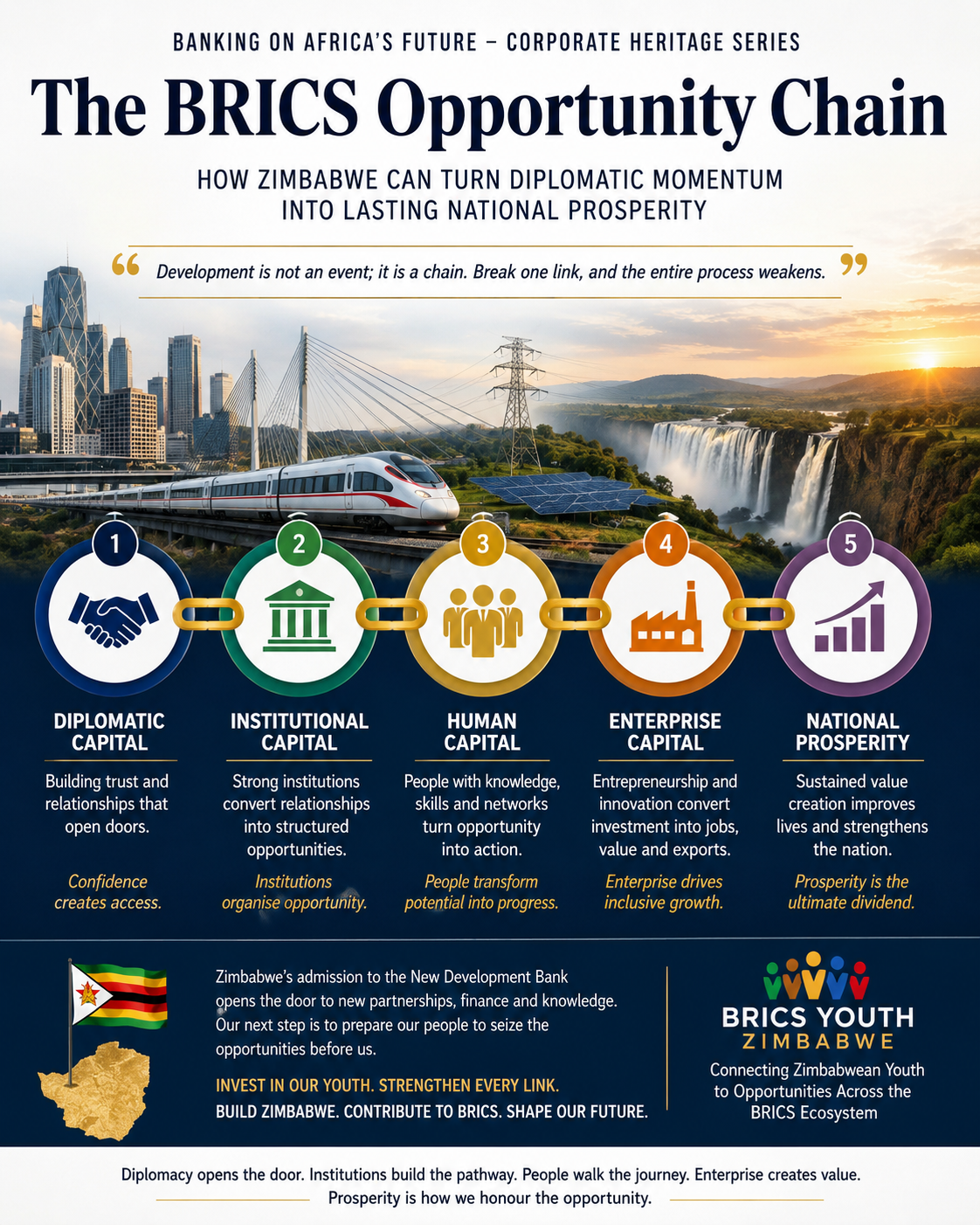
Throughout the Banking On Africa’s Future Corporate Heritage Series, we have examined hundreds of enterprises, institutions and founders across the world. Although their industries differ, they share a common pattern. Success rarely begins with money. It begins with confidence. Confidence attracts relationships. Relationships create institutions. Institutions mobilise capital. Capital enables enterprise. Enterprise generates prosperity. That pattern suggests a simple proposition, development is not an event; it is a chain. Break one link, and the entire process weakens.
Zimbabwe’s relationship with the New Development Bank can be understood through that same lens. The first link is diplomatic capital. Nations invest decades building relationships, participating in regional organisations and engaging with international partners. Admission to an institution such as the New Development Bank reflects the value of those relationships. It is evidence that confidence has been established between countries. Diplomacy, therefore, should never be viewed merely as protocol. It is an economic asset capable of opening doors that markets alone cannot.
The second link is institutional capital. Development banks do not exist simply to lend money. They exist to organise long-term investment around clearly defined development objectives. Their purpose is to transform diplomatic relationships into structured opportunities for infrastructure, industrialisation and sustainable growth. Zimbabwe’s engagement with the New Development Bank should therefore be viewed not only as access to finance, but also as access to a broader development ecosystem built on cooperation, knowledge and shared ambition.
The third, and perhaps most important, link is human capital. Having attended the BRICS Summit in Johannesburg in 2023, I was struck by a reality that received far less media attention than the meetings of Heads of State. Alongside the official programme, young entrepreneurs were building commercial partnerships, researchers were establishing academic collaborations, innovators were demonstrating new technologies, and skills programmes were preparing future leaders. It became evident that BRICS is not sustained solely by governments. It is strengthened by people who acquire knowledge, build relationships and create value across borders. That observation may ultimately prove more significant than any communiqué issued at the summit.
Human capital naturally leads to the fourth link, enterprise capital. Roads, railways and power stations do not create prosperity by themselves. Their value depends on entrepreneurs who establish businesses, engineers who design solutions, researchers who develop technologies and professionals who manage institutions. Development finance can provide the platform, but only productive enterprise converts investment into employment, innovation and national income. In that sense, every successful economy is ultimately built not by infrastructure alone, but by people capable of using infrastructure productively.
If these four links remain connected, the fifth follows almost naturally, national prosperity. Prosperity is not produced by diplomatic success in isolation, nor by development finance in isolation. It emerges when relationships, institutions, people and enterprise reinforce one another over time. This is perhaps the most important lesson Zimbabwe can draw from its engagement with the BRICS Bank. The opportunity before the country is not simply to finance projects. It is to strengthen every link in the opportunity chain.
This is why I believe the next national conversation should extend beyond infrastructure finance to the preparation of people. Zimbabwe possesses talented young entrepreneurs, researchers, engineers, farmers, innovators and professionals. What they require is an organised platform through which they can engage meaningfully with the wider BRICS ecosystem. A BRICS Youth Zimbabwe initiative could provide that bridge by connecting Zimbabwean youth with opportunities in entrepreneurship, research, innovation, leadership development and skills exchange across the BRICS community. Such a platform would not exist to duplicate existing institutions, but to ensure that Zimbabwe’s greatest resource, its people, is positioned to benefit from and contribute to the opportunities that deeper BRICS cooperation can create.
Every generation inherits opportunities that previous generations could only imagine. The question is never whether those opportunities exist. The question is whether people are prepared to organise themselves to seize them. Zimbabwe’s engagement with the New Development Bank has opened a new chapter. Whether that chapter becomes a story of transformation will depend not only on the projects that are financed, but on the people who choose to build because the opportunity now exists.
Perhaps that is what the BRICS Bank was truly banking on.
Not merely Zimbabwe’s natural resources.
Not merely its infrastructure needs.
But its capacity to produce a generation capable of transforming diplomatic opportunity into enterprise, enterprise into prosperity, and prosperity into a stronger future for the nation.





