










Business & Economy
Eleven Years Later: Africa’s Agricultural Opportunity Was Never Just About Land


Published
2 months agoon

By Tinashe T. T. Mpasiri
On 14 August 2015, I wrote about agriculture as an African investment opportunity.
At the time, I was looking at two things: the continent’s enormous agricultural potential and the investment case for farmland.
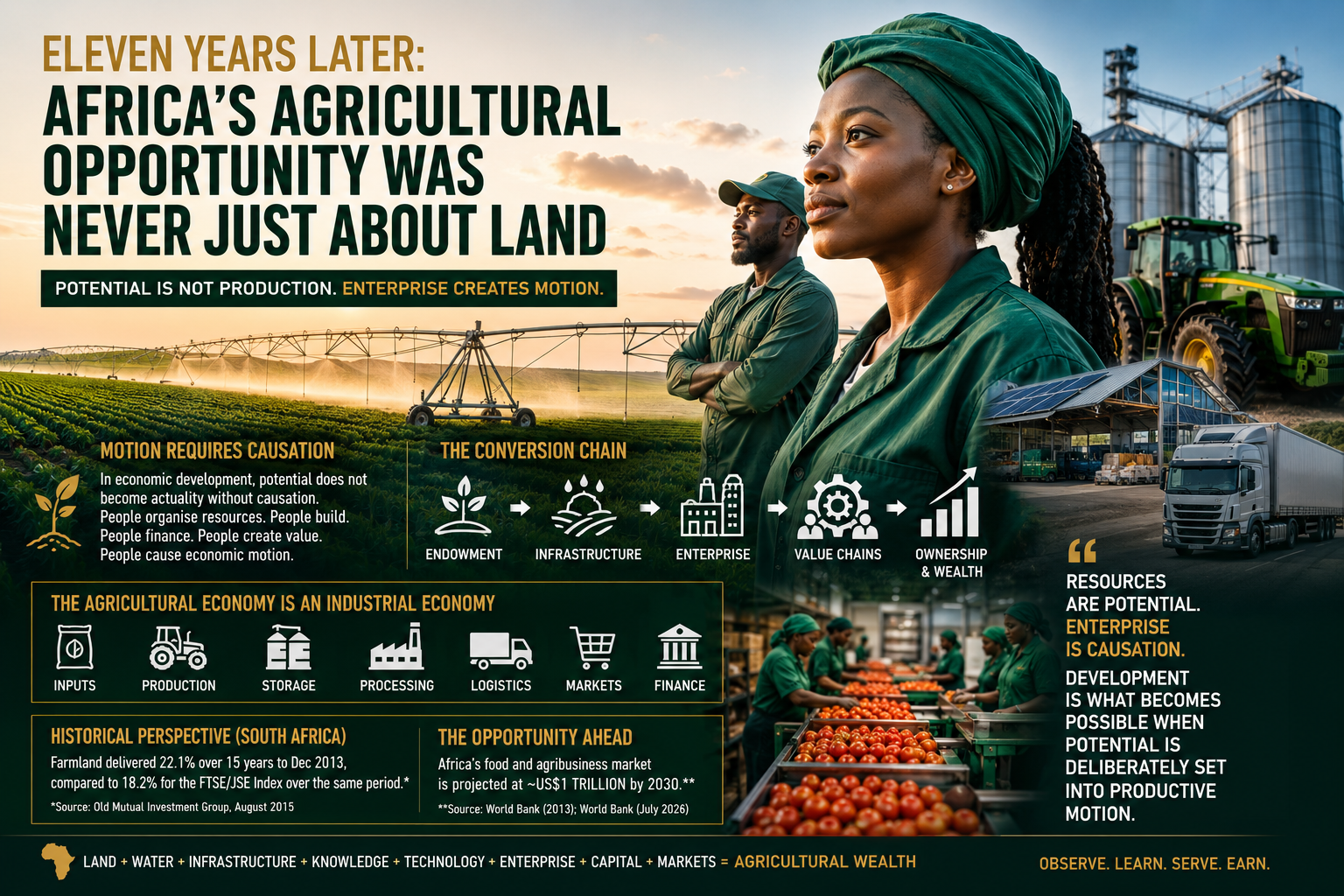
I cited research suggesting that millions of hectares of African land were physically suitable for irrigation while only a fraction of that potential was being utilised. I also referred to South African farmland, which had delivered a historical return of 22.1% over the 15 years to December 2013, compared with 18.2% for the FTSE/JSE Index over the same period.
Those were historical numbers.
Eleven years later, I am more interested in the philosophy behind them.
Africa possesses land. It possesses water resources. It possesses people. It possesses growing markets. And it possesses an expanding population that must be fed.
Yet possession does not automatically produce prosperity.
Potential is not production.
That distinction may explain one of Africa’s great economic contradictions.
Motion Requires Causation
In economic development, potential does not become actuality without causation.
Things do not move from what they could be into what they produce simply because they exist.
Land does not irrigate itself.
Water does not build canals.
Crops do not finance their own production.
Harvests do not construct warehouses.
Produce does not refrigerate, process, package, transport or market itself.
At every stage, there must be a causative agent.
People cause economic motion.
Entrepreneurs organise resources. Engineers design systems. Farmers produce. Investors allocate capital. Workers operate enterprises. Scientists develop technologies. Financial institutions structure funding.
This is why describing Africa as “resource rich” tells us remarkably little about whether Africans will become prosperous.
Resources describe potential.
Enterprise creates motion.
Africa Has a Conversion Challenge
For decades, African economic discourse has celebrated endowment.
We speak about hectares of arable land, minerals beneath the ground, rivers, sunshine, youthful populations and enormous consumer markets.
But endowment is not output.
Africa does not become an agricultural powerhouse because fertile land exists within its geography.
Someone must convert that land into productive capacity.
The more useful question is therefore:
How do we convert natural endowment into productive infrastructure, productive infrastructure into enterprises, enterprises into value chains, and value chains into African-owned wealth?
This is not merely a question of agriculture.
It is a question of economic architecture.
Irrigation Is Economic Infrastructure
Consider irrigation.
It is tempting to think of it simply as something farmers need to water crops.
Economically, it is much more significant.
A road converts geographic proximity into commercial connectivity.
Electricity converts machinery into productive capacity.
Telecommunications convert distance into communication.
Irrigation converts water and land into more reliable agricultural production.
And reliability changes economics.
More predictable production can improve the viability of financing, insurance, processing contracts, warehousing, cold-chain investment and long-term supply arrangements.
Irrigation therefore does more than move water.
It can move agriculture from uncertainty towards bankability.
The Farm Is Where an Industrial Value Chain Begins
This is where we need to distinguish farming from enterprise agriculture.
The farmer may grow tomatoes.
But someone supplies the seed.
Someone manufactures or distributes fertiliser.
Someone finances the irrigation equipment.
Someone services the tractor.
Someone aggregates the harvest.
Someone grades it.
Someone stores it.
Someone transports it.
Someone processes it.
Someone manufactures the packaging.
Someone insures the cargo.
Someone finances the transaction.
Someone distributes the finished product.
And someone eventually places it before the consumer.
Agriculture therefore does not end at the farm gate.
The farm is where an industrial value chain begins.
Agriculture is an activity.
Enterprise agriculture is an economic system.
That distinction matters because Africa’s food market is projected to reach approximately US$1 trillion by 2030. The opportunity is therefore not confined to producing food. It extends across processing, energy, storage, manufacturing, packaging, transportation, finance, insurance, technology and trade.
The agricultural opportunity is an industrial opportunity.
Young Africans Do Not All Have to Become Farmers
This changes how we should speak to Africa’s young people about agriculture.
We frequently tell them that agriculture represents opportunity and then reduce that opportunity to one proposition:
Become a farmer.
That is unnecessarily limiting.
A young African can participate in agriculture without owning a farm.
She can build an irrigation company.
He can manufacture agricultural equipment.
She can develop agricultural-finance technology.
He can operate refrigerated logistics.
She can establish a food-processing company.
He can develop agricultural insurance products.
She can manufacture packaging.
He can become a commodity trader.
She can become an agricultural engineer.
They can build enterprises solving the thousands of problems between soil and supermarket.
That is how agriculture becomes aspirational.
Not by romanticising farming, but by revealing the enormous industrial economy hidden inside it.
Capital Must Finance Systems
My 2015 post looked at farmland partly through the lens of investment returns.
Today, I would broaden the proposition.
The objective should not simply be to make African farmland attractive to investors.
We must make African agricultural value chains investable.
Capital should finance irrigation networks, productive farms, processing facilities, warehouses, agricultural technology, machinery, cold chains, logistics businesses and distribution networks.
But capital introduces another question:
Who owns the enterprises?
Africa could dramatically increase agricultural production while Africans capture only a fraction of the wealth created around that production.
A farmer may produce the commodity while somebody else finances it, processes it, transports it, brands it, distributes it and captures much of the margin.
Production is therefore not synonymous with ownership.
Africans must participate throughout agricultural value chains not merely as labourers and primary producers, but as founders, shareholders, engineers, financiers, manufacturers, processors and investors.
The Real Asset Is the System
This is where my thinking has moved furthest since 2015.
I once looked primarily at the land and saw an asset.
Today, I see the system.
Because the economic asset is created when land, water, knowledge, technology, infrastructure, capital, enterprise and markets are deliberately organised into productive capacity.
And that returns us to causation.
An economy is not something that simply happens to a geography.
People cause economies.
People establish enterprises.
People mobilise capital.
People construct infrastructure.
People develop technology.
People enter agreements.
People assume risk.
People solve problems.
People create value.
Through those actions, resources move from what they could become into what they produce.
From Endowment to Enterprise
Eleven years after that Facebook post, I would therefore amend my original proposition.
Africa’s agricultural opportunity was never simply its land.
It was what could be caused to happen through that land.
As we approach 2030, the strategic question is no longer merely:
Can Africa feed itself?
We must also ask:
Who will build the enterprises that feed Africa?
Who will finance them?
Who will engineer them?
Who will process the harvest?
Who will manufacture the equipment?
Who will move the food?
Who will build the brands?
Who will own the intellectual property?
Who will own the shares?
And who will accumulate the wealth created by this enormous agricultural economy?
Those questions take us beyond farming.
They take us into industrialisation, capital formation and ownership.
Africa has spent generations describing what lies beneath its soil and upon its land.
The next chapter must be about what Africans deliberately cause to happen with it.
Because resources are potential.
Enterprise is causation.
And development is what becomes possible when potential is deliberately set into productive motion.
Observe. Learn. Serve. Earn.

Over the years, I have found it challenging to define myself solely by an academic qualification, trade, or occupation. My eagerness to learn, especially about how to build and deploy capital, has allowed me to accumulate diverse experiences in a short span of time. Through this journey, I have discovered that at my core, I am a storyteller. I tell the stories of corporations, their heritage, and the individuals who act in their name. I explore the role of these institutions in fulfilling the promise of a better Africa, and, most importantly, the causal link between the rule of law and economic development. As a fellow believer in Africa’s potential, can I count on you to be a point of light in securing our continent’s future?




