



Development & Sustainability
Sustainable development goals off track as global leaders urged to deploy AI to meet 2030 targets



By Professor Arthur G.O. Mutambara
The world is rapidly running out of time to meet the United Nations Sustainable Development Goals (SDGs), with new data showing that humanity is falling dangerously short on its commitments to end poverty, protect the planet and secure prosperity for all by 2030.
Adopted in 2015, the 17 SDGs were designed as a universal framework to address the world’s most pressing challenges, including poverty, hunger, health, education, gender equality, clean water, energy access and sustainable economic growth. Each goal is supported by specific targets and indicators intended to guide and measure progress across all countries, regardless of income level.
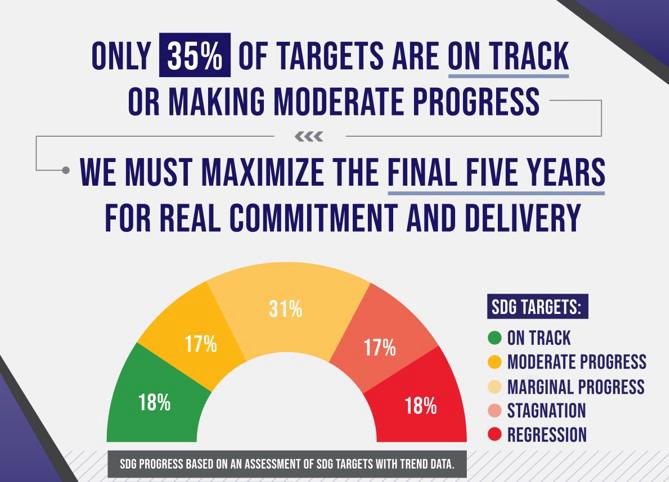
However, the 2025 United Nations SDG Report paints a sobering picture. According to the latest assessment, published in July, only 18 percent of SDG targets are currently on track, while a further 17 percent are making moderate progress. This leaves the global success rate at just 35 percent. Nearly half of the targets are advancing too slowly, and 18 percent are regressing.
“These figures confirm that humanity is failing on the arduous journey to achieve the SDGs by 2030,” the report notes, citing persistent poverty, hunger, gender inequality, climate change and limited access to essential services as major obstacles to progress.
UN Secretary-General António Guterres has described the situation as a “global development emergency”, calling for urgent action across six critical transitions: food systems, energy, digital connectivity, education, jobs and social protection, and climate and biodiversity. While gains have been made in areas such as renewable energy, internet access and certain health outcomes, stark disparities persist between regions and income groups.
Sub-Saharan Africa and other low-income regions remain the most affected, facing high poverty levels, food insecurity and inadequate access to clean water, sanitation and reliable energy. Climate change continues to compound these vulnerabilities, undermining development gains and increasing the cost of inaction.
The report warns that the SDGs remain achievable, but only if governments and stakeholders act decisively and immediately. It highlights the urgent need for bold investment, coherent policy frameworks, improved data systems and strengthened international cooperation. Sustainable financing and inclusive governance are identified as critical enablers of accelerated progress.
Findings from the 2025 report mirror those of the 2024 SDG assessment, which showed that nearly half of the targets were stagnating and more than a third were stalled or regressing. The earlier report identified a global funding gap of US$4.2 trillion, worsened by reduced official development assistance from major donor countries. Lingering impacts of the COVID-19 pandemic, escalating conflicts, geopolitical tensions and climate instability have further undermined progress.
Analysts point to multiple, interconnected reasons for the failure to meet SDG targets. Deep inequalities within and between countries, limited institutional capacity in the Global South, weak governance, and the gap between political rhetoric and concrete action have all contributed to poor outcomes. The interdependent nature of the SDGs means that slow progress in one area, such as education or health, often constrains advancement in others.
Conflict, political instability and environmental degradation continue to divert resources away from long-term development priorities, while climate change threatens to derail progress across all goals. The COVID-19 pandemic alone reversed gains in poverty reduction, employment, healthcare and education, placing additional strain on already stretched systems.
With only five years remaining until 2030, Professor Arthur G.O. Mutambara argues that incremental change is no longer sufficient. He echoes the UN Secretary-General’s call for the world to “shift into overdrive” and poses a central question: what must be done differently?
According to Mutambara, the answer lies in combining stronger political commitment and integrated policy action with the deliberate deployment of transformative technologies—chief among them artificial intelligence (AI). He contends that AI, if strategically and responsibly implemented, can offer powerful tools to overcome many of the systemic barriers hindering SDG achievement.
AI-driven data analytics and predictive modelling can significantly improve decision-making across sectors. In agriculture, AI can optimise crop yields, manage pests and reduce food loss, directly supporting efforts to end hunger. In healthcare, machine learning can enable early disease detection, outbreak forecasting and personalised treatment, improving outcomes while reducing costs.
AI also has the potential to transform energy systems by optimising power grids, integrating renewable sources and reducing emissions, accelerating the transition to a low-carbon economy. In education, adaptive AI-powered learning platforms can personalise instruction and expand access to quality education for marginalised communities.
“Deploying AI to achieve the SDGs should form part of the global shift into overdrive,” Mutambara argues, stressing that such efforts must be guided by a clear strategic framework, robust governance and a well-defined implementation matrix.
As the 2030 deadline approaches, the message from the latest SDG assessments is unequivocal: without urgent, coordinated action and the intelligent use of emerging technologies, the vision of sustainable development for all will remain out of reach. Harnessed effectively, artificial intelligence could yet become a critical enabler in reversing current trends and putting humanity back on course.
This article is adapted from Professor Arthur G.O. Mutambara’s work, “Deploying Artificial Intelligence to Achieve the UN Sustainable Development Goals: Enablers, Drivers and Strategic Framework.”





