By Tinashe T. T. Mpasiri | 4 September 2026
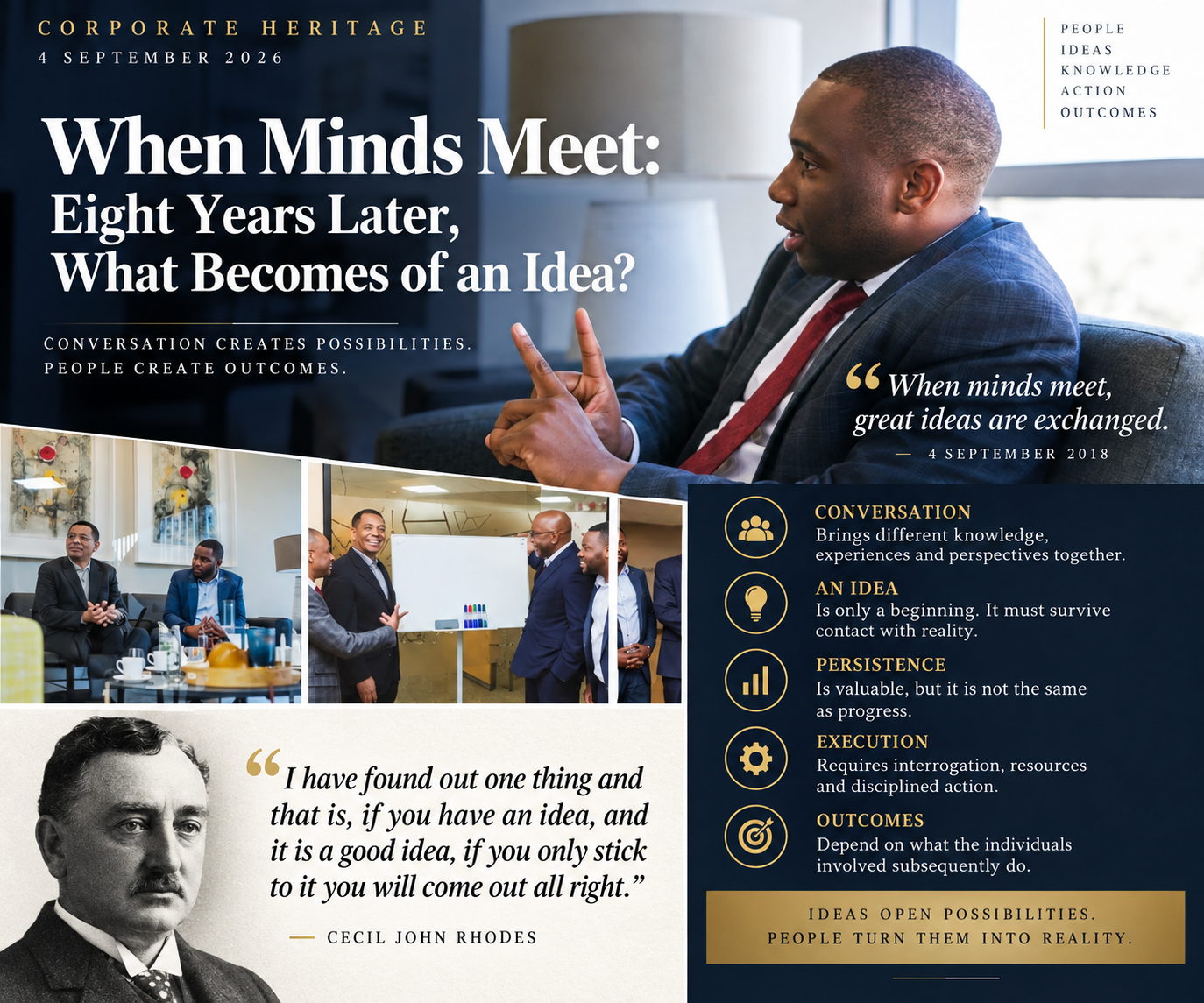
On 4 September 2018, I shared photographs from an engagement with Mutumwa D. Mawere, Washington Kapapiro and others.
My caption was simple:
“When minds meet, great ideas are exchanged.”
I accompanied it with a quotation attributed to Cecil John Rhodes:
“I have found out one thing and that is, if you have an idea, and it is a good idea, if you only stick to it you will come out all right.”
Eight years later, I find myself interrogating both statements.
I still believe deeply in the value of conversation. Much of what I have learned about enterprise, institutions, capital and human relationships has emerged not only from books or formal education, but through encounters with other human beings.
But experience has made me more precise about what actually occurs when minds meet.
What Is Being Exchanged?
A meeting has no mind. A boardroom possesses no knowledge. Conversation guarantees no useful outcome.
The value resides in the people participating and what each brings into the encounter.
Every person arrives carrying a particular accumulation of knowledge, experience, assumptions and observations. Conversation creates an opportunity for these different fields of knowledge to intersect.
Someone may know what another does not. A question may expose an assumption that has never been tested. Disagreement may reveal a weakness. Another perspective may make visible an opportunity previously overlooked.
Conversation can therefore be economically valuable because knowledge dispersed among individuals becomes accessible to others.
But accessibility is not application.
Is a Good Idea Enough?
The Rhodes quotation interests me more today than it did in 2018.
How does one know that an idea is good?
The person who conceived it may believe passionately in it. That conviction does not establish that customers will pay for it, investors will finance it, technology can deliver it, the law permits it or its economics are sustainable.
Reality eventually gets a vote.
An idea therefore requires more than persistence. It requires interrogation.
What problem does it address? For whom? What value does the proposed solution create? What resources are required to execute it? What assumptions must hold for the proposition to work?
These questions do not diminish imagination.
They discipline it.
When Persistence Becomes Attachment
Persistence is rightly celebrated in enterprise. Many worthwhile undertakings survive precisely because someone refuses to surrender at the first encounter with difficulty.
But persistence and progress are not synonyms.
There is little virtue in repeatedly executing an assumption after evidence has demonstrated that it is wrong. An entrepreneur who modifies a business model after discovering that customers behave differently from what was anticipated has not necessarily abandoned the idea.
The entrepreneur may simply have learned.
Sometimes an idea should be defended. Sometimes it should be modified. Sometimes it should be abandoned.
Wisdom lies partly in recognising which circumstance one is confronting.
The Distance Between Idea and Outcome
Looking at the photographs from 4 September 2018 also raises another question.
What becomes of all the ideas exchanged in rooms such as that one?
A person can participate in extraordinary conversations, meet accomplished individuals, attend conferences and read excellent books without materially altering any outcome.
Exposure creates possibility, not consequence.
What is heard must first be understood and then subjected to judgment. Useful knowledge has to find expression in decisions and conduct. Relationships require purposeful engagement, opportunities require evaluation, and promises ultimately have to be performed.
The distance between an idea and an outcome is occupied by human action.
That is perhaps the qualification missing from my 2018 caption.
Eight Years Later
If I were writing that caption today, I would put it differently:
When minds meet, knowledge can be exchanged, assumptions challenged and possibilities revealed. What becomes of those possibilities depends upon what the individuals involved subsequently do.
It is less romantic than saying that great ideas are exchanged.
It is also more precise.
The photographs record a meeting that occurred eight years ago. Their greater value today is not simply that the meeting happened or that ideas were discussed.
They provide a timestamp against which I can examine the evolution of my own thinking.
In 2018, I was interested in the power of the idea.
In 2026, I am equally interested in what stands between the idea and its consequence.
An idea may open a possibility. Conversation may sharpen it. Evidence may strengthen or destroy the assumptions beneath it. Persistence may keep it alive long enough to succeed—or keep someone attached to something that should have been abandoned.
The decisive question is therefore not merely whether an idea is good.
What does the person who encounters the idea learn from reality, and what does that person subsequently do?
Eight years later, that is the question the photograph leaves me with.