By Tinashe T. T. Mpasiri | 27 August 2026
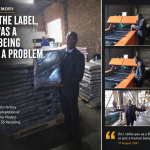
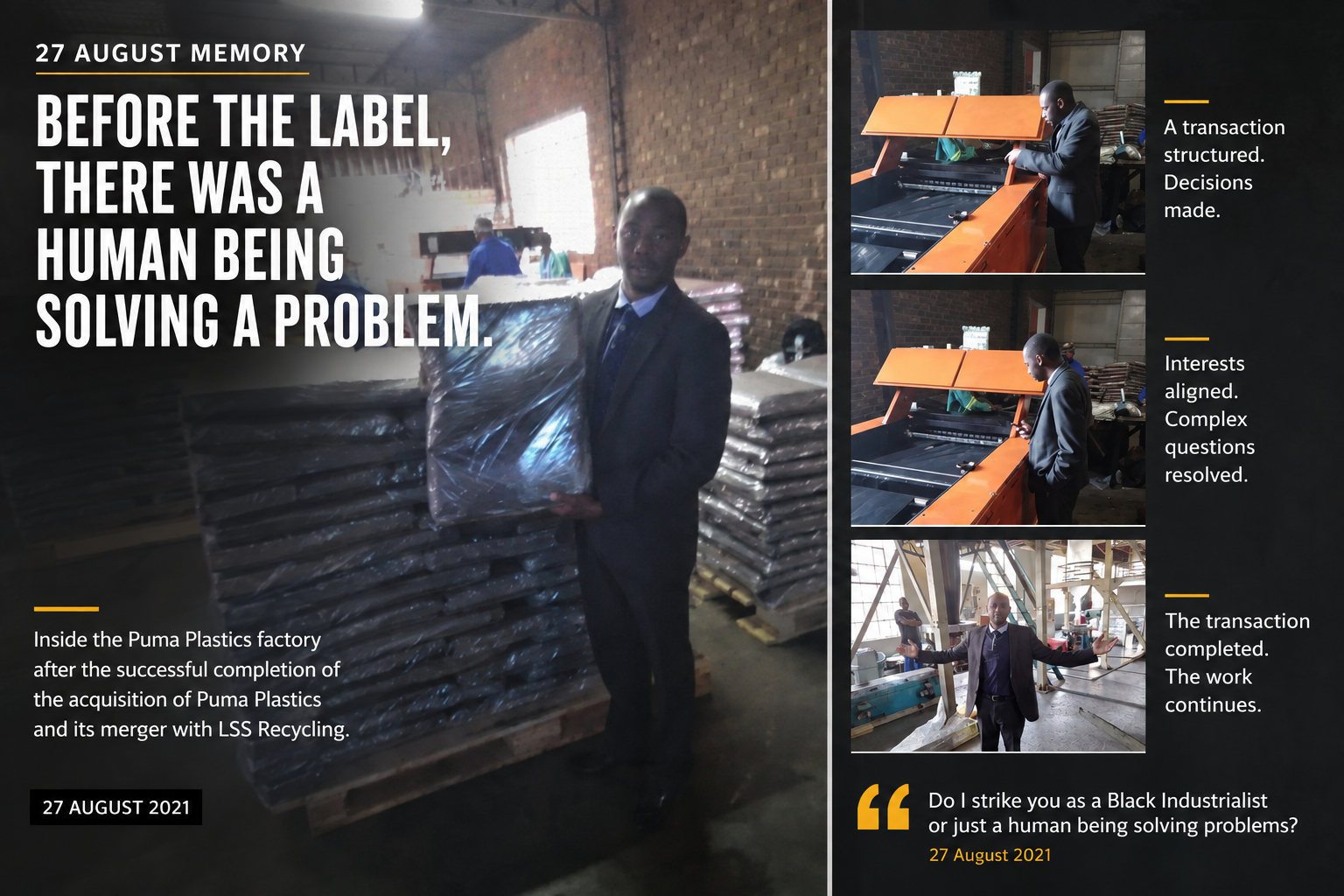
On 27 August 2021, I posted photographs of myself inside the Puma Plastics factory and asked a question:
“Do I strike you as a Black Industrialist or just a human being solving problems?”
Five years later, the photographs remain, but I read the question differently.
I was not at the factory as a visitor.
The photographs were taken after the successful completion of the acquisition of Puma Plastics and its merger with LSS Recycling, a corporate transaction in which I had played a role.
That context changes the meaning of the image.
Before I stood beside the machinery for a photograph, there had been a corporate problem requiring human intervention. An acquisition had to be pursued, interests brought together, a transaction structured and commercial questions resolved. Decisions were made and the transaction eventually reached completion.
Then came the photograph.
Yet the question occupying my mind that day was not principally about the transaction.
It was about identity.
Was I a Black Industrialist, or simply a human being solving problems?
Five Years Later, I See a Different Question
The term Black Industrialist has a particular meaning within South Africa’s economic transformation architecture. It arose within a historical context in which black people were systematically excluded from ownership, capital, industrial assets and meaningful participation in significant parts of the economy.
That history cannot be erased by vocabulary.
But neither should a policy description replace the human being it seeks to describe.
A racial category cannot acquire a company, negotiate a transaction or restructure a balance sheet. Neither can a geography independently establish an enterprise or conceive what might be possible.
Human beings perform these actions.
They may subsequently organise through corporations, partnerships, governments and other institutions. Capital can be assembled, contracts concluded, boards convened and employees engaged in production. Eventually, the outcome acquires an institutional identity.
But the institution should not obscure the human actions through which the outcome was produced.
Perhaps that is what I was wrestling with in 2021 without yet having the language I possess today.
From Identity Literacy to Corporate Literacy
I used #IdentityLiteracy in the original post.
Five years later, I can see more clearly why the question mattered.
A corporation is useful precisely because human beings can organise capital, knowledge, labour, assets and contractual relationships through it. But recognising the utility of the corporation does not require attributing independent human faculties to it.
Puma Plastics did not wake up one morning and decide to be acquired.
LSS Recycling did not develop a desire to merge.
Human beings conceived, negotiated and executed the transaction through corporate vehicles.
This is where identity literacy intersects with corporate literacy.
The words used to describe a person, corporation or economic activity can be useful. They help classify, communicate and construct policy. The difficulty begins when a description is mistaken for an explanation of causation.
“Black Industrialist” described something about the person standing inside that factory. It did not explain how the transaction happened.
To understand the outcome, one has to look beyond the label and examine what particular human beings actually did.
The Photograph Means Something Different Now
When I look at the photograph taken inside the Puma Plastics factory on 27 August 2021, I see a younger version of myself standing inside the physical consequence of a completed corporate transaction.
The machinery was visible. The factory was visible.
What could not be photographed were the ideas, conversations, relationships, negotiations and decisions that preceded that moment.
Enterprise is often encountered through its visible outcomes: a factory, a company, a title, a balance sheet or the person ultimately associated with the business. What remains largely invisible is the chain of human decisions that made those outcomes possible.
Economic outcomes have histories.
Corporate heritage is partly an exercise in reconstructing those histories so that the human agency behind an outcome is not obscured by the corporate or social labels subsequently attached to it.
That is why an old photograph can become more valuable with time.
It preserves an outcome.
Memory helps recover the human actions behind it.
So, Was I a Black Industrialist?
Five years later, I would answer my own question differently.
Black Industrialist may describe a policy category.
Corporate finance specialist may describe an area of professional competence.
Director may identify an office occupied within a corporation.
None of these descriptions possesses a mind.
None can independently decide or act.
The human being does.
On 27 August 2021, the human being in those photographs had participated in solving a corporate problem and bringing a transaction to completion.
The more interesting question, therefore, is no longer what I should have been called.
It is what the label explained, and what it could never explain.
It could locate me within a particular social, historical or policy context. It could not explain the ideas I contributed, the conversations I initiated, the decisions I made or the actions through which I participated in producing an outcome.
That distinction has become clearer to me with time.
Perhaps this is also why I remain interested in corporate heritage.
A company name can survive for generations. A factory can remain standing. A transaction can appear in corporate records. A balance sheet can preserve the numerical consequences.
But behind each of these sits something much easier to lose:
the history of the human beings whose actions produced the outcome.
On 27 August 2021, I asked whether I was a Black Industrialist or a human being solving problems.
Five years later, I would put it differently:
Before asking what to call the human being, first understand what the human being actually did.
27 August 2021 — the question.
27 August 2026 — a deeper understanding of what I was really asking.
#CorporateHeritage #CorporateLiteracy #TheafricaIWant #BOAF #MergersAndAcquisitions