







Corporate Heritage
17 July 1986: LTV Corporation and the Anatomy of Corporate Rescue — When Does a Company Really Die?


By Tinashe T. T. Mpasiri | 17 July 2026
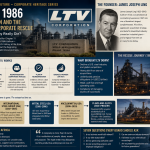
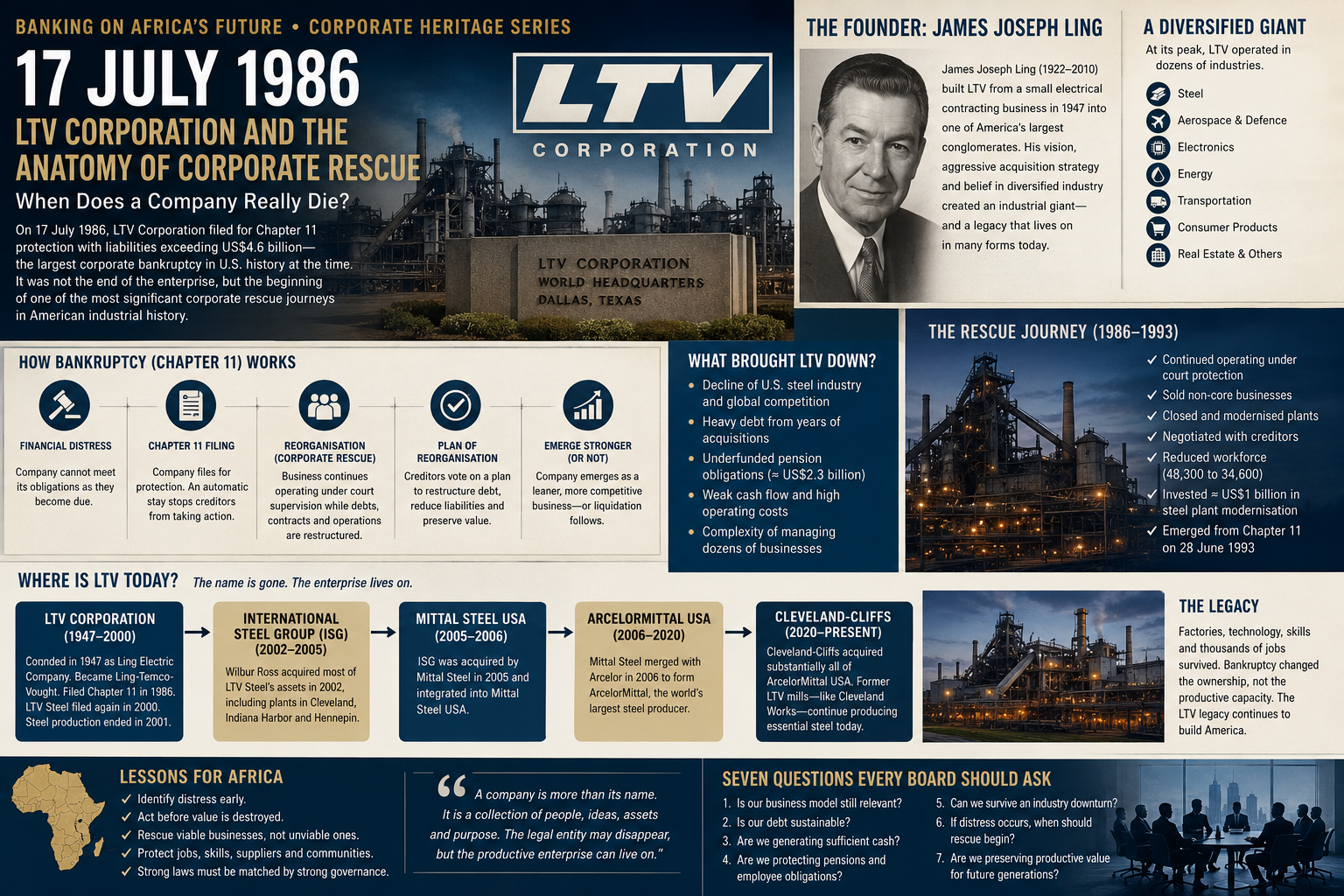
On 17 July 1986, LTV Corporation filed for protection under Chapter 11 of the United States Bankruptcy Code.

With liabilities exceeding US$4.6 billion, it became the largest corporate bankruptcy in American history at the time.
Newspapers described it as the collapse of an industrial giant.
Lawyers described it as one of the most complex corporate reorganisations ever attempted.
Economists saw it as evidence of the decline of American heavy industry.
But corporate historians should ask a different question:
Did LTV actually die on 17 July 1986?
The answer is no.
Nor did it survive in the way many imagine.
LTV teaches us that companies, like nations, have life cycles. Some recover. Some merge. Some split into smaller institutions. Some disappear as legal entities while their factories, technologies, employees and ideas continue serving society under entirely different ownership.
That is why understanding bankruptcy is not merely about failure.
It is about understanding how economies preserve productive value.
Who was James Ling?
Every institution begins with a founder.
LTV began with James Joseph Ling, born in Hugo, Oklahoma, in 1922.
Ling did not inherit an industrial empire.
He studied engineering, served in the United States Navy during the Second World War and, in 1947, borrowed approximately US$2,000 to establish Ling Electric Company in Dallas, Texas.
His ambition was far larger than electrical contracting.
Ling believed diversified industrial groups could create value by bringing together complementary businesses under one corporate structure.
Today we call this a conglomerate strategy.
It was bold.
It was innovative.
And for a time, it worked brilliantly.
Through acquisitions and mergers, Ling Electric became Ling-Temco-Vought, one of the largest conglomerates in America.
Its businesses ranged across aerospace, defence, steel, electronics and manufacturing.
Its products helped build America’s industrial and military strength.
Yet history reminds us that vision alone does not guarantee permanence.
The rise of the conglomerate
The decades following the Second World War witnessed an explosion of corporate consolidation.
Management theory suggested diversified groups were less risky because weakness in one industry could be offset by strength in another.
Investors rewarded growth.
Banks rewarded acquisitions.
Capital markets financed expansion.
The result was the emergence of some of the world’s largest conglomerates.
LTV became one of their symbols.
Yet diversification also created complexity.
More businesses required more capital.
More subsidiaries required stronger governance.
More acquisitions required more borrowing.
Growth eventually became dependent upon debt.
And debt always expects tomorrow’s cash.
What is bankruptcy?
One of the greatest misconceptions in business is that bankruptcy means a company has failed forever.
It does not.
Bankruptcy is a legal mechanism through which society attempts to preserve order when financial obligations can no longer be met.
Its purpose is not to punish failure.
Its purpose is to maximise value.
Sometimes that value lies in saving the company.
Sometimes it lies in selling parts of the business.
Sometimes it lies in transferring assets to owners better positioned to operate them successfully.
Insolvency, bankruptcy and corporate rescue
This distinction is essential.
A company becomes insolvent when it cannot meet its financial obligations.
Bankruptcy is the legal process through which those obligations are addressed.
Corporate rescue is one possible outcome of that legal process.
Different countries use different terminology.
The United States has Chapter 11.
South Africa has Business Rescue.
Zimbabwe provides for Corporate Rescue Proceedings under its Insolvency Act.
The philosophy is identical.
Save viable businesses before destroying them.
What brought LTV to its knees?
The collapse was not caused by one catastrophic decision.
It was the convergence of several forces:
•declining American steel competitiveness
•inexpensive imported steel
•enormous acquisition debt
•collapsing oil prices affecting energy operations
•underfunded pension obligations
•high operating costs
•weakening cash flow.
This is an important corporate lesson.
Companies rarely fail because of one problem.
They fail because many manageable problems become interconnected.
Corporate rescue is not a miracle
Chapter 11 allowed LTV to continue operating.
Factories continued producing.
Employees continued working.
Creditors negotiated rather than dismantled the business.
Management remained in office under court supervision.
This illustrates a profound principle.
Corporate rescue is not designed to save shareholders.
It is designed to preserve economic value.
That distinction is often overlooked.
Did the rescue succeed?
Yes.
And no.
LTV emerged from bankruptcy in 1993, proving that corporate rescue can work.
But survival after rescue depends upon whether the underlying business has truly become competitive.
Seven years later, LTV entered Chapter 11 once again.
This time, liquidation became unavoidable.
Where is LTV today?
The original corporation no longer exists.
Yet the factories did not disappear.
The steel mills became part of International Steel Group, later Mittal Steel, then ArcelorMittal, and today many operate within Cleveland-Cliffs.
The aerospace operations followed a different corporate lineage through the American defence industry.
This means something extraordinary happened.
The company died.
The enterprise survived.
The African lesson
Africa often measures corporate success by whether a company still carries the same registered name.
That is too narrow.
The better questions are:
Are the factories still producing?
Are people still employed?
Has the technology been preserved?
Have suppliers survived?
Has institutional knowledge been retained?
Have creditors recovered value?
Has the economy been strengthened?
Those questions determine whether corporate rescue has succeeded.
A framework for directors
Every board should continually ask seven questions:
- Is our business model still relevant?
- Is our debt sustainable?
- Are we generating sufficient cash?
- Are we protecting pension and employee obligations?
- Can we survive an industry downturn?
- If distress occurs, when should rescue begin?
- Are we preserving productive value for future generations?
Boards that wait until insolvency often discover that rescue has become far more difficult.
The Corporate Heritage Lesson
The LTV story teaches that a corporation is more than its name.
It is a collection of people, factories, ideas, technology, relationships and purpose.
The legal entity may disappear.
The productive enterprise may continue.
The ultimate objective of corporate rescue is therefore not simply to preserve a company registration.
It is to preserve productive capacity, employment, institutional knowledge and economic value.
That is why every Banking On Africa’s Future corporate heritage article should end with one enduring question,
Where is the company today?
Because corporate heritage is not simply about how institutions are founded.
It is about whether they continue to fulfil the promise for which they were established.





