









Corporate Heritage
The Birth of Econet Wireless Zimbabwe: How One Man’s Five-Year Court Battle Changed African Telecommunications Forever


By Tinashe T. T. Mpasiri | 10 July 2026
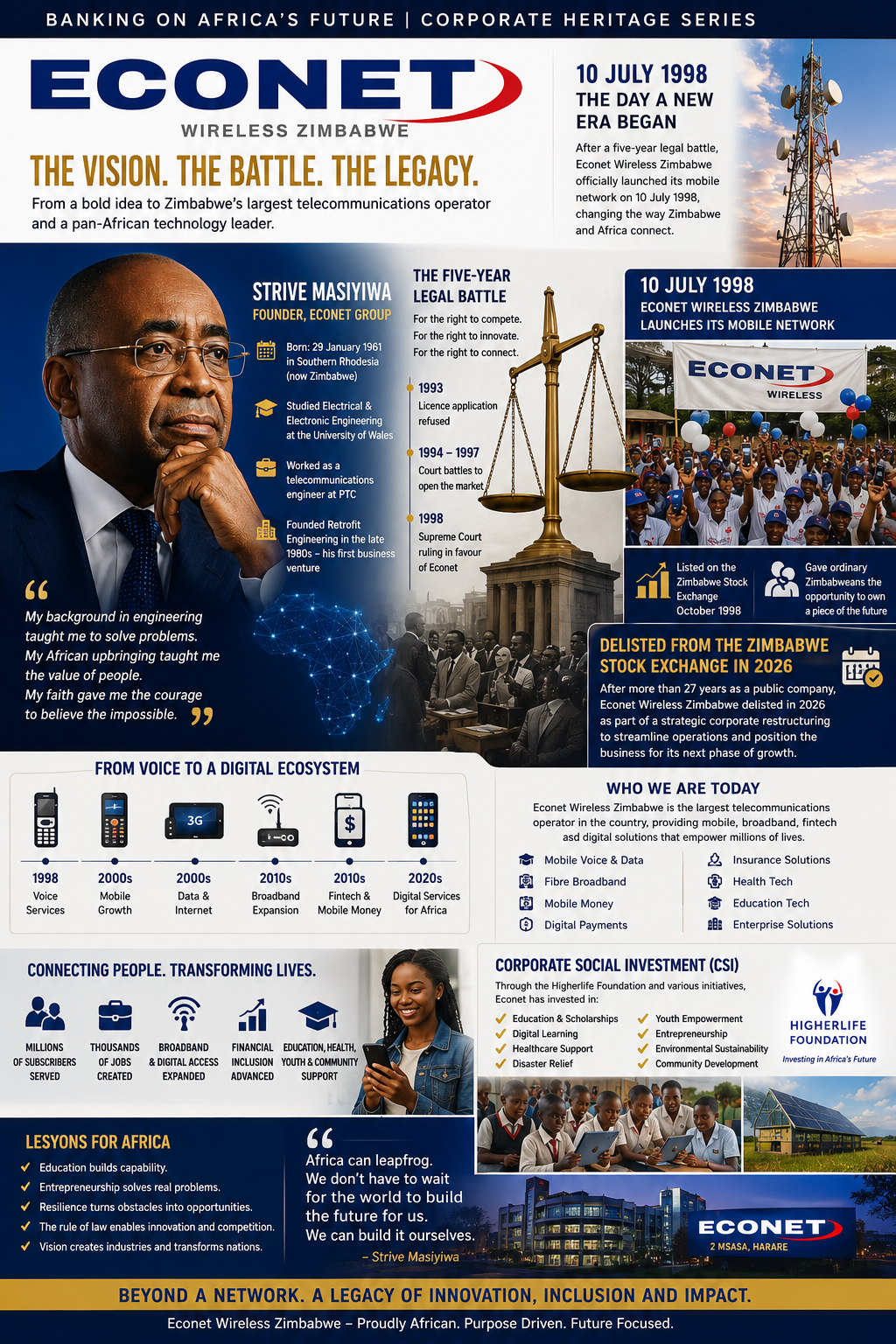
10 July 1998 is one of the defining dates in African corporate history.
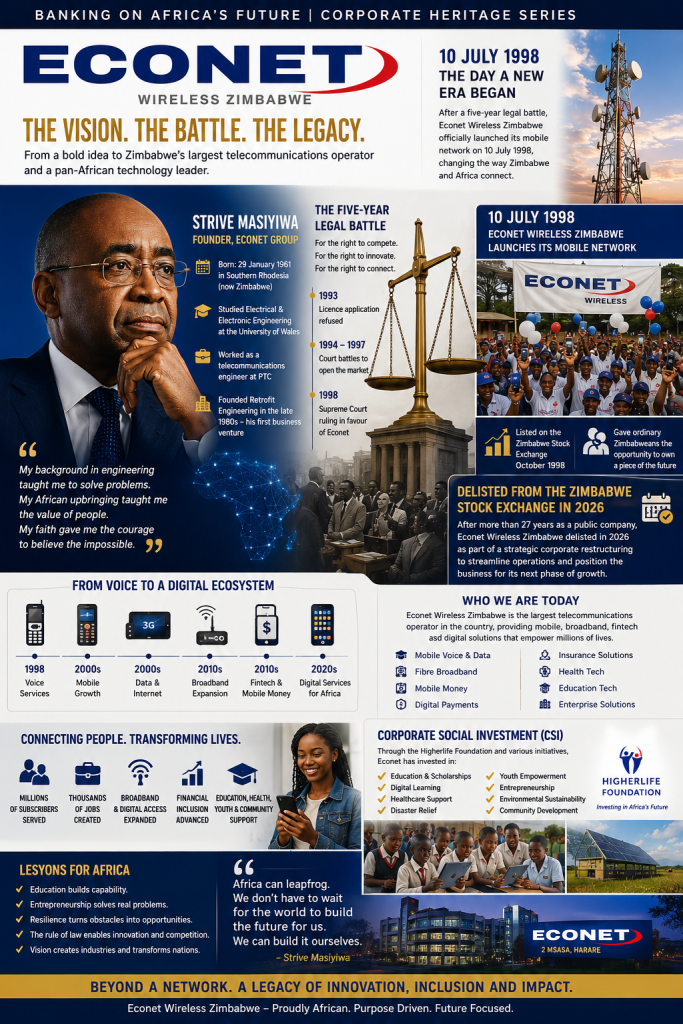
On this day, Econet Wireless Zimbabwe officially launched its mobile telecommunications network after one of the most remarkable legal and entrepreneurial battles in modern African business. It was not simply the launch of another telecommunications company, it was the triumph of constitutionalism, entrepreneurship, persistence and private enterprise over monopoly.

Few African corporations were born through such prolonged adversity.
Today, Econet has grown into Zimbabwe’s largest telecommunications company, connecting millions of people through voice, data, broadband, mobile money, insurance, digital services and financial technology. Yet behind the company stands an entrepreneur whose story deserves to be studied in every African business school.
That entrepreneur is Strive Masiyiwa.
A Boy Born in Zimbabwe, Raised Across Africa
Strive Masiyiwa was born on 29 January 1961 in what was then Southern Rhodesia.
His family later relocated to Northern Rhodesia (now Zambia) before eventually settling in Scotland, where he completed part of his education.
Unlike many celebrated entrepreneurs, Masiyiwa did not inherit a large business empire.
He studied Electrical and Electronic Engineering at the University of Wales, graduating in 1983.
Engineering gave him something invaluable:
- systems thinking
- analytical discipline
- problem-solving ability
- understanding of communications technology.
These skills would later become the foundation upon which Econet was built.
Early Career: Learning Before Leading
After university he returned to Zimbabwe.
He joined the state-owned Zimbabwe Posts and Telecommunications Corporation (PTC), where he worked as a telecommunications engineer.
This experience proved decisive.
Rather than merely learning how telephone systems worked, he witnessed first-hand the enormous inefficiencies of a government monopoly.
Telephone waiting lists stretched for years.
Businesses struggled to obtain lines.
Large sections of the country had virtually no telecommunications infrastructure.
Where others saw frustration…
Masiyiwa saw opportunity.
Entering Business
In the late 1980s he left employment and established his own engineering company, Retrofit Engineering, which specialised in electrical engineering projects.
The business generated cash flow, technical credibility and relationships within industry.
Contrary to popular myth, Econet was not built overnight.
It emerged after years of engineering entrepreneurship.
Where Did the Capital Come From?
One of the questions frequently asked is:
Who financed Econet?
The answer illustrates another entrepreneurial lesson.
The initial funding came from several sources:
- profits generated from Retrofit Engineering
- support from family members
- private investors
- later strategic international investors who believed in the mobile telecommunications vision.
Capital did not arrive because banks suddenly believed in the idea.
It came because Masiyiwa first established credibility, demonstrated technical expertise and convinced others that mobile telephony represented Africa’s future.
His greatest initial asset was not money.
It was conviction.
The Vision Behind Econet
During the early 1990s mobile telecommunications was transforming Europe and North America.
Africa remained largely dependent upon fixed-line monopolies.
Masiyiwa believed Africa could leapfrog traditional telephone infrastructure by embracing wireless technology.
It was an extraordinary insight.
Instead of spending decades laying millions of kilometres of copper cables, Africa could move directly into the mobile era.
Today that prediction appears obvious.
In 1993 it was revolutionary.
The Five-Year Legal Battle
What followed became one of Africa’s greatest corporate legal battles.
Zimbabwe’s telecommunications sector was protected by monopoly legislation.
Government repeatedly refused Masiyiwa’s licence applications.
Rather than abandon the dream, he challenged the monopoly in court.
The litigation lasted approximately five years.
The matter eventually reached the Supreme Court, where constitutional principles concerning freedom of enterprise and equal protection became central issues.
The eventual judgment opened Zimbabwe’s telecommunications market to competition.
Without that legal victory, Econet might never have existed.
This remains one of the strongest demonstrations that the rule of law is itself economic infrastructure.
Markets cannot flourish where entrepreneurship depends solely upon administrative discretion.
10 July 1998: A New Era Begins
When Econet officially switched on its network on 10 July 1998, history changed.
Within months subscriber numbers surged.
Three months later the company listed on the Zimbabwe Stock Exchange, giving ordinary Zimbabweans the opportunity to participate in one of Africa’s fastest-growing telecommunications businesses.
The listing also demonstrated that African technology companies could attract public investment and create substantial shareholder value.
Beyond Telecommunications
Econet gradually evolved into a technology ecosystem.
Its businesses expanded into:
- mobile communications
- fibre broadband
- enterprise connectivity
- mobile financial services
- digital payments
- insurance technology
- health technology
- education technology
- renewable energy solutions.
The company increasingly became a digital infrastructure business rather than simply a mobile operator.
Why Did Econet Delist?
After more than two decades as a public company, Econet Wireless Zimbabwe delisted from the Zimbabwe Stock Exchange in 2023.
Corporate delisting can occur for several legitimate reasons.
These include:
- corporate restructuring
- simplifying ownership
- reducing regulatory compliance costs
- facilitating mergers or reorganisations
- allowing controlling shareholders greater strategic flexibility
- pursuing alternative capital structures.
Delisting should not automatically be interpreted as corporate decline.
Many successful global companies have voluntarily delisted as part of broader strategic restructuring.
For investors, however, delisting usually reduces public trading opportunities and changes the company’s relationship with minority shareholders.
Corporate Social Investment: Profit with Purpose
One of Econet’s distinguishing characteristics has been its commitment to corporate citizenship.
Through the Higher Life Foundation, founded by Strive Masiyiwa and his wife, Tsitsi, hundreds of thousands of young Africans have received educational support through scholarships, leadership development and digital learning initiatives.
Econet has also invested significantly in:
- disaster relief
- healthcare support
- digital education
- environmental sustainability
- community connectivity
- youth empowerment
- entrepreneurship programmes.
Its approach demonstrates that corporate value extends beyond financial statements.
Long-term success increasingly depends upon creating value for society as well as shareholders.
Lessons for Africa
The Econet story teaches several enduring lessons.
First, education matters.
Engineering equipped Masiyiwa with technical competence.
Second, entrepreneurship begins by solving real problems.
He addressed Africa’s communications deficit.
Third, resilience often matters more than capital.
Five years of litigation would have discouraged many entrepreneurs.
Fourth, the rule of law is indispensable to economic development.
Without an independent judiciary willing to uphold constitutional rights, one of Africa’s most influential telecommunications companies might never have been born.
Finally, vision creates industries.
Masiyiwa did not merely establish a mobile network.
He helped transform how millions of Africans communicate, transact, learn and conduct business.
Banking On Africa’s Future Reflection
Corporate heritage is not merely about celebrating successful companies.
It is about understanding the institutions, founders, legal frameworks, innovation and perseverance that produce them.
On this day, we honour not only the launch of Econet Wireless Zimbabwe, but the enduring lesson that visionary entrepreneurs, supported by the rule of law, can reshape nations.
Africa’s future will not be built by resources alone. It will be built by institutions that protect enterprise, entrepreneurs who solve meaningful problems, and corporations that create lasting value for society.





