






Corporate Heritage
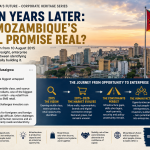
Eleven Years Later: Was Mozambique’s Retail Promise Real?


Published
2 months agoon

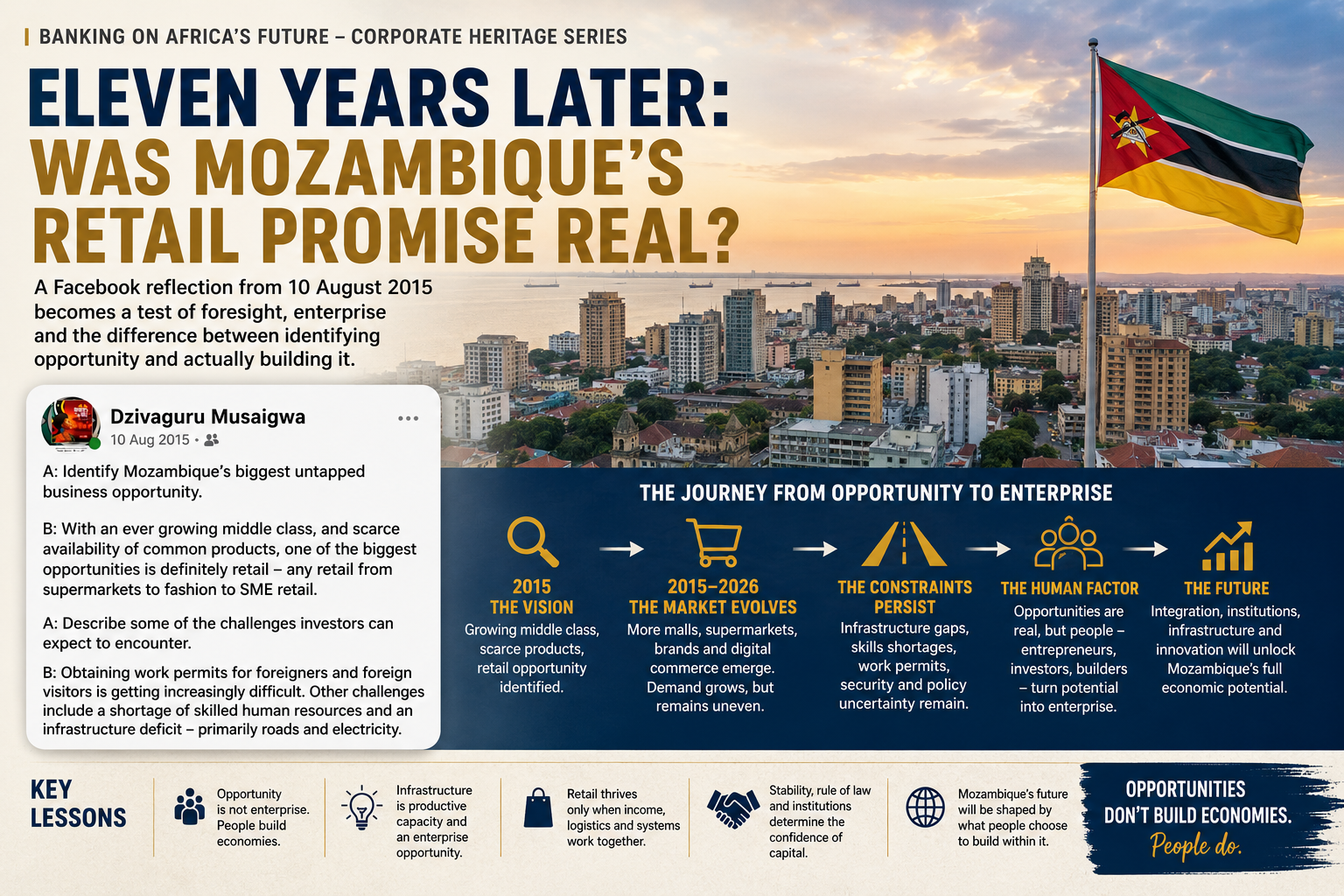
A Facebook reflection from 10 August 2015 becomes a test of foresight, enterprise and the difference between identifying opportunity and actually building it.
By Tinashe T. T. Mpasiri | 10 August 2026
On 10 August 2015, I shared a short exchange about Mozambique.
The question was straightforward: What was Mozambique’s biggest untapped business opportunity?
The answer pointed towards retail.
Mozambique appeared to have an expanding consumer market, yet many ordinary products remained relatively difficult to obtain. Supermarkets, fashion, consumer goods and SME retail therefore seemed to present considerable room for enterprise.
The same conversation identified obstacles: shortages of skilled people, inadequate roads and electricity infrastructure, and difficulties associated with bringing foreign skills into the country.
Eleven years later, the Facebook memory presents a useful opportunity to do something more important than celebrate an old prediction.
We can test it.
Was retail really the opportunity we thought it was?
And, perhaps more importantly, what does Mozambique teach us about the difference between seeing an opportunity and converting it into productive enterprise?
The Mozambique of 2015
To understand the proposition, we must return to the economic imagination surrounding Mozambique at the time.
The country had emerged as one of Southern Africa’s important frontier-market stories. Major discoveries of offshore natural gas had dramatically increased international interest. Coal, aluminium, agriculture, ports, transport corridors and energy all contributed to expectations that Mozambique could become one of the region’s important growth economies.
That optimism had consequences beyond extractive industries.
Workers need food.
Families need clothing.
Companies need suppliers.
Growing towns need supermarkets, pharmacies, restaurants, warehouses, transport businesses and financial services.
Large industrial investments therefore potentially create economic activity far beyond the industry receiving the original capital.
That was the logic behind the retail proposition.
Retail was not necessarily about opening another shop.
It was about recognising what happens when income, urbanisation, infrastructure and consumer demand begin interacting.
But Was Retail Really Mozambique’s Biggest Opportunity?
With eleven years of hindsight, the word “biggest” deserves interrogation.
Mozambique possesses substantial natural and geographic advantages.
Its enormous offshore gas discoveries transformed it into a potentially significant LNG producer. The country also possesses agricultural potential, hydropower resources, minerals and a coastline that gives its ports strategic importance to landlocked economies including Zimbabwe, Zambia and Malawi.
The Maputo, Beira and Nacala corridors are not merely transport routes.
They are economic arteries.
Mozambique therefore presented opportunities in energy, agriculture, logistics, infrastructure, mining, manufacturing and services alongside retail.
The more accurate 2015 proposition may consequently have been:
Retail was one of Mozambique’s most visible underdeveloped opportunities — but it sat downstream of much larger productive systems.
That distinction matters.
You cannot sustainably build a consumer economy without asking what produces the income that sustains consumption.
The Retail Opportunity Was Real — But Complicated
Mozambique’s retail landscape did develop.
Formal shopping centres, supermarkets and international and regional brands became increasingly visible, particularly around Maputo and other urban centres.
Yet the development of retail also demonstrated something that economic statistics sometimes obscure.
A population is not automatically a market.
A market requires purchasing power.
Population growth can create millions of potential consumers, but businesses ultimately depend on households having sufficient disposable income to purchase what enterprises produce.
That makes the phrase “growing middle class” particularly important.
Entrepreneurs must distinguish between demographic potential and effective demand.
The two are not synonymous.
Then History Intervened
The eleven years after that Facebook post were anything but straightforward.
Mozambique experienced the consequences of the hidden-debt scandal, severe fiscal pressures, devastating cyclones, the COVID-19 shock and a violent insurgency concentrated in Cabo Delgado.
At the same time, enormous LNG projects reinforced the extraordinary scale of Mozambique’s natural-resource potential.
This is precisely why enterprise cannot be understood through opportunity alone.
An entrepreneur may correctly identify demand and still confront circumstances that radically change the economics of an investment.
Political stability matters.
Currency stability matters.
Infrastructure matters.
Institutions matter.
Security matters.
The rule of law matters.
Capital does not evaluate opportunity in isolation. Capital evaluates opportunity against risk.
The Infrastructure Question Has Not Disappeared
One observation from 2015 remains particularly important: infrastructure.
Retail depends upon far more than shelves and cash registers.
Someone must manufacture or import the products.
Someone must finance the inventory.
Someone must transport the goods.
Warehouses must store them.
Electricity must power refrigeration, lighting and payment systems.
Telecommunications networks must connect businesses.
Roads must connect producers, ports, distribution centres and consumers.
This is why infrastructure should not simply be understood as government expenditure.
Infrastructure is productive capacity.
And while governments may commission, finance, regulate or procure infrastructure, engineers, construction companies, financiers, equipment suppliers and workers ultimately organise the resources that physically build it.
The distinction matters because infrastructure deficits themselves represent enterprise opportunities.
A poor road does not merely describe a problem.
It describes unmet demand for engineering, construction, finance, maintenance, logistics and materials.
Electricity Tells the Same Story
Mozambique presents one of Africa’s fascinating energy paradoxes.
It possesses enormous electricity-generation potential, including the Cahora Bassa hydropower system, while electricity access and transmission infrastructure have historically remained uneven.
That teaches another enterprise lesson.
Possessing a resource is different from organising a system capable of delivering its benefits to people.
Coal underground is not electricity.
Gas beneath the ocean is not industrialisation.
Water flowing through a river is not economic development.
Land is not agriculture.
A mineral deposit is not wealth.
Each requires human agency, capital, technology, institutions and organisation before its potential becomes economically useful.
And Then Came the Digital Shopfront
There is another development that the 2015 discussion could not fully capture.
Retail itself has changed.
Mobile money, digital payments, social commerce, delivery platforms and increasingly connected consumers have blurred the distinction between the physical shop and the digital marketplace.
The entrepreneur looking at Mozambique today therefore should not simply ask:
Where should I open a supermarket?
The better question may be:
How do I build the system through which goods move from producers to consumers?
That system can include procurement, warehousing, payments, distribution, transport, data, credit and last-mile delivery.
Sometimes the greatest opportunity surrounding the shop is not the shop.
It is the infrastructure behind it.
The Missing Question: Who Was Going to Build It?
This brings us to perhaps the greatest weakness in how we often discuss African economic opportunity.
We speak about countries as though geography itself possesses agency.
“Mozambique must industrialise.”
“Africa must manufacture.”
“Zimbabwe must beneficiate.”
“South Africa must create jobs.”
But a geographical location cannot incorporate a company, raise capital, employ workers or negotiate with suppliers.
People do.
Entrepreneurs do.
Engineers do.
Investors do.
Workers do.
Managers do.
People acting through governments establish policies and institutions. People acting through companies organise productive resources.
That distinction sits at the heart of the philosophy behind Banking On Africa’s Future.
Africa is a location.
Its future will be determined by what people choose to build within it.
Opportunity Is Not Enterprise
Perhaps that is the most important lesson from the Facebook post eleven years later.
Identifying an opportunity is relatively easy.
Building an enterprise capable of exploiting it is considerably harder.
An entrepreneur must identify a problem, understand the customer, mobilise capital, assemble skills, secure suppliers, navigate regulation, establish governance, manage cash flow and deliver consistently.
The market gap does not perform any of those functions.
People do.
This is why an economy can possess enormous opportunities while its citizens remain poor.
The existence of opportunity does not guarantee the organisation of opportunity.
Enterprise is the bridge between the two.
From Untapped Opportunity to Organised Capacity
If I were asked the same question today — What is Mozambique’s biggest untapped business opportunity? — I would hesitate before naming a sector.
Retail?
Agriculture?
Energy?
Logistics?
Manufacturing?
Gas?
Each presents possibilities.
But perhaps the deeper opportunity is integration.
Producing what people consume.
Processing what farmers grow.
Generating and transmitting the electricity enterprises require.
Building the logistics systems that connect producers to markets.
Financing SMEs that can become larger enterprises.
Developing the human capital capable of managing increasingly sophisticated businesses.
And creating institutions in which investors can confidently commit capital for decades rather than months.
That is how natural resources become industries.
That is how consumers become markets.
That is how markets produce enterprises.
And that is how enterprises create jobs, tax revenues, skills, wealth and eventually new generations of investors.
Eleven years ago, the question was:
Where is Mozambique’s opportunity?
Eleven years later, perhaps the better question is:
Who will organise the people, capital, knowledge and institutions required to turn Mozambique’s enormous potential into productive enterprise?
Because opportunities do not build economies.
People do.
#CorporateHeritage #CorporateLiteracy #TheAfricaIWant #BOAF

Over the years, I have found it challenging to define myself solely by an academic qualification, trade, or occupation. My eagerness to learn, especially about how to build and deploy capital, has allowed me to accumulate diverse experiences in a short span of time. Through this journey, I have discovered that at my core, I am a storyteller. I tell the stories of corporations, their heritage, and the individuals who act in their name. I explore the role of these institutions in fulfilling the promise of a better Africa, and, most importantly, the causal link between the rule of law and economic development. As a fellow believer in Africa’s potential, can I count on you to be a point of light in securing our continent’s future?




