


Corporate Heritage
Organisation Before Economic Power: Revisiting a Women’s Day Reflection Five Years Later


Published
2 months agoon

By Tinashe T. T. Mpasiri | 9 August 2026
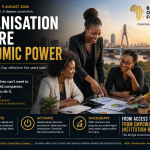
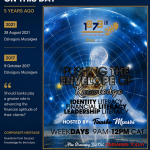
On 9 August 2021, I published a reflection on Facebook about women, enterprise, organisation and opportunity.
It was Women’s Day in South Africa.
I wrote then that I had spent considerable time encouraging women to organise themselves. I spoke about creating communities where experiences could be shared, ideas exchanged and individuals connected to opportunities.
Five years later, on 9 August 2026, I return to that post with a deeper appreciation of what I was actually wrestling with.
The issue was never simply women.
It was organisation.
And organisation matters because economic power rarely emerges from isolated individuals, however talented they may be.
People Must Organise
One sentence from the 2021 post was deliberately provocative:
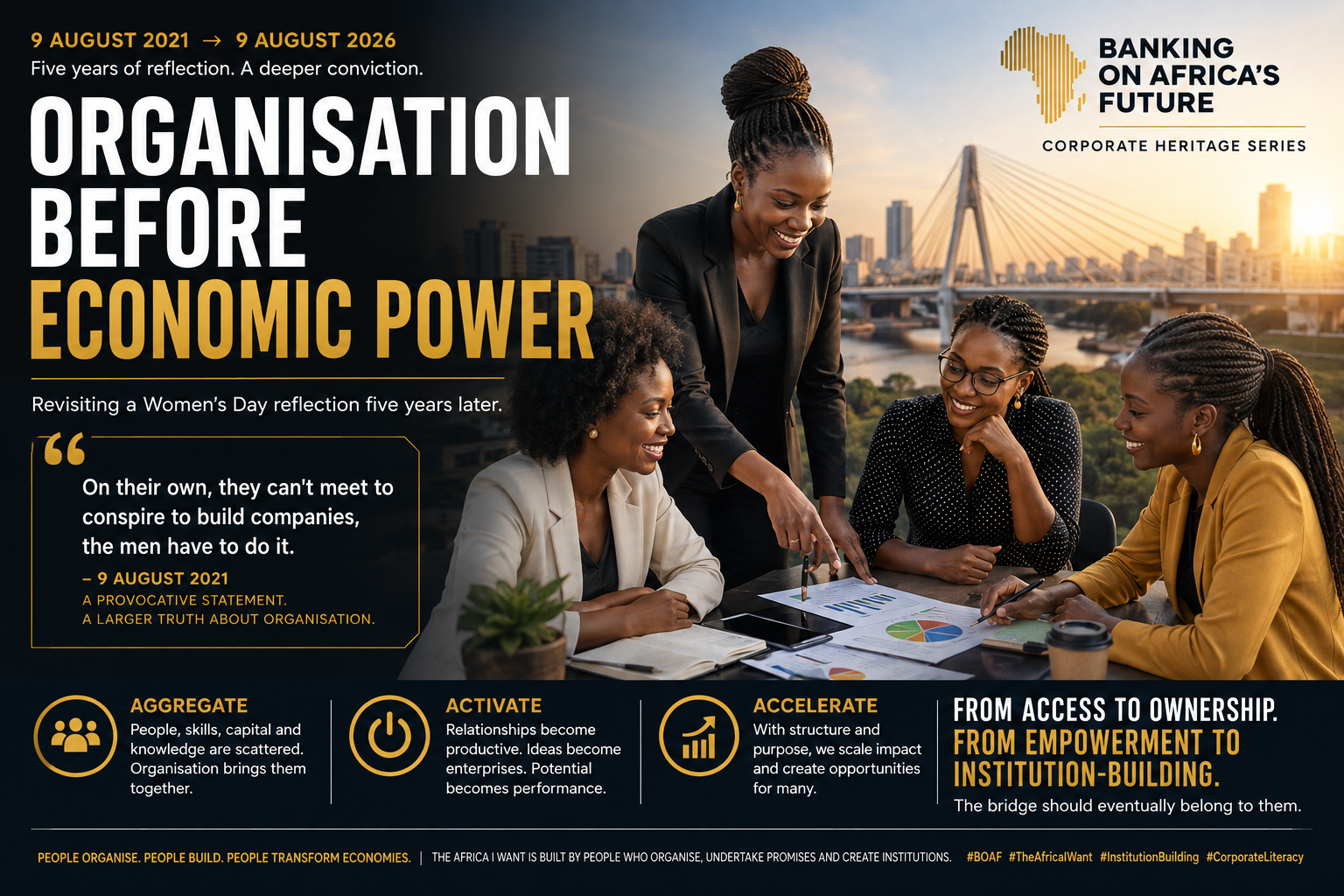
“On their own, they can’t meet to conspire to build companies, the men have to do it.”
Five years later, I would express the proposition differently.
Women do not need men to organise them.
What entrepreneurs — women and men alike — need are mechanisms through which individuals can find one another, combine capabilities, exchange information, mobilise resources and undertake promises together.
Companies themselves demonstrate this principle.
A company is not a building. It is not a logo. It is not a registration certificate.
It is an institutional arrangement through which people organise capital, labour, knowledge, relationships and risk around a particular promise.
The real question therefore becomes: how do we create environments in which more women can organise around enterprise?
Not merely attend conferences.
Not merely receive motivational speeches.
Not merely occupy seats.
But meet one another and say: What can we build together?
From Access to Ownership
In 2021, I described part of my role as “building bridges to opportunity”.
At the time, I was actively involved in initiatives seeking to increase women’s participation in the energy and petroleum industry and agriculture, including the emerging cannabis sector.
The intention was straightforward: connect people who might ordinarily struggle to access certain opportunities with networks, knowledge and possibilities that could accelerate their enterprises.
There remains value in that work.
But five years later, I think the ambition must go further.
A bridge to opportunity is useful. Ownership is better.
If someone continuously requires another person to introduce them to capital, markets, information or decision-makers, the underlying structural problem has not necessarily been solved.
Institution-building changes the equation.
Instead of asking only how women can access existing opportunities, we should also ask:
How do women aggregate capital? How do they build companies? How do they create investment vehicles? How do they develop supply chains? How do they become employers, directors, shareholders and eventually investors themselves?
That is the movement from participation towards economic agency.
Aggregate. Activate. Accelerate.
Looking back, I can also see the early foundations of an idea that would become much clearer in my thinking: Aggregate, Activate, Accelerate.
First, people must aggregate.
Skills scattered across thousands of individuals remain fragmented capacity. Capital scattered among individuals remains fragmented capital. Knowledge trapped within separate networks remains fragmented intelligence.
Organisation aggregates these resources.
Then they must be activated around a productive purpose.
A network becomes economically meaningful when relationships begin producing transactions, enterprises, investment, employment, knowledge or solutions.
Only then can we meaningfully speak about acceleration.
You cannot sustainably accelerate what has not first been organised.
The People Who Become Bridges
There was another line in that 2021 post that I understand differently today:
“It’s not easy to get anyone to assist you with your business to make money.”
Entrepreneurship can be remarkably lonely.
Capital matters, but capital does not always arrive as money.
Sometimes capital arrives as an introduction.
Sometimes it is information.
Sometimes credibility.
Sometimes mentorship.
Sometimes somebody puts your name into a room you could not enter yourself.
Sometimes somebody simply believes that your promise deserves an opportunity to be tested.
These relationships should never be treated casually.
The people who genuinely help another person become economically productive are participating in the creation of enterprise.
The Women Who Built Me
My 2021 reflection also acknowledged something personal.
I wrote about two women whom I regarded as mothers: Dr Amai Mpa and Tsitsi Guramatunhu.
I wrote that without their contribution to my life, I would not have become the gentleman I was becoming.
That gratitude remains.
None of us is entirely self-made.
Behind many entrepreneurs, executives and institution-builders are people whose contributions will never appear on a balance sheet.
They encouraged.
They corrected.
They introduced.
They sacrificed.
They opened doors.
They provided knowledge.
They created confidence when confidence was itself scarce capital.
Recognising those people is part of understanding our own corporate heritage.
Beyond Empowerment
Perhaps this is the greatest evolution between my reflection of 2021 and my thinking in 2026.
I remain interested in empowerment.
But I am increasingly interested in what comes after empowerment.
A person can be empowered and remain economically dependent.
A person can be trained and remain outside the market.
A person can attend conferences for years without building an enterprise.
A person can even occupy an important seat without possessing meaningful economic agency.
The destination must therefore be greater than empowerment.
It must include enterprise, ownership, capital formation and institution-building.
That is where economic participation begins becoming economic power.
The Bridge Should Eventually Belong to Them
Five years ago, I wanted to help build bridges through which women could reach opportunities they might otherwise struggle to access.
I still believe in building bridges.
But today I would add something.
The ultimate success of a bridge-builder is not creating permanent dependence on the bridge-builder.
It is helping create people and institutions capable of building bridges of their own.
Women organising other women.
Entrepreneurs financing other entrepreneurs.
Founders mentoring future founders.
Businesswomen becoming investors.
Employees becoming employers.
Opportunity recipients becoming opportunity creators.
That is how economic ecosystems reproduce themselves.
And perhaps that is the lesson I was searching for on 9 August 2021 without yet possessing all the language to articulate it.
Organisation precedes economic power.
People aggregate.
People activate resources.
People build companies.
People mobilise capital.
People create opportunities.
People build institutions.
And when those institutions become strong enough to survive the individuals who started them, empowerment has begun its transformation into something far more enduring: economic agency.
Banking On Africa’s Future means banking on the capacity of people to organise, undertake promises, build enterprises and create institutions capable of serving generations yet to come.

Over the years, I have found it challenging to define myself solely by an academic qualification, trade, or occupation. My eagerness to learn, especially about how to build and deploy capital, has allowed me to accumulate diverse experiences in a short span of time. Through this journey, I have discovered that at my core, I am a storyteller. I tell the stories of corporations, their heritage, and the individuals who act in their name. I explore the role of these institutions in fulfilling the promise of a better Africa, and, most importantly, the causal link between the rule of law and economic development. As a fellow believer in Africa’s potential, can I count on you to be a point of light in securing our continent’s future?




