









Corporate Heritage
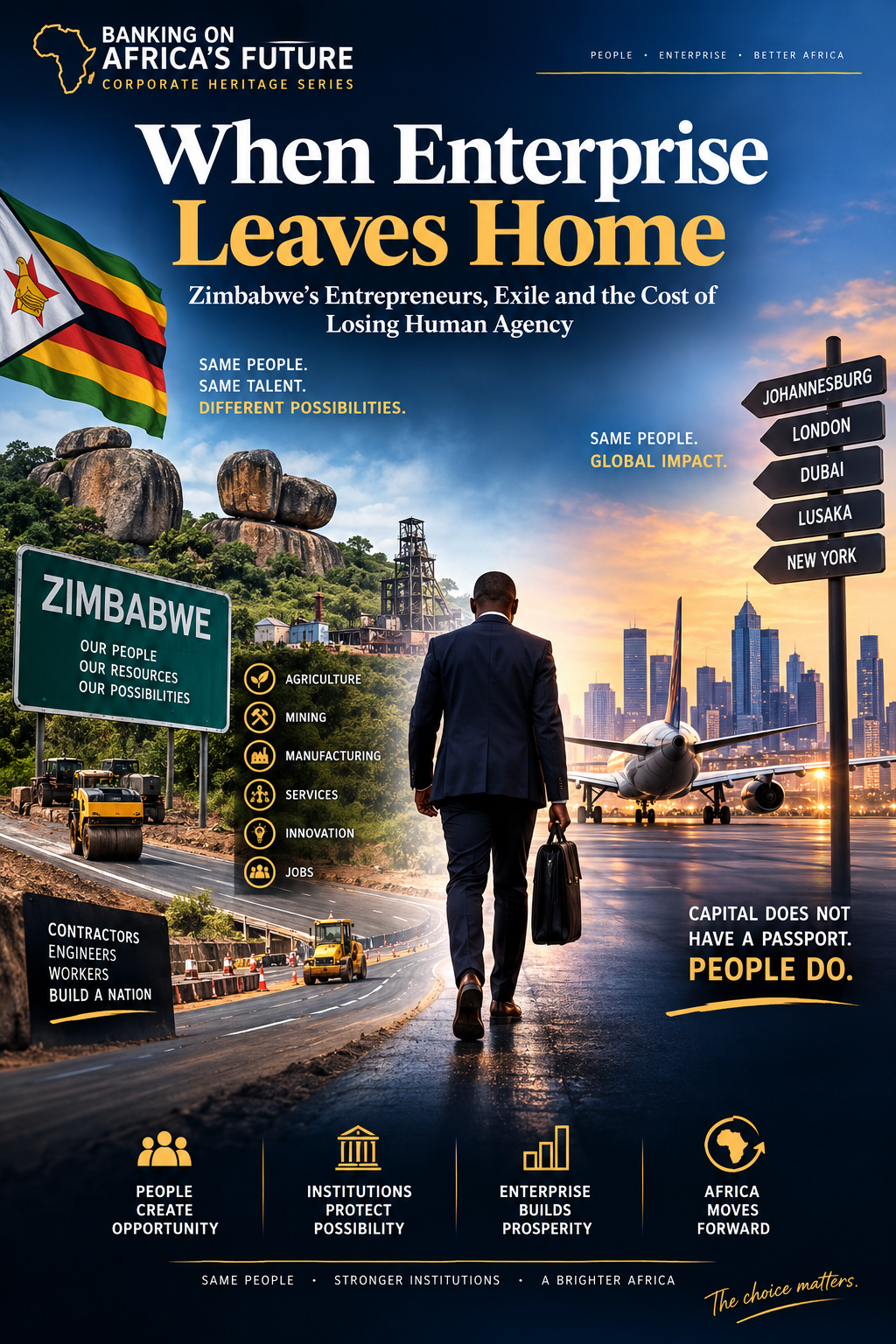
When Enterprise Leaves Home – Zimbabwe’s Entrepreneurs, Exile and the Cost of Losing Human Agency


Published
2 months agoon

By Tinashe T. T. Mpasiri | 9 August 2026
On 9 August 2018, I posed a question on Facebook about Zimbabwe’s exiled business tycoons and the circumstances that had led them away from home.
Eight years later, I find myself returning to that question.
But perhaps the more important question is no longer simply who left Zimbabwe?
It is, what does a country lose when the people capable of organising its resources choose to build elsewhere?
That question takes us beyond exile. It takes us into entrepreneurship, property rights, institutional confidence and human agency.
Enterprise Did Not Begin in 1980
Black Zimbabwean entrepreneurship predates independence.
People such as George Tawengwa built substantial business interests despite colonial restrictions on African participation in the economy. Tawengwa’s interests extended into transport, retail and commercial agriculture.
His story demonstrates something fundamental.
Land does not farm itself. Minerals do not mine themselves. Money does not invest itself. Machines do not establish factories.
People organise resources into productive enterprises.
Political independence therefore carried an economic promise, that removing racial barriers would create conditions in which many more Zimbabweans could build, own and expand enterprises.
What happened subsequently deserves examination.
Masiyiwa: Fighting for the Right to Compete
Strive Masiyiwa recognised the possibilities of mobile telecommunications and sought to establish a private network.
But Zimbabwe’s telecommunications environment was dominated by the state-owned Posts and Telecommunications Corporation.
What followed was a prolonged legal battle over Econet’s right to operate.
Eventually, Masiyiwa prevailed, and Econet launched commercially in 1998.
Today, we know what Econet became.
But there is a more difficult question:
How many potential Masiyiwas encountered institutional barriers and simply walked away?
Those businesses cannot be counted because they were never created.
Their employees never appeared on payrolls. Their suppliers never received contracts. Their taxes were never collected.
That is the invisible cost of frustrating enterprise.
Mawere and the Security of Enterprise
The experience of Mutumwa Mawere raises a different institutional question.
Mawere became associated with a substantial portfolio of businesses, most prominently Shabanie Mashaba Mines. SMM was subsequently placed under reconstruction through Zimbabwe’s Reconstruction of State-Indebted Insolvent Companies framework.
The state had its arguments. Mawere had his. Creditors and other stakeholders had interests.
But beyond those competing positions lies a fundamental question:
Under what circumstances can control over an enterprise be altered through state action, and what independent processes protect everyone involved?
Other entrepreneurs watch such cases.
Other investors watch.
Because people controlling capital study what happened to those who invested before them.
This is why Capital Chases Confidence.
The Factory Cannot Leave. The Entrepreneur Can.
Zimbabwe possesses land, minerals, infrastructure and an educated population.
But resources are only potential.
Consider something as ordinary as a road.
We often say government builds roads. Yet government does not operate a grader or lay asphalt.
In the Harare-Beitbridge project, public authorities commissioned and administered the programme, while contractors including Masimba Construction and Bitumen World participated in physically executing the works.
Even saying Masimba built the road is ultimately shorthand.
Companies do not hold shovels.
People organised through companies do.
Engineers design. Managers coordinate. Machine operators move earth. Workers construct. Public officials administer contracts. Executives organise resources.
Institutions provide structure and order, but human beings exercise agency through them.
That distinction is essential to understanding development.
From Brain Drain to Enterprise Drain
Africa frequently discusses brain drain: doctors, engineers, academics and scientists leaving their countries.
Perhaps we should speak equally seriously about enterprise drain.
When an entrepreneur leaves, a country potentially loses more than one skilled person.
It may lose the institution that person would have created.
The factory cannot leave Zimbabwe by itself.
The mine cannot leave.
The farm cannot leave.
But the person capable of mobilising capital to develop those assets can board an aircraft.
And the next enterprise may consequently be built in Johannesburg, London, Dubai, Lusaka or elsewhere rather than Harare or Bulawayo.
This is why natural-resource abundance does not automatically produce prosperity.
Resources cannot mobilise themselves.
Not Everyone Who Left Was Exiled
Eight years later, I would also refine the language of my original question.
Not every Zimbabwean businessperson living abroad is an exile.
Some left voluntarily. Some internationalised their businesses. Some pursued opportunities elsewhere. Others encountered political, regulatory, legal or commercial disputes that influenced their departure.
Masiyiwa and Mawere themselves should not simply be collapsed into the same category.
Corporate heritage requires us to establish who did what, under what circumstances, through which institution and with what consequence.
The purpose is not to manufacture heroes and villains.
It is to learn.
The Question Zimbabwe Must Answer
Zimbabweans have demonstrated their abilities throughout the world.
That creates an extraordinary paradox.
If Zimbabwean entrepreneurs can build successful enterprises elsewhere, then the fundamental problem cannot simply be an absence of entrepreneurial capacity.
We must also examine the environment in which that capacity is exercised.
Are contracts enforceable?
Is property secure?
Are regulations predictable?
Can an entrepreneur compete without political proximity?
Can a dispute with the state be determined independently?
Can someone who builds something today reasonably expect to own it tomorrow?
These are not questions for wealthy tycoons alone.
They matter even more to the emerging entrepreneur whose entire wealth may consist of one house, one truck, one farm or one company.
Eight Years Later
On 9 August 2018, I asked about Zimbabwe’s exiled business tycoons.
On 9 August 2026, I would frame the question differently:
What must Zimbabwe do so that the next great Zimbabwean entrepreneur chooses to build from Zimbabwe?
Not because government tells them to.
Not because patriotism demands it.
But because that person can look at the institutional environment and confidently conclude:
I can build here. I can own here. I can compete here.
And here lies the deeper lesson.
We sometimes say that capital has a passport.
Strictly speaking, it does not.
People do.
Money does not decide where to invest. People do.
Minerals do not decide whether to become mines. People do.
Land does not decide whether to become productive. People do.
Countries do not develop themselves.
People, organised through functioning institutions, develop places.
Zimbabwe’s challenge is therefore greater than attracting money.
It is creating institutions worthy of the confidence of the human beings who decide what money, knowledge and resources will become.
Because resources may remain at home.
But the person capable of turning them into tomorrow’s enterprise can leave.

Over the years, I have found it challenging to define myself solely by an academic qualification, trade, or occupation. My eagerness to learn, especially about how to build and deploy capital, has allowed me to accumulate diverse experiences in a short span of time. Through this journey, I have discovered that at my core, I am a storyteller. I tell the stories of corporations, their heritage, and the individuals who act in their name. I explore the role of these institutions in fulfilling the promise of a better Africa, and, most importantly, the causal link between the rule of law and economic development. As a fellow believer in Africa’s potential, can I count on you to be a point of light in securing our continent’s future?




