








Corporate Heritage
Five Signatures That Turned Geography Into Economic Power


Published
2 months agoon

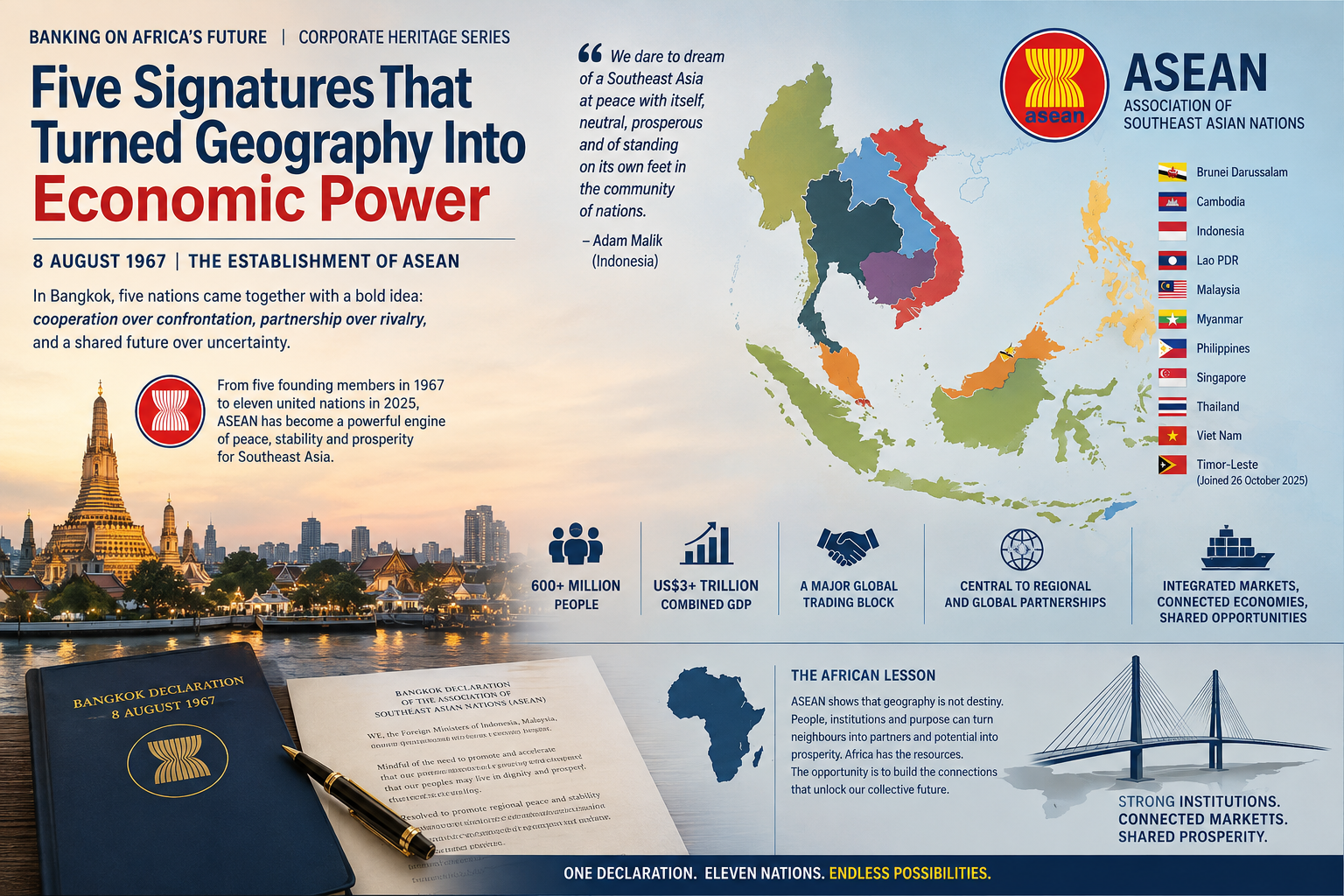
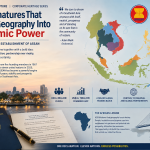
8 August 1967 | The Establishment of ASEAN
By Tinashe T. T. Mpasiri | 8 August 2026
On 8 August 1967, five foreign ministers gathered in Bangkok, Thailand, and signed a document consisting of only a handful of paragraphs.
They were Adam Malik of Indonesia, Tun Abdul Razak of Malaysia, Narciso R. Ramos of the Philippines, S. Rajaratnam of Singapore and Thanat Khoman of Thailand.
The document they signed became known as the Bangkok Declaration.
Their signatures established the Association of Southeast Asian Nations (ASEAN).
There was no factory being opened. No company was being listed. No mineral deposit had been discovered. No billionaire had written a cheque.
What these five men were attempting to create was perhaps more fundamental, an institution through which neighbouring countries could convert proximity into cooperation, cooperation into stability, and stability ultimately into economic opportunity.
Nearly six decades later, ASEAN has expanded from five founding states to eleven members and sits at the centre of one of the world’s most consequential economic regions.
Its history raises an important question for Africa.
What happens when people stop treating geography as destiny and begin organising it as an economic proposition?
A Region That Had Reasons Not to Cooperate
ASEAN was not born from harmony.
Southeast Asia in the 1960s was navigating decolonisation, the Cold War, the Vietnam War, communist insurgencies, territorial disagreements and deep political suspicion between neighbouring states.
Indonesia and Malaysia had only recently emerged from Konfrontasi, the confrontation triggered by Indonesian opposition to the formation of Malaysia.
Singapore had separated from Malaysia in 1965.
The Philippines and Malaysia had their own diplomatic tensions.
These were not countries naturally marching towards political union.
That is precisely what makes 8 August 1967 significant.
The architects of ASEAN were not responding to an absence of differences. They were asking whether countries with differences could nevertheless identify interests sufficiently important to pursue together.
Regional cooperation itself was not entirely new. Earlier experiments included the Association of Southeast Asia, or ASA, established by Malaya, the Philippines and Thailand, and MAPHILINDO, involving Malaya, the Philippines and Indonesia.
Neither became the enduring institution Southeast Asia required.
The diplomatic environment changed following the end of Indonesia-Malaysia Confrontation in 1966. Thailand, with Foreign Minister Thanat Khoman playing an important bridge-building role, helped facilitate discussions among the countries that would become ASEAN’s founders.
The breakthrough was collective.
The Five Institutional Entrepreneurs
Corporate history often teaches us to look for founders.
Who saw the opportunity?
Who assembled the people?
Who mobilised capital?
Who built the institution?
The same questions can be asked of ASEAN.
Its recognised Founding Fathers were five political leaders and diplomats:
Adam Malik — Indonesia
Tun Abdul Razak — Malaysia
Narciso R. Ramos — Philippines
S. Rajaratnam — Singapore
Thanat Khoman — Thailand
Their enterprise, however, required a different form of capital.
They were not principally aggregating money.
They were aggregating political capital, diplomatic credibility, national interests and trust.
That is worth understanding.
Institutions, like companies, are constructed by people. A declaration cannot negotiate itself. A country cannot shake another country’s hand. A region cannot decide anything.
People acting with authority on behalf of those countries and institutions make those decisions.
ASEAN therefore did not create itself.
Five men representing five governments chose to establish it.
What Were They Building?
ASEAN stands for the Association of Southeast Asian Nations.
The Bangkok Declaration set out ambitions that went considerably beyond trade.
The founders sought to accelerate economic growth, social progress and cultural development; promote regional peace and stability; encourage collaboration on matters of common interest; provide mutual assistance in training and research; and cooperate more effectively in agriculture, industry, trade, transportation and communications.
The economic proposition was already visible.
But ASEAN was not initially conceived simply as a free-trade arrangement.
It was also an architecture for stability.
That distinction matters because commerce requires confidence.
An investor contemplating a factory does not consider only labour costs. The investor considers political stability, infrastructure, market access, regulation, logistics and whether goods can reliably reach customers.
A manufacturer considering a regional supply chain asks whether borders function.
Banks consider whether agreements will be honoured.
Entrepreneurs consider whether markets will remain accessible tomorrow.
ASEAN’s founders were therefore helping construct something every functioning economy requires, predictability.
From Five Countries to Eleven
Institutions demonstrate their value partly through whether others eventually want to join them.
ASEAN began with Indonesia, Malaysia, the Philippines, Singapore and Thailand.
Brunei Darussalam joined in 1984.
Vietnam joined in 1995.
Laos and Myanmar followed in 1997.
Cambodia joined in 1999.
Then came another historic development.
On 26 October 2025, Timor-Leste formally became ASEAN’s 11th member, fourteen years after applying for membership.
An institution created by five countries in Bangkok had gradually become an organisation encompassing virtually the entire Southeast Asian region.
But membership numbers tell only part of the story.
The deeper question is what ASEAN enabled its members to build.
From Political Cooperation to Economic Integration
ASEAN’s economic architecture developed incrementally.
In 1992, members agreed to establish the ASEAN Free Trade Area, or AFTA, seeking to reduce tariffs and strengthen Southeast Asia as a competitive production base.
Then, in 2015, came another major milestone, the formal establishment of the ASEAN Economic Community.
The ambition was increasingly clear.
Southeast Asia should not merely consist of neighbouring national economies.
It should progressively function as an interconnected economic region.
That meant facilitating trade in goods and services, encouraging investment, improving connectivity and enabling companies to organise production across borders.
This changed the meaning of geography.
A component could be manufactured in one country, processed in another, assembled somewhere else and exported through another regional hub.
Instead of every economy attempting to manufacture everything itself, regional value chains could emerge.
That is one of ASEAN’s most important economic lessons.
Integration is not simply about selling finished products to your neighbours. It is also about producing things together.
The Power of Scale
Consider the commercial proposition.
A relatively small economy negotiating independently offers investors one domestic market.
Aggregate several neighbouring markets and the calculation changes.
Suddenly there are hundreds of millions of potential consumers.
Manufacturers see scale.
Banks see transactions.
Infrastructure investors see corridors.
Technology companies see users.
Logistics companies see volumes.
Entrepreneurs see markets larger than their national borders.
This is what regional integration can do, it converts fragmented demand into economic scale.
ASEAN today represents a population of well over 600 million people and a collective economy measured in trillions of US dollars.
If treated as a single economic entity, it would rank among the world’s largest economies.
Its importance has consequently extended beyond Southeast Asia.
ASEAN has developed economic relationships with major global powers and sits at the centre of broader regional arrangements.
Most notably, its members participate in the Regional Comprehensive Economic Partnership (RCEP), alongside China, Japan, South Korea, Australia and New Zealand.
The five signatures placed on the Bangkok Declaration in 1967 therefore ultimately became connected to an economic architecture vastly larger than anything contained in that original document.
Did ASEAN Make Its Members Rich?
We should be careful.
Corporate heritage must not become mythology.
ASEAN did not manufacture Singapore’s prosperity.
It did not industrialise Malaysia by itself.
It did not build Thailand’s automobile industry.
It did not create Vietnam’s manufacturing transformation.
People did those things; entrepreneurs, workers, policymakers, engineers, investors, educators and institution builders operating within those countries.
Domestic policy mattered.
Education mattered.
Infrastructure mattered.
Foreign direct investment mattered.
Industrial strategy mattered.
Governance mattered.
Entrepreneurship mattered.
ASEAN’s contribution was different.
It helped create a regional environment within which those productive activities could interact at greater scale.
The distinction is fundamental.
Institutions do not produce prosperity independently of people.
Good institutions expand the space within which people can produce prosperity.
ASEAN Is Not Perfect
There is another reason ASEAN deserves serious rather than celebratory treatment.
Its model has limitations.
ASEAN traditionally places considerable emphasis on consensus and non-interference in members’ domestic affairs, principles sometimes described collectively as the “ASEAN Way.”
That approach helped countries with very different political systems remain around the same table.
But consensus can also produce paralysis.
Myanmar’s political crisis has exposed particularly difficult questions about how far regional solidarity should extend when developments inside one member state threaten ASEAN’s credibility.
Large economic disparities also remain.
Singapore’s income levels cannot meaningfully be compared with those of several less-developed ASEAN members without recognising enormous differences in productivity, infrastructure and institutional capacity.
ASEAN itself acknowledges these development gaps.
Integration, therefore, remains unfinished.
Perhaps that is another lesson.
Institutions do not need to be perfect to be useful. They need to possess the capacity to learn, adapt and endure.
So What Can Africans Learn?
The easiest conclusion would be, Africans should copy ASEAN.
That would be intellectually lazy.
Africa has already created institutions for regional and continental cooperation.
There is the African Union.
There are regional economic communities including SADC, ECOWAS, EAC, COMESA and others.
Most importantly, there is now the African Continental Free Trade Area (AfCFTA).
The question therefore is not whether Africa understands the concept of integration.
The more difficult question is, how do agreements become economic behaviour?
A free-trade agreement cannot move a truck.
A declaration cannot manufacture a product.
A summit cannot clear cargo at a border.
A protocol cannot generate electricity.
People must build the factories, railways, ports, power stations, payment systems, warehouses, companies and digital infrastructure that allow integration to become commercially meaningful.
This is where ASEAN’s experience becomes particularly valuable.
Regional integration becomes powerful when companies begin organising themselves around it.
Imagine a mineral extracted in Zimbabwe.
Processed in Zambia.
Converted into a component in Botswana.
Assembled into a finished product in South Africa.
Financed through Johannesburg.
Insured through Mauritius.
Transported through Mozambique.
And sold across an African continental market.
Then AfCFTA would no longer merely be an agreement.
It would have become an African production system.
That is the difference between geography and economic architecture.
Geography Is Not an Economy
Africa possesses extraordinary geography.
It has people.
Minerals.
Agricultural land.
Energy resources.
Cities.
Ports.
Universities.
Entrepreneurs.
Capital.
Markets.
But none of these automatically aggregate themselves.
Copper does not establish a battery factory.
Land does not create an agricultural value chain.
A population does not automatically become a market.
Countries sharing borders do not automatically become trading partners.
People must organise resources into productive systems.
The same principle can be observed in Southeast Asia.
ASEAN did not erase national identities.
Indonesia remained Indonesia.
Singapore remained Singapore.
Thailand remained Thailand.
What the founders recognised was that sovereignty and cooperation did not necessarily have to be enemies.
Countries could retain their identities while creating institutions through which common interests could be pursued.
What Were the Five Founders Banking On?
Adam Malik, Tun Abdul Razak, Narciso Ramos, S. Rajaratnam and Thanat Khoman could not have known precisely what Southeast Asia would look like almost sixty years later.
They could not guarantee ASEAN’s success.
They could not foresee every member that would eventually join.
They certainly could not predict every factory, supply chain, investment corridor or trade agreement that would subsequently emerge.
But entrepreneurship, whether commercial, social or institutional, rarely begins with certainty.
It begins with a proposition about the future.
On 8 August 1967, five men effectively made one.
They were banking on the proposition that cooperation could produce greater possibilities than confrontation; that stability could create the confidence required for economic development; and that neighbouring countries could become more consequential by organising their common interests rather than merely sharing geography.
The remarkable thing is not simply that ASEAN survived.
It is that succeeding generations continued building upon an institution they inherited.
From five members to eleven.
From a short declaration to an economic community.
From neighbouring markets to interconnected production networks.
From regional uncertainty to an organisation that today occupies an important position in the global economic architecture.
And therein lies perhaps the most important lesson for Africa.
Resources matter. Geography matters. Population matters.
But organisation determines what becomes of them.
Five signatures in Bangkok did not transform Southeast Asia overnight.
They did something that comes before transformation.
They created an institution through which transformation could be pursued.
Perhaps the question for our generation is therefore not whether Africa possesses enough resources, enough people or enough opportunity.
It is whether we are prepared to build, strengthen and use the institutions capable of aggregating them.
Because geography gives people neighbours.
Institution-building can turn those neighbours into partners.
And partnership, when translated into production, trade and enterprise, can turn geography into economic power.
#CorporateHeritage #CorporateLiteracy #TheAfricaIWant #BOAF

Over the years, I have found it challenging to define myself solely by an academic qualification, trade, or occupation. My eagerness to learn, especially about how to build and deploy capital, has allowed me to accumulate diverse experiences in a short span of time. Through this journey, I have discovered that at my core, I am a storyteller. I tell the stories of corporations, their heritage, and the individuals who act in their name. I explore the role of these institutions in fulfilling the promise of a better Africa, and, most importantly, the causal link between the rule of law and economic development. As a fellow believer in Africa’s potential, can I count on you to be a point of light in securing our continent’s future?




