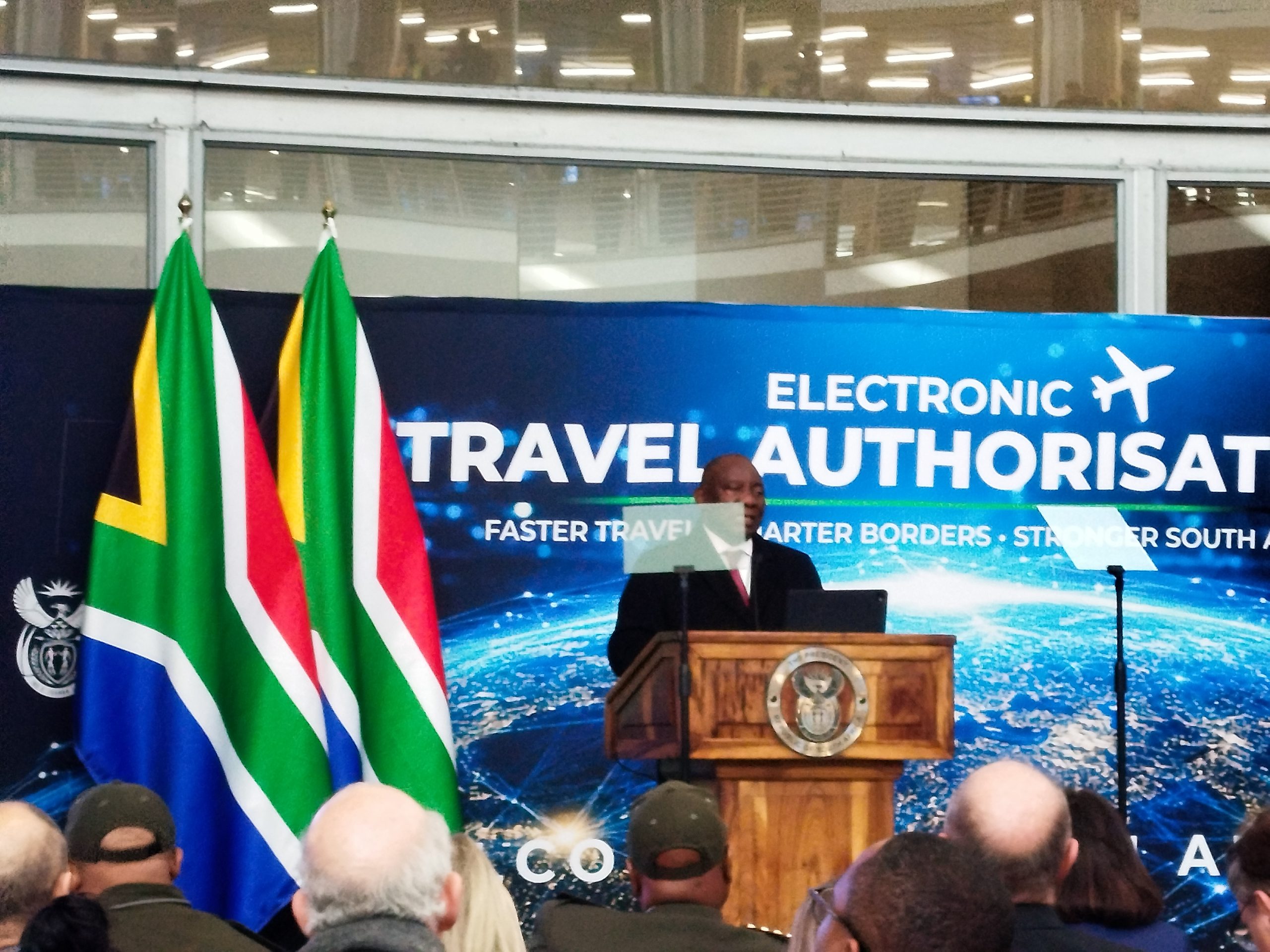
JOHANNESBURG, 12 August 2026 — President Cyril Ramaphosa has officially launched South Africa’s Electronic Travel Authorisation (ETA) system, describing the digital immigration reform as a key intervention to make the country more accessible to legitimate travellers while strengthening border security and supporting tourism, investment and job creation.
Speaking at OR Tambo International Airport on Wednesday, Ramaphosa said the way a country manages its borders increasingly influences its ability to compete for tourists, investors, international conferences, students and skilled professionals.
“Every nation is known by the way it welcomes the world,” the President said, arguing that a visitor’s first impression of South Africa often begins at the border rather than at a hotel, tourist attraction or conference venue.
The ETA will enable eligible travellers to apply online without having to visit a South African diplomatic mission or visa processing centre. According to Ramaphosa, the system is intended to make applications faster and decisions more predictable while improving the overall experience of travelling to South Africa.
The system was initially introduced for travellers from China, India, Indonesia and Mexico as part of preparations for South Africa’s G20 Presidency and will now be expanded to additional countries.
Government ultimately intends to extend digital processing beyond visitor authorisations to work visas, study visas and other immigration services as part of the Department of Home Affairs’ broader Home Affairs @ Home digital transformation programme.
Visa reform positioned as economic reform
Ramaphosa placed the launch firmly within South Africa’s economic reform agenda, arguing that cumbersome immigration processes can carry a direct economic cost.
“Visa reform is therefore not simply an immigration reform. It is an economic reform. It is a jobs reform,” he said.
The President linked the initiative to the latest Quarterly Labour Force Survey released by Statistics South Africa on Tuesday, saying the country’s unemployment crisis, particularly among young people, meant reforms had to be judged by their ability to expand economic opportunity.
He argued that increasing international arrivals could stimulate activity throughout the tourism and broader services economy through increased demand for accommodation, restaurants, aviation, tour operators, conferences and related businesses.
The ETA also forms part of the government’s wider structural reform programme under Operation Vulindlela, established in 2020 to address constraints holding back economic growth.
Ramaphosa said immigration reform should be viewed alongside changes being implemented in electricity, telecommunications, freight rail, ports and water infrastructure.
“These are not isolated reforms,” he said. “Together they are removing barriers to growth, investment and job creation.”
Easier entry, stronger security
While emphasising greater accessibility, Ramaphosa rejected the suggestion that simplifying lawful entry into South Africa would weaken immigration controls.
“A modern immigration system is not a weaker immigration system. It is a smarter immigration system,” he said.
The ETA incorporates digital processing and biometric verification designed to allow authorities to assess travellers before they arrive in the country.
According to the President, technology should enable stronger identity management, risk assessment and border security while allowing legitimate travellers to move through the immigration system more efficiently.
The reform comes amid continuing public concern over illegal immigration, border management and enforcement of immigration and labour laws.
Ramaphosa said the ETA therefore sought to reconcile two objectives that are sometimes presented as competing priorities: economic openness and national security.
The system forms part of government’s Comprehensive Approach to Migration Management and is aligned with broader reforms contemplated under the Revised White Paper on Citizenship, Immigration and Refugee Protection.
Borders as economic infrastructure
Ramaphosa also called for greater coordination between government institutions and the private sector, saying modern borders should not be regarded simply as immigration checkpoints.
“Our borders are not merely points of entry. They are strategic national assets,” he said.
The President said border management sits at the intersection of security, tourism, trade, logistics and economic development, requiring cooperation between Home Affairs, the Border Management Authority, the South African Revenue Service, tourism authorities, diplomatic missions, the aviation industry and technology partners.
Launching the system at OR Tambo International Airport was also symbolic, Ramaphosa said.
He recalled how Oliver Reginald Tambo travelled internationally during the struggle against apartheid to mobilise support for South Africa’s liberation.
“He took South Africa to the world,” Ramaphosa said. “Today, through this new system, we are strengthening the way in which the world comes to South Africa.”
The President said the ETA should ultimately be judged not merely as another government technology project, but by whether it makes South Africa more competitive, improves the performance of public institutions and contributes to economic growth.
He said the launch represented another step towards building a state capable of simultaneously protecting its borders and opening the country to legitimate tourism, skills, trade and investment.
“Let the launch of the Electronic Travel Authorisation be remembered not simply as the introduction of a new digital system, but as another important milestone in South Africa’s journey towards becoming a modern, capable and competitive state,” Ramaphosa said.