





Legal Literacy
Five Years Later: The Zuma Contempt Case and the Price of Legal Illiteracy

Published
2 months agoon
By Tinashe T. T. Mpasiri | 8 August 2026
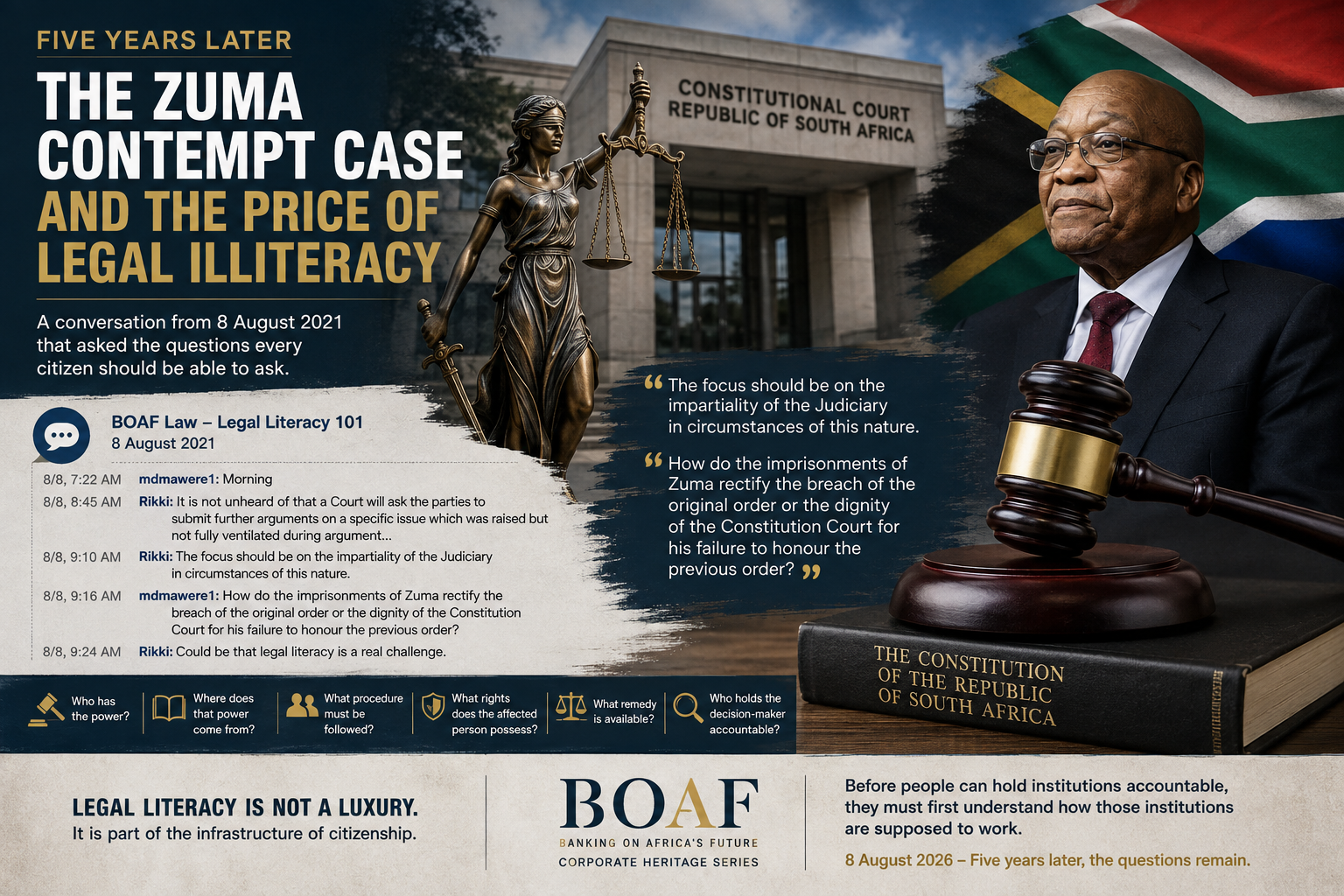
On 8 August 2021, I shared a conversation on Facebook under the banner BOAF Law — Legal Literacy 101.
South Africa was still wrestling with the extraordinary imprisonment of former President Jacob Zuma following contempt proceedings before the Constitutional Court.
The politics surrounding Zuma were overwhelming.
But beneath the personalities, political loyalties and public anger sat a much more important question, Do ordinary citizens understand how the institutions exercising power over them actually work?
Five years later, that question deserves another hearing.
Not because Jacob Zuma should be above the law.
Precisely the opposite.
Because if the rule of law means anything, its greatest test comes when the person before the law is unpopular, politically powerful or deeply controversial.
The law cannot depend upon who is standing before it.
A Conversation About More Than Zuma
The discussion I shared that morning began with questions about the Constitutional Court, international law and the International Covenant on Civil and Political Rights.
But it soon moved somewhere more fundamental.
What exactly was the nature of the contempt before the Court?
Was the process civil, criminal or something occupying the territory between the two?
What rights attached to the person facing imprisonment?
What was the appropriate remedy?
And perhaps most importantly, how should judicial authority be exercised when the dignity and authority of the court itself are implicated?
One participant put the concern starkly,
“The focus should be on the impartiality of the Judiciary in circumstances of this nature.”
Whether one agreed with every legal proposition advanced in that discussion was almost secondary to what the conversation represented.
Citizens were interrogating institutional power.
That is legal literacy.
Contempt Is Not a Small Matter
Courts cannot function if their orders can simply be ignored.
A constitutional democracy therefore requires mechanisms capable of compelling obedience to lawful court orders.
The 2021 discussion recognised this. It acknowledged the inherent authority of courts to regulate their proceedings and ensure that their orders are capable of being enforced.
But the conversation then raised the harder question.
What is contempt actually trying to achieve?
If contempt proceedings are intended to secure compliance with an order, what happens when the sanction imposed no longer makes compliance with that original order possible or necessary?
That question was captured powerfully in the thread,
“How do the imprisonments of Zuma rectify the breach of the original order or the dignity of the Constitution Court for his failure to honour the previous order?”
That is not merely a Zuma question.
It is a question about institutional design.
Every institution entrusted with coercive power requires rules governing not only whether that power may be exercised, but how, why and within what limits.
The Difference Between Authority and Accountability
One of the great misunderstandings of constitutional democracy is the assumption that defending judicial independence requires citizens never to question judges.
It requires almost the opposite.
Judicial independence protects courts from improper interference so that judges can decide cases according to law.
Judicial accountability asks whether that enormous authority is itself exercised according to law.
The two principles are not enemies.
They depend upon each other.
A legislature must operate within constitutional limits.
An executive must operate within constitutional limits.
And a judiciary must operate within constitutional limits.
That is the architecture of constitutional government.
The rule of law does not mean that courts rule.
It means that law rules, including over those entrusted with interpreting it.
The Most Important Person in the Case Was Not Zuma
This is where the lesson becomes bigger than the personalities involved.
Imagine removing Jacob Zuma’s name from the case.
Replace him with an ordinary citizen.
Someone without political influence.
Someone without expensive lawyers.
Someone whose imprisonment would never become international news.
Would we still care about the procedure used before that person’s liberty was taken away?
We should.
Rights acquire their meaning precisely because they belong to people irrespective of identity, status or popularity.
A constitutional safeguard that protects only people society likes is not much of a safeguard.
And a principle that suddenly becomes inconvenient when applied to someone we dislike was probably never a principle in the first place.
Why Legal Literacy Matters
At 9:24 that morning in 2021, the conversation ended with a deceptively simple observation,
“Could be that legal literacy is a real challenge.”
Five years later, I think that sentence was the most important contribution in the entire thread.
A society cannot meaningfully defend institutions it does not understand.
Nor can citizens effectively hold institutions accountable when they do not understand the source, scope and limits of institutional power.
Legal literacy does not mean everyone must become a lawyer.
It means understanding enough to ask elementary questions.
Who has the power?
Where does that power come from?
What procedure must be followed?
What rights does the affected person possess?
What remedy is available?
Who holds the decision-maker accountable?
These questions apply far beyond criminal courts.
They apply to companies, boards, regulators, municipalities, government departments, universities, banks, traditional institutions and virtually every organised structure through which human beings exercise authority over others.
Institutions Do Not Act in the Abstract
This is particularly important to the philosophy underpinning Banking On Africa’s Future.
We often speak as though institutions possess minds of their own.
“The government decided.”
“The company refused.”
“The court ordered.”
“The bank declined.”
But behind every institution are human beings exercising powers created by rules.
Someone makes the decision.
Someone possesses authority.
Someone has a duty.
Someone must account for how that authority was exercised.
Understanding structure therefore becomes indispensable to understanding power.
Who is who?
And understanding order becomes equally important.
Who does what?
Without those two pieces of literacy, institutional power can appear mysterious, almost supernatural.
It isn’t.
Institutions are human architecture.
Rule of Law Is Bigger Than Winning
The enduring lesson of the Zuma episode should therefore not be reduced to whether one supported or opposed Jacob Zuma.
That would waste an extraordinary opportunity for institutional learning.
The more important question is what the episode taught citizens about constitutional power.
Democracy cannot simply mean elections.
It requires institutions.
Institutions require rules.
Rules require people capable of administering them.
And those people must themselves remain subject to the framework from which their authority originates.
That is why legal literacy is not an academic luxury.
It is part of the infrastructure of citizenship.
Five years ago, a Facebook conversation about one controversial former president ended with a concern about whether South Africans understood their legal system.
Today, the question is even larger.
If citizens do not understand the institutions exercising power in their name, how can they distinguish lawful authority from the mere exercise of power?
And if they cannot make that distinction, how can they defend the rule of law when it matters?
Perhaps that is the unfinished lesson of 8 August 2021.
Before people can hold institutions accountable, they must first understand how those institutions are supposed to work.
Over the years, I have found it challenging to define myself solely by an academic qualification, trade, or occupation. My eagerness to learn, especially about how to build and deploy capital, has allowed me to accumulate diverse experiences in a short span of time. Through this journey, I have discovered that at my core, I am a storyteller. I tell the stories of corporations, their heritage, and the individuals who act in their name. I explore the role of these institutions in fulfilling the promise of a better Africa, and, most importantly, the causal link between the rule of law and economic development. As a fellow believer in Africa’s potential, can I count on you to be a point of light in securing our continent’s future?



