







Opinion
Rule of Law as Capital: Africa’s Unfinished Equation of Prosperity

By Tinashe Mpasiri
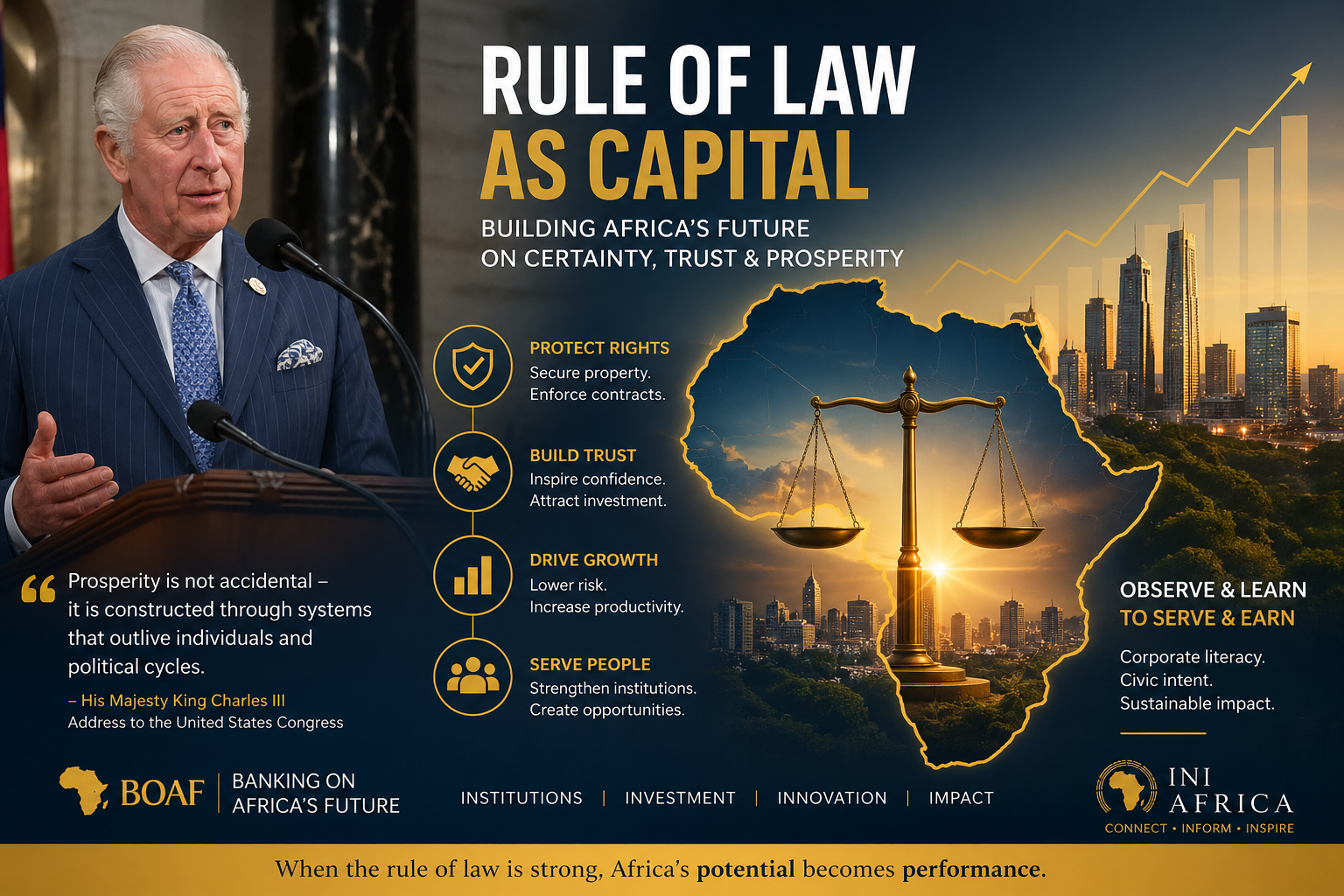
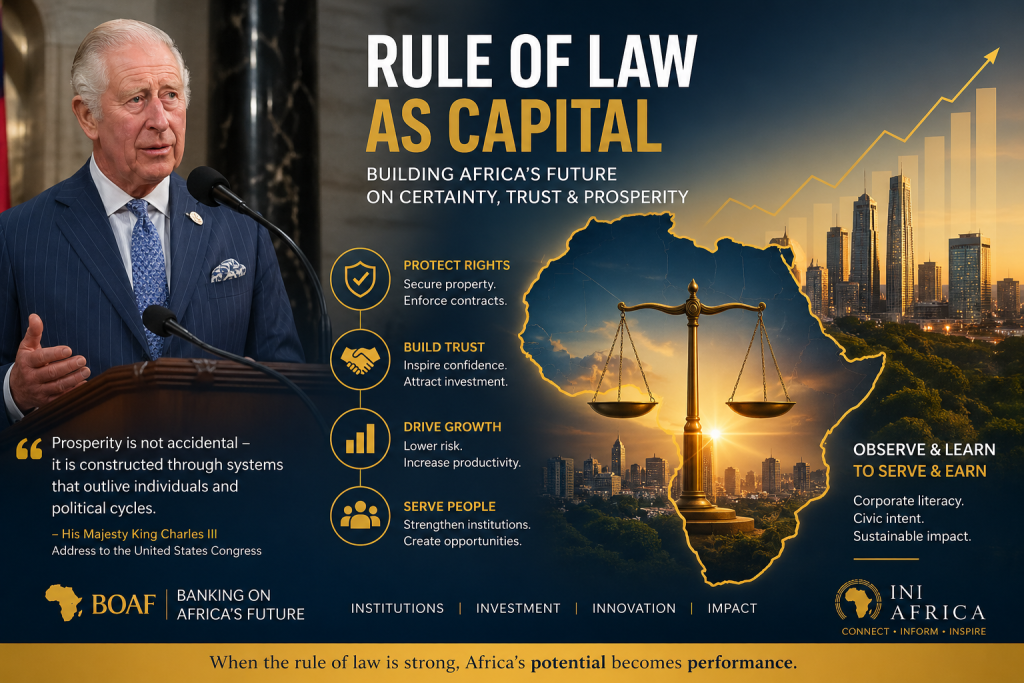
In a recent address before the United States Congress, King Charles III reaffirmed a principle often acknowledged but insufficiently operationalised: that the rule of law is not merely a moral aspiration, it is an economic instrument.
He pointed to a historical truth demonstrated by both the United Kingdom and the United States: that stable, predictable legal systems, anchored by independent judiciaries and accessible rules, have underwritten centuries of sustained economic growth.
This is not philosophy. It is infrastructure.
And for Africa, it is the missing multiplier.
From Principle to Productive Capacity
The rule of law is frequently framed in constitutional or political terms. Yet its most profound impact lies in its economic function.
It answers three fundamental questions that every investor, entrepreneur, and citizen asks:
• Can I trust the system to protect my assets?
• Will contracts be enforced impartially?
• Are the rules stable enough to plan for the future?
Where the answers are “yes,” capital flows. Where they are uncertain, capital hesitates, or exits.
BOAF positions this not as an abstract governance issue, but as a production input. Just as minerals, labour, and technology are inputs into economic output, so too is legal certainty.
Without it, growth is incidental. With it, growth is engineered.
Africa’s Paradox: Resource Wealth, Institutional Deficit
Africa holds approximately 30% of the world’s mineral reserves. It is central to the global energy transition. It is young, urbanising, and increasingly connected.
Yet, the continent continues to attract a disproportionately low share of global capital flows.
The constraint is not geological. It is institutional.
Inconsistent enforcement of contracts, regulatory unpredictability, and politicisation of institutions increase the risk premium attached to African economies. Investors price uncertainty, and Africa pays for it through higher costs of capital and missed opportunities.
This is the paradox BOAF seeks to resolve.
The BOAF Thesis: Rule of Law as a Catalyst for Capital Formation
Banking On Africa’s Future advances a simple but powerful proposition:
The rule of law is not a byproduct of development, it is a precondition for it.
This shifts the narrative from dependency to design.
Under this framework, strengthening the rule of law becomes synonymous with:
• Lowering the cost of capital
• Unlocking domestic savings into productive investment
• Enabling cross-border trade under frameworks like AfCFTA
• Building trust between state, market, and citizen
It is, in effect, the foundation upon which markets are built.
From Observation to Participation
Africa does not lack ideas. It lacks coordinated execution.
BOAF’s role is to bridge this gap by cultivating what can be described as corporate literacy with civic intent, a generation that understands not only how markets function, but how institutions sustain them.
This is where the principle of “Observe & Learn to Serve & Earn” becomes operational.
Observe: Study systems that have historically delivered prosperity
Learn: Extract transferable institutional lessons
Serve: Apply these lessons within African contexts
Earn: Generate value through sustainable, rule-based economic activity
This is not passive learning. It is active statecraft at the individual and institutional level.
Reframing the African Growth Story
Africa’s growth narrative must evolve from one of potential to one of predictability.
Natural resources can attract interest.
Demographics can generate momentum.
But only institutions can sustain growth.
The lesson embedded in King Charles III’s address is clear: prosperity is not accidental, it is constructed through systems that outlive individuals and political cycles.
Conclusion: The Discipline of Certainty
If Africa is to secure its economic future, it must treat the rule of law not as a constitutional ideal, but as a discipline, as one that is consistently applied, protected, and refined.
The continent does not need to reinvent the principles of prosperity. It needs to internalise and institutionalise them.
Banking On Africa’s Future is, at its core, a call to do precisely that.
Because in the final analysis:
Capital does not follow hope. It follows certainty.
And certainty is the currency of the rule of law.