


Agriculture
Ramaphosa Calls for Expanded Agricultural Financing as South Africa Moves to Release 2.5 Million Hectares to Black Farmers

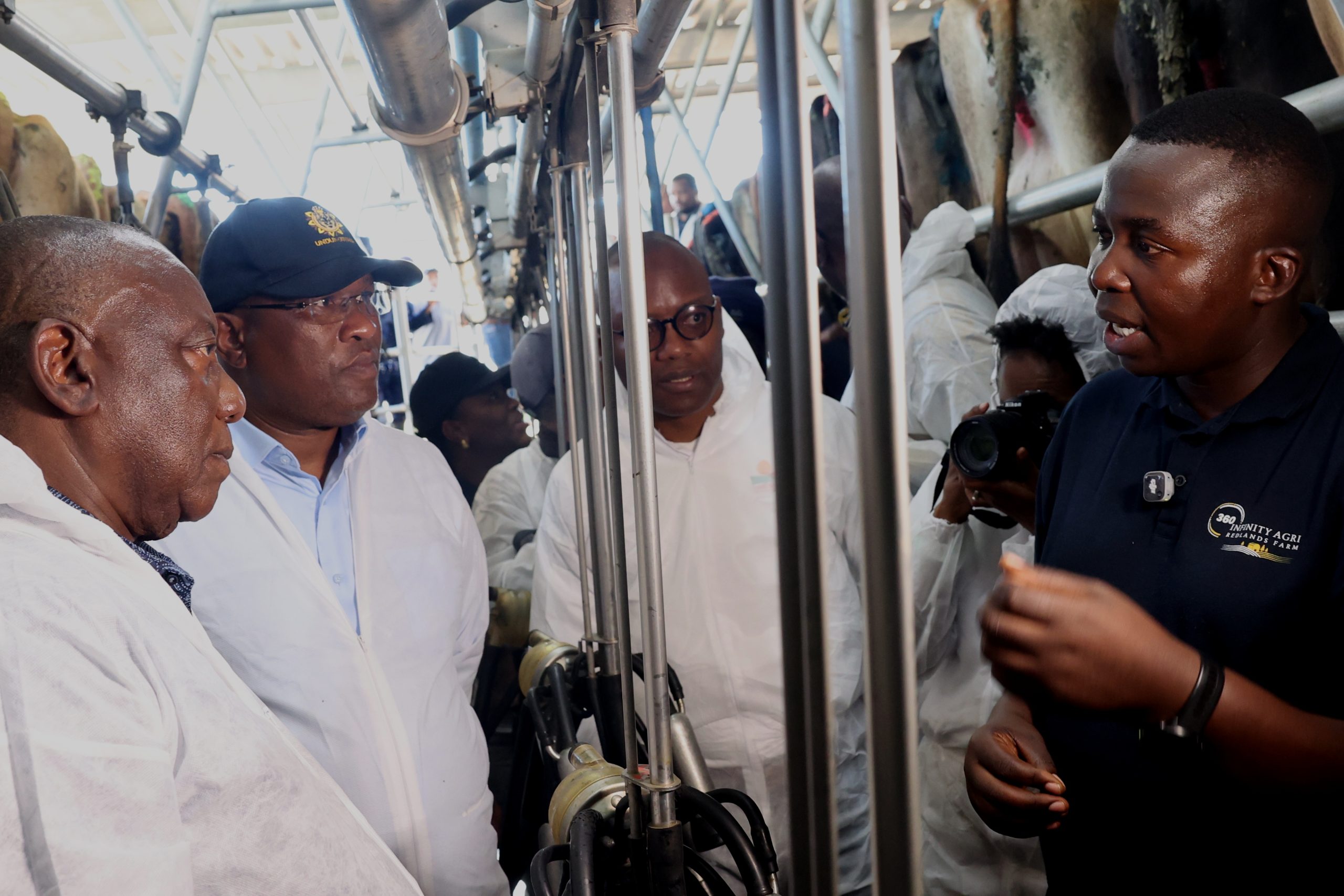
President Cyril Ramaphosa has called for expanded access to affordable agricultural finance, practical mentorship and stronger market linkages as government moves to transfer approximately 2.5 million hectares of state-acquired land to black farmers.
STUTTERHEIM, EASTERN CAPE, 8 October 2026 — President Cyril Ramaphosa says South Africa’s agricultural transformation programme must move beyond providing land to emerging farmers and focus on building commercially viable enterprises capable of competing in domestic and international markets.
Speaking during a visit to Redlands Dairy Farm in Stutterheim on Thursday, Ramaphosa identified access to finance, practical farming knowledge and effective partnerships as critical ingredients for transforming black-owned agricultural enterprises.
The President described Redlands, a black- and youth-owned commercial dairy operation led by Tshilidzi Matshidzula, as an example of what can be achieved when land ownership is accompanied by financial support, infrastructure, skills and entrepreneurship.
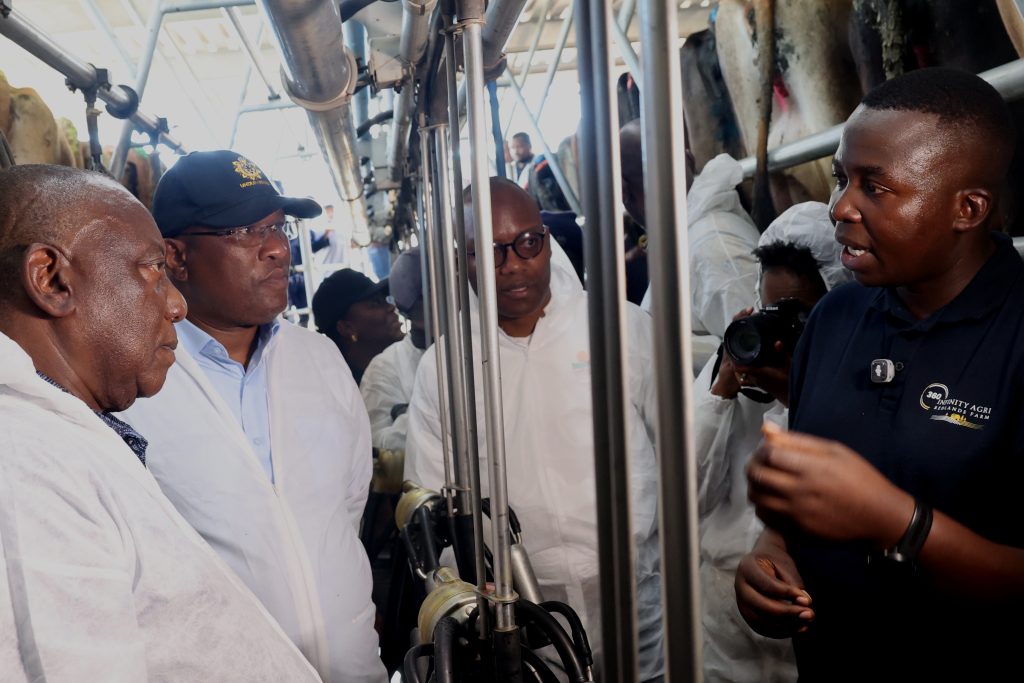
“The first lesson is that supporting an aspiring farmer with a dream requires more than simply providing access to land,” Ramaphosa said.
His remarks come as government advances plans to release approximately 2.5 million hectares of land acquired over the years, with the Department of Land Reform and Rural Development having begun transferring land to beneficiaries with title deeds.
The President acknowledged that several government land reform and redistribution projects had experienced difficulties, underscoring the need for a more comprehensive approach to agricultural development.
Land ownership must translate into productive capacity
Ramaphosa argued that farming differs from many other professions because commercial competence is developed substantially through practical experience.
He emphasised the importance of established commercial farmers mentoring emerging producers and transferring knowledge of production systems, animal health, technology, weather risks and farm management.
He cited mentorship programmes operated by Farmers for Africa, Grain SA and the Citrus Growers’ Association, alongside initiatives supported by banks, agribusinesses and government.
However, he said more such partnerships were needed to help emerging farmers overcome the barriers to commercial production.
The President warned that farmers without assets, collateral or an established production history frequently struggle to secure financing from commercial lenders.
This prevents them from purchasing equipment, improving infrastructure, acquiring livestock and expanding operations, even where their businesses have commercial potential.
Blended finance at the centre of agricultural transformation
Ramaphosa identified the Land Bank’s Blended Finance Scheme as an important instrument for bridging the financing gap between emerging and established commercial producers.
Introduced in 2022 as a ten-year agricultural transformation intervention, the programme combines government grants with loan funding to reduce financing costs while supporting commercially sustainable enterprises.
Redlands Dairy Farm has benefited from the scheme, receiving support covering farm acquisition, infrastructure, livestock, dairy equipment, mechanisation and working capital.
According to Ramaphosa, the strong demand for the programme demonstrates the need for a more sustainable financing model capable of reaching additional black producers.
He directed attention to the role of National Treasury, the Land Bank and relevant government departments in developing affordable long-term funding solutions.
The President acknowledged that the Land Bank’s reliance on borrowing at ordinary market rates constrains its capacity to provide affordable agricultural credit.
He said National Treasury would work on sustainable financing arrangements while government continued supporting the rebuilding of the development finance institution.
“The real power of blended finance is not simply the amount of grant funding government provides,” Ramaphosa said.
“It is the amount of productive investment that every rand of public funding can ultimately unlock.”
He stressed that public funding alone would not meet South Africa’s agricultural investment requirements and called for greater participation from commercial banks, financial markets, development partners and private investors.
Agricultural exports valued at R266 billion
Ramaphosa also highlighted the importance of expanding export opportunities, arguing that agricultural transformation would remain incomplete unless emerging commercial farmers could access established domestic and international markets.
According to figures he presented, South Africa exported approximately R266 billion worth of agricultural products in 2025, with about half of the country’s agricultural production destined for international markets.
He said African markets account for roughly half of South Africa’s agricultural export earnings, while the European Union, Asia, the Middle East and the Americas remain important trading destinations.
The President indicated that government was pursuing additional opportunities in China, other BRICS countries, the Middle East and Asia to expand market access for South African agricultural products.
He stressed that new market opportunities must be supported by improvements in productivity, competitiveness and sustainability.
The President also called on the private sector to open agricultural value chains to emerging producers, enabling them to participate beyond primary production in processing, distribution and other commercially valuable activities.
Animal health and seed production require greater investment
The President identified animal and plant health as essential components of a competitive agricultural economy.
Referring to the recent foot-and-mouth disease outbreak, Ramaphosa said government had made progress in controlling its spread and was strengthening vaccine procurement and domestic production capabilities.
He disclosed that the Department of Agriculture had recently briefed him on vaccine procurement and initiatives involving private-sector participation in local vaccine manufacturing.
Ramaphosa also called for greater investment in plant health and seed breeding, arguing that an efficient seed industry was fundamental to agricultural productivity.
Agriculture employs 1.3 million across the value chain
Ramaphosa said the value of South Africa’s agricultural economy had more than doubled since 1994, with agriculture and related value chains now employing approximately 1.3 million people.
He argued that expanding commercial agricultural activity would generate opportunities beyond farming through increased demand for transport, logistics, machinery, processing, manufacturing and other services.
The Eastern Cape, he said, has substantial agricultural potential that could be harnessed to address unemployment and poverty.
However, he acknowledged continuing structural inequalities between established commercial agriculture and underdeveloped farming communities, particularly in the province’s northern regions.
He described the challenge as one of overcoming a country with “two agricultures”, where parts of the sector advance while others remain excluded from meaningful economic development.
The President argued that integrating emerging producers into agricultural value chains would require coordinated investment in finance, skills, technology, infrastructure and markets.
Government urged to replicate Redlands model
Concluding his address, Ramaphosa called for greater cooperation between government, organised agriculture, financial institutions, agribusinesses and development partners to replicate commercially successful farming enterprises such as Redlands.
He said government had a responsibility to create an enabling environment, while financial institutions needed to mobilise investment and private companies needed to facilitate access to markets.
“We need many more Redlands across South Africa. We must take what works and scale it up,” he said.
The President congratulated Matshidzula, his family and the Redlands team, recognising their contribution to demonstrating how coordinated financial and technical support can strengthen emerging commercial farming enterprises.
His address placed agricultural transformation within a broader economic development agenda, linking land redistribution to productive investment, enterprise development, employment creation and international trade.
The central policy challenge emerging from the visit is whether government and its financing partners can replicate this integrated support model at sufficient scale to accommodate the growing number of farmers expected to receive land.
With approximately 2.5 million hectares earmarked for release, the effectiveness of the programme will depend not only on transferring title deeds but also on whether beneficiaries can secure the capital, skills and market access needed to establish sustainable agricultural businesses.



You must be logged in to post a comment Login