



Agriculture
When Minds Meet: Ten Years After My Conversation with Nhlanhla Nene

Published
2 months agoon
By Tinashe T. T. Mpasiri | 18 August 2026
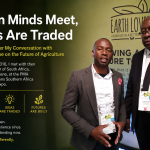
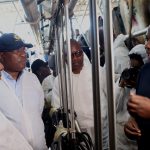
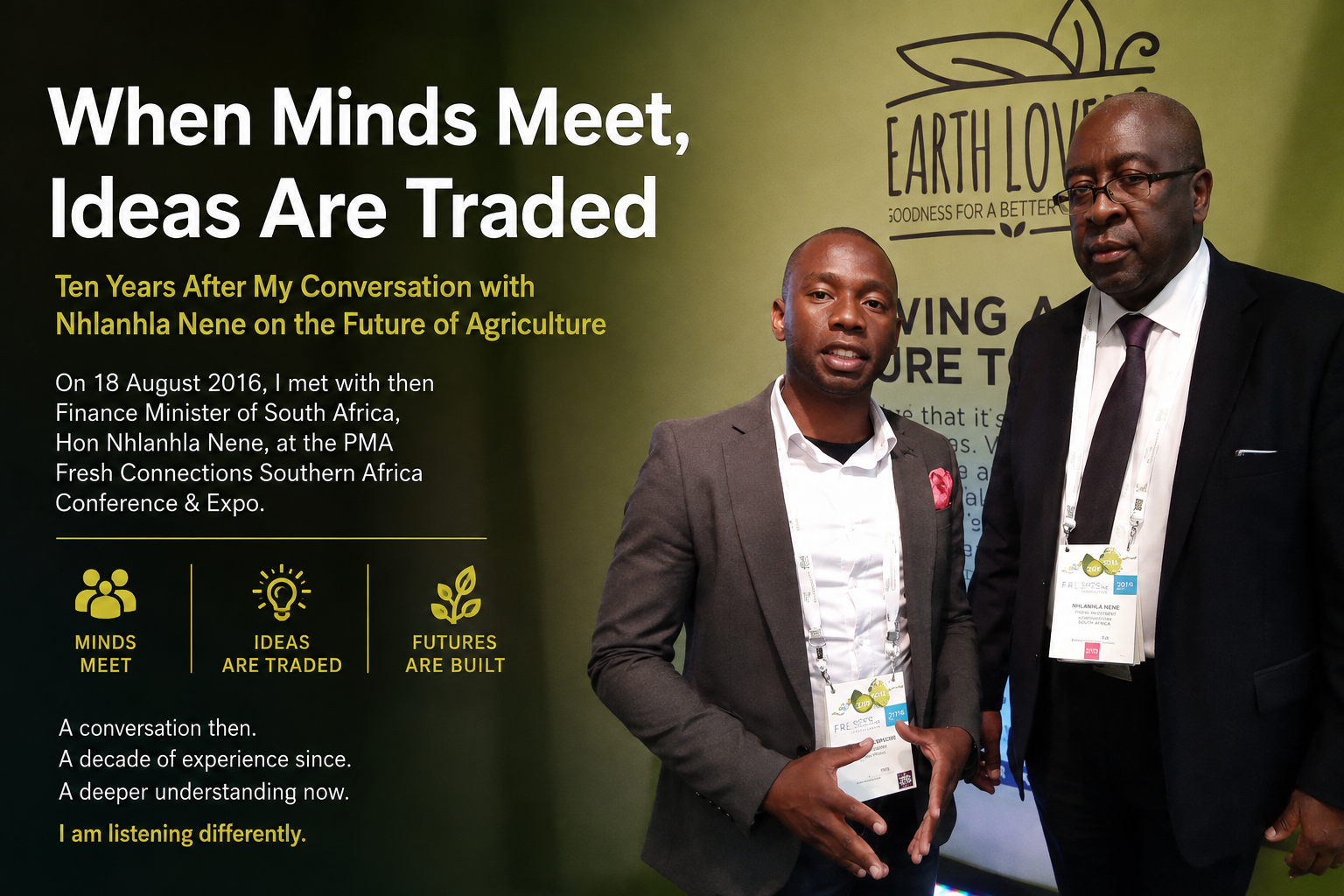
On 18 August 2016, I shared a conversation I had recorded with South Africa’s former Minister of Finance, Nhlanhla Nene, at the PMA Fresh Connections Southern Africa Conference and Expo at the CSIR International Convention Centre in Pretoria.
The caption accompanying the post read:
“When minds meet, ideas are traded. With Hon Nhlanhla Nene at PMA Fresh Connections Southern Africa Conference & Expo.”
Five years later, in 2021, I revisited the memory with another question:
“Whom can you bank on securing Africa’s future in the fresh produce value chain?”
Today, 18 August 2026, exactly ten years after the original post, I return to that conversation once again.
The recording has not changed.
Nene’s answers have not changed.
But I have.
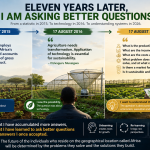
Ten years of experience, observation, unlearning, relearning and learning have changed how I hear his answers — and, perhaps more importantly, how I hear my own questions.
Reading My Own Questions Ten Years Later
Southern Africa had experienced a difficult agricultural season in 2016, with drought placing pressure on agricultural production and food security.
I asked Nene what lessons farmers and government could draw from that experience.
His response went beyond drought.
He spoke about efficient farming methods, technology, skills, experienced farmers and new markets.
Listening today, I hear something I did not fully appreciate then.
He was describing an agricultural system.
Behind every harvest sits a network of economic activity: seed is developed and supplied; irrigation systems are engineered and manufactured; technology is designed and deployed; capital is mobilised; crops are cultivated; produce is aggregated, transported, processed, packaged and distributed before ultimately reaching a buyer.
Each stage requires knowledge, enterprise, capital and human action. Remove enough of those capabilities and the value chain begins to fail.
Agriculture therefore cannot be reduced to putting seed into soil.
It is an enterprise system.
From Participation to Capability
Some of my own questions also sound different to me today.
I repeatedly asked Nene how black farmers could be educated and equipped to participate more meaningfully in commercial agriculture.
The historical basis for the question was legitimate. South Africa’s economic history deliberately restricted access to land, capital, education and markets according to race.
But ten years later, I would formulate the economic question differently.
I would ask:
What capabilities must an individual possess, acquire or access to build a competitive agricultural enterprise?
That does not erase history.
It asks what must happen next.
Participation and productive capability are not synonymous.
An individual may enter agriculture without possessing the technical knowledge, working capital, infrastructure, technology, management systems or market relationships necessary to compete.
The objective therefore cannot end at participation.
It must extend to capability.
What Happens After Land Changes Hands?
This distinction became particularly important when our conversation turned to land reform.
I referred to Zimbabwe’s experience and asked how South Africa could pursue land reform without damaging agricultural production.
Nene argued that reform should be accompanied by proper skills and support so that farms that were commercially viable before transfer remained commercially viable afterwards.
Ten years later, I find the emphasis on “afterwards” particularly important.
Land transfer can be measured relatively easily.
Productive transformation is harder.
It requires asking what happened after the transaction.
Did production continue?
Did yields improve?
Did revenue grow?
Were existing jobs preserved and new ones created?
Was additional capital invested?
Were new markets reached?
Could the enterprise withstand drought, changing input costs and commodity-price volatility?
An agricultural enterprise is an assembled productive system. Land is one component of that system alongside capital, infrastructure, management, agronomic knowledge, technology, employees, logistics, suppliers and markets.
Transformation should therefore be evaluated not only by the transfer of assets, but by the productive capability created after transfer.
The success of reform ultimately has to be visible in what the asset becomes capable of producing.
Knowledge Must Be Allowed to Travel
Nene also emphasised partnerships between emerging farmers and established commercial farmers, many of whom were white.
His argument was straightforward: people entering commercial agriculture could learn from people who had spent considerably longer operating within it.
Ten years later, I think there is a broader economic principle contained in that answer.
Productive knowledge must be allowed to travel.
A person who has farmed commercially for thirty or forty years possesses knowledge that cannot always be captured in a manual.
There is knowledge accumulated through drought.
Through failed harvests.
Through changing markets.
Through managing employees.
Through negotiating with retailers.
Through disease outbreaks.
Through investments that worked, and investments that did not.
Experience is accumulated intellectual capital.
Correcting historical exclusion should therefore not require discarding productive knowledge accumulated during that history.
The challenge is to broaden access to both productive assets and productive knowledge.
Mentorships, apprenticeships, commercial partnerships and joint ventures should consequently not be regarded merely as gestures of goodwill.
Properly structured, they are mechanisms for transferring productive capability.
Production Is Only Half the Question
Another part of Nene’s 2016 response has grown more important with time.
He spoke about finding new markets.
Agricultural discussions frequently concentrate on production: hectares planted, yields achieved, livestock numbers, irrigation capacity and inputs.
But producing more does not automatically mean creating more economic value.
The commercial interrogation must begin earlier.
Who is the customer?
What does that customer require?
At what quality and specification?
In what volume?
At what price?
How frequently?
What standards must be met?
How will the product reach the customer?
What does the logistics chain cost?
And after every participant in that chain has been paid, what margin remains?
Those questions change the planting decision itself.
The market is no longer something to search for after harvest.
It becomes part of the original enterprise design.
That distinction is essential if agriculture is to become increasingly investable, scalable and aspirational.
Technology Was Already Knocking
In 2016, Nene also spoke about taking advantage of new technologies.
A decade later, that proposition has become even more significant.
Controlled-environment agriculture, precision irrigation, sensors, drones, satellite imagery, automation, data analytics and artificial intelligence are expanding the possibilities available to agricultural enterprises.
Technology changes the question from merely:
How much land is available?
to:
How intelligently can the available resources be converted into productive output?
The competitive agricultural enterprise of the future may not necessarily distinguish itself by possessing the greatest number of hectares.
Its advantage may lie in producing greater value from every hectare, litre of water, unit of energy, hour of labour and rand of capital deployed.
That is a fundamentally different way of thinking about agricultural productivity.
South Africa Must Also Know How to Learn
I also asked Nene what lessons the rest of Africa could draw from South Africa.
His response deserves remembering.
He believed South Africa was well positioned to lead in agriculture, but immediately added that the country needed to be humble enough to learn from other African countries that had performed better in particular areas.
There is considerable wisdom in that qualification.
The objective should not be to determine permanently who teaches and who learns.
It should be to identify where useful knowledge exists and how efficiently it can travel.
If an irrigation model works in one jurisdiction, others should be able to study it.
If an agricultural financing mechanism succeeds elsewhere, its architecture should be interrogated.
If producers develop methods of increasing yields while reducing water consumption, that knowledge should travel.
If an enterprise solves a market-access problem, others should be capable of learning from the solution.
Progress becomes unnecessarily expensive when every generation, enterprise or jurisdiction insists on independently rediscovering lessons for which others have already paid.
When Minds Meet, Ideas Are Traded
This brings me back to the words I wrote in 2016:
“When minds meet, ideas are traded.”
Ten years later, I find considerably more meaning in that sentence.
When minds meet, the exchange is not merely conversation.
Knowledge can move.
Experience can be shared.
Assumptions can be challenged.
Questions can reveal possibilities.
But the exchange itself is only the beginning.
An idea encountered today may acquire greater meaning after experience tests it tomorrow.
New knowledge may challenge it.
Failure may expose its weaknesses.
Success may validate part of it.
Reflection may reorganise it.
And years later, the same idea may reveal something that could not have been understood when it was first encountered.
That is intellectual compounding.
The conversation I had with Nhlanhla Nene in 2016 has therefore become more valuable to me with time.
Not because his answers have changed.
Because my capacity to interrogate them has.
What Kind of Africa?
Towards the end of our conversation, I asked Nene what kind of Africa he wanted to see.
His answer was an Africa that was food secure and capable of becoming a food basket for the rest of the world.
A decade later, I remain interested in that ambition, but I now find myself more interested in the capabilities required to realise it.
Where will the knowledge come from?
How will it be transferred?
How will agricultural enterprises be capitalised?
Which technologies will increase productivity?
Which markets will absorb production?
How will commercially viable enterprises survive beyond their founders?
How will lessons from failure become institutional knowledge rather than disappearing with the people who experienced them?
And how do individuals entering agriculture today avoid paying again for lessons previous generations have already purchased through experience?
Those questions move the conversation from aspiration towards productive capability.
I Am Listening Differently
Ten years ago, I thought part of the significance of that afternoon was that I had interviewed a former Minister of Finance.
Today, I understand its value differently.
Nhlanhla Nene gave me answers.
Time gave me the opportunity to interrogate them.
Some have survived the decade remarkably well.
Others have become more important.
And some of my own questions no longer survive my present understanding.
Perhaps that is what learning looks like.
The mind should not merely accumulate information.
It should remain capable of revisiting what it once believed, testing it against experience and changing when a better understanding emerges.
In 2016, two minds met and ideas were traded.
Ten years later, some of those ideas are still producing intellectual returns.
I am no longer merely listening to the interview.
I am listening differently.
#CorporateHeritage #CorporateLiteracy #TheAfricaIWant #BOAF
Over the years, I have found it challenging to define myself solely by an academic qualification, trade, or occupation. My eagerness to learn, especially about how to build and deploy capital, has allowed me to accumulate diverse experiences in a short span of time. Through this journey, I have discovered that at my core, I am a storyteller. I tell the stories of corporations, their heritage, and the individuals who act in their name. I explore the role of these institutions in fulfilling the promise of a better Africa, and, most importantly, the causal link between the rule of law and economic development. As a fellow believer in Africa’s potential, can I count on you to be a point of light in securing our continent’s future?



