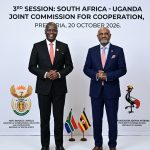
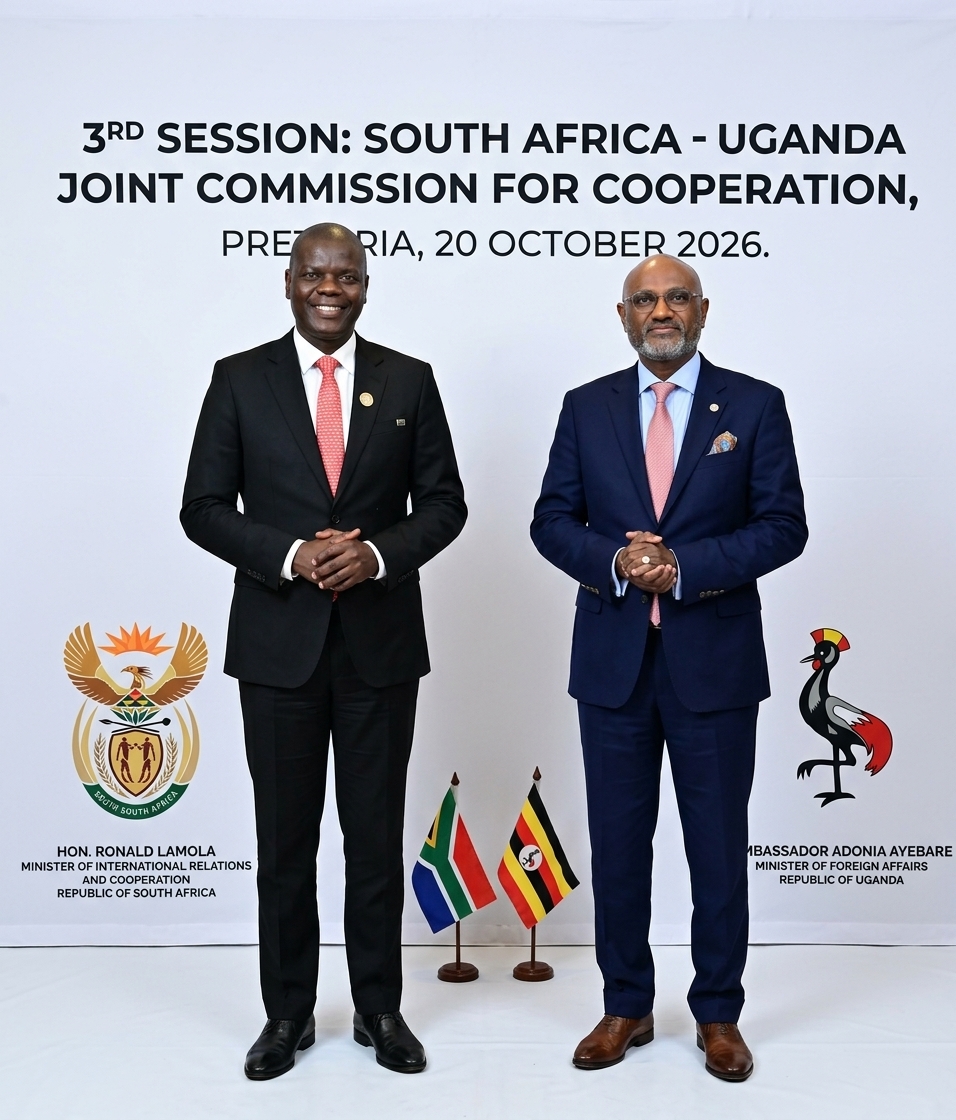
South Africa and Uganda are set to deepen bilateral cooperation across key economic, security and development sectors when their foreign affairs ministers co-chair the third session of the South Africa–Uganda Joint Commission for Cooperation (JCC) in Pretoria on Tuesday, 20 October 2026.
South Africa’s Minister of International Relations and Cooperation, Ronald Lamola, will co-chair the session alongside Uganda’s Minister of Foreign Affairs, Ambassador Adonia Ayebare.
The meeting is expected to provide a platform for the two countries to consolidate existing relations and explore opportunities for expanded cooperation across a broad range of sectors, including trade and investment, agriculture, defence and security, education, health, tourism, transport and infrastructure development.
Science and technology, political and diplomatic relations, and social development will also feature among the areas of bilateral engagement.
The discussions come against the backdrop of broader continental efforts to strengthen economic integration, expand intra-African trade and promote cooperation in addressing shared development challenges.
For both countries, the JCC provides an institutional framework through which bilateral priorities can be discussed, areas of mutual interest identified and cooperation advanced across government and economic sectors.
Continental integration and regional security on the agenda
Beyond bilateral relations, the third session will provide an opportunity for South Africa and Uganda to exchange views on regional, continental and international developments of mutual concern.
The agenda includes peace and security in Africa, implementation of the African Union’s Agenda 2063, the African Continental Free Trade Area (AfCFTA), African Union institutional reform processes and cooperation within multilateral organisations.
Agenda 2063 provides the African Union’s long-term framework for continental transformation, while the AfCFTA seeks to expand trade among African countries by reducing barriers to the movement of goods and services and supporting the development of integrated regional markets.
Cooperation between South Africa and Uganda in these areas is relevant to wider continental efforts to translate political commitments into practical economic opportunities, including stronger commercial relationships, investment flows and cross-border value chains.
Trade and investment remain central to bilateral engagement
The inclusion of trade and investment, agriculture, transport and infrastructure development on the JCC agenda places economic cooperation among the key areas for discussion.
Both countries have opportunities to explore areas of complementarity across their productive sectors, strengthen commercial links and identify practical avenues for businesses to participate in bilateral economic activity.
Agriculture, in particular, is an important area of potential cooperation, alongside science and technology, tourism and infrastructure development. Progress in these sectors could support knowledge exchange, productive investment and the development of commercial partnerships.
However, translating bilateral engagement into measurable economic outcomes will depend on the implementation of agreed priorities, the participation of businesses and investors, and the removal of barriers that constrain trade and investment.
The third session of the South Africa–Uganda Joint Commission for Cooperation therefore represents an opportunity to consolidate diplomatic engagement while advancing discussions on the practical requirements for deeper economic relations.
The meeting is scheduled to take place in Pretoria on 20 October 2026. The outcomes of the session will be important in determining the next steps in the two countries’ bilateral cooperation.







You must be logged in to post a comment Login