








Opinion
Money Does Not Solve Problems. Problem Solving Produces Money.

By Tinashe T. T. Mpasiri | 16 July 2026
One of the most persistent assumptions in business and economic development is that money is the primary solution to society’s challenges. Entrepreneurs often say they need more capital. Governments seek larger budgets. Communities call for greater financial assistance. The underlying belief is simple, if only there were more money, the problems would disappear.
Yet I have come to a different conclusion.
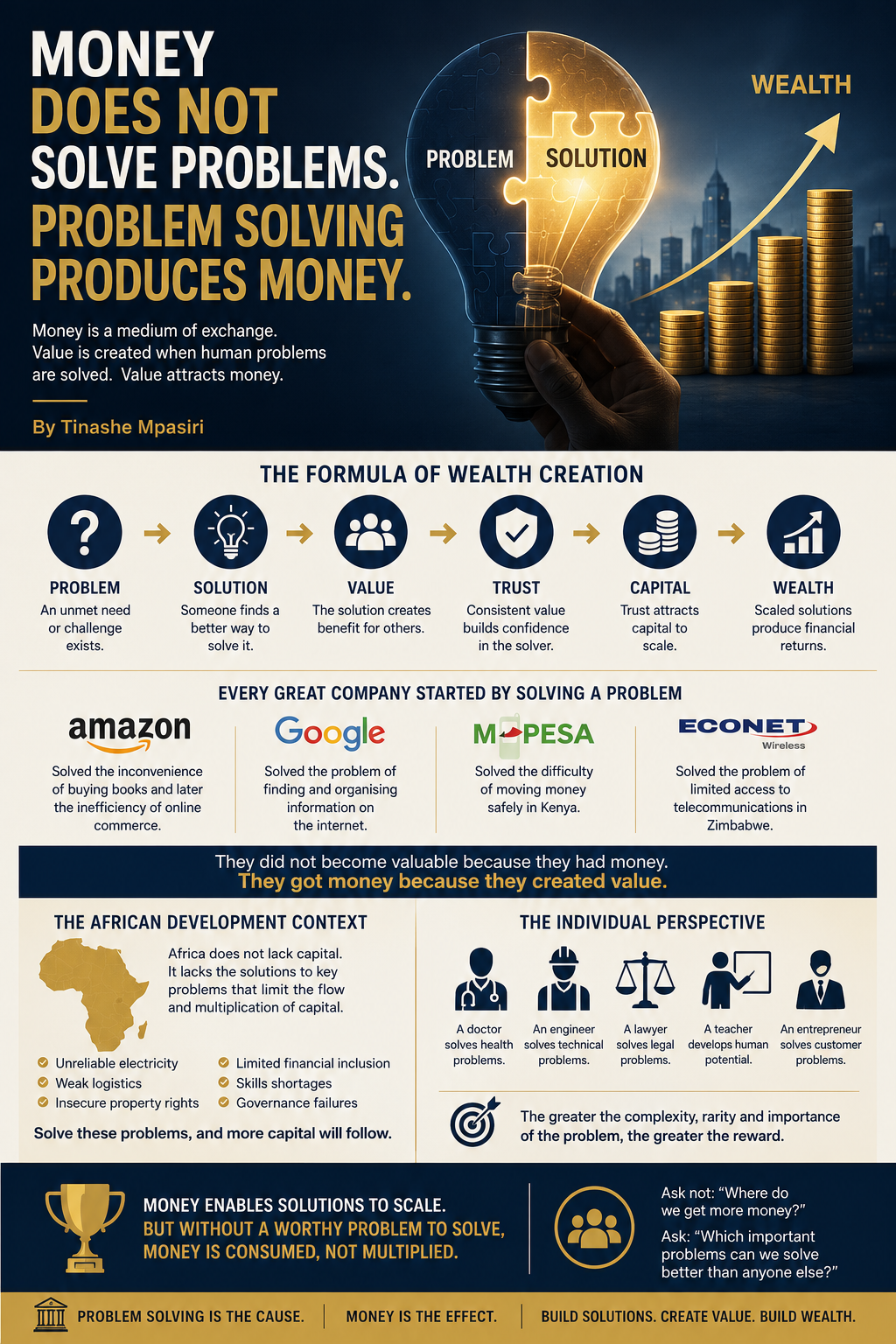
Money does not solve problems. Problem solving produces money.
At first glance, the statement appears controversial. But history, economics, and the evolution of great institutions suggest otherwise.
Money, by itself, creates nothing. It is neither wealth nor value. It is simply a medium of exchange, a mechanism through which society rewards those who create value for others. Problems, on the other hand, represent unmet human needs. Every unmet need presents an opportunity for innovation, service, and enterprise.
The journey to sustainable wealth therefore follows a different sequence:
Problem → Solution → Value → Trust → Capital → Wealth
This is the pattern that has shaped some of the world’s most influential companies. Amazon transformed commerce by making shopping more convenient. Google organised the world’s information. M-Pesa revolutionised financial inclusion by making mobile money accessible. Econet Wireless connected millions who had previously been excluded from modern telecommunications.
These companies did not become successful because they started with unlimited capital. Rather, they attracted capital because they demonstrated an ability to solve meaningful problems. Investors did not fund money; they funded solutions.
This principle also explains how capital markets operate. Banks lend to borrowers they believe can generate value. Venture capitalists back founders who can solve large problems. Shareholders invest in companies whose management can create future cash flows by serving customers better than their competitors. Capital follows confidence, and confidence is earned through competence in solving problems.
The lesson is equally important for Africa.
Across the continent, discussions about development often begin with the question of funding. Yet perhaps the more important question is, What problems are preventing Africa from attracting and multiplying capital?
Reliable electricity, efficient logistics, secure property rights, quality education, financial inclusion, transparent governance, and trusted institutions are not simply development goals—they are problems waiting to be solved. Every meaningful solution expands economic opportunity and attracts investment. Sustainable prosperity is built by increasing society’s capacity to solve problems, not merely by increasing the supply of money.
The same principle applies to individuals. Our income is often a reflection of the problems we are capable of solving. A doctor solves health problems. An engineer solves technical problems. A lawyer resolves legal disputes. A teacher develops human potential. An entrepreneur identifies unmet needs and builds solutions around them. As the complexity, rarity, and importance of the problem increase, society is generally willing to pay more for the solution.
This observation has become increasingly evident through the Banking On Africa’s Future – Corporate Heritage Series. Institutions that endure for generations are not those that merely accumulated capital. They are organisations that continually adapted to solve the evolving needs of society. When companies stop solving relevant problems, revenue declines, investor confidence weakens, capital leaves, and institutions eventually disappear.
None of this suggests that money is unimportant. Money enables ideas to scale. It finances research, builds factories, employs people, and expands markets. However, without a meaningful problem to solve, money is often consumed rather than multiplied. Capital cannot compensate for the absence of purpose or value creation.
Perhaps, then, the question entrepreneurs, policymakers, and business leaders should ask is not, “Where do we find more money?” Instead, we should ask, “Which important problems can we solve better than anyone else?”
When we answer that question effectively, money is no longer the objective. It becomes the consequence.
In the end, money is often the effect.
Problem solving is the cause.
And societies that cultivate problem solvers will always be better positioned to create wealth than societies that simply pursue money.
“I am because of the human problems I contribute to solving.”



