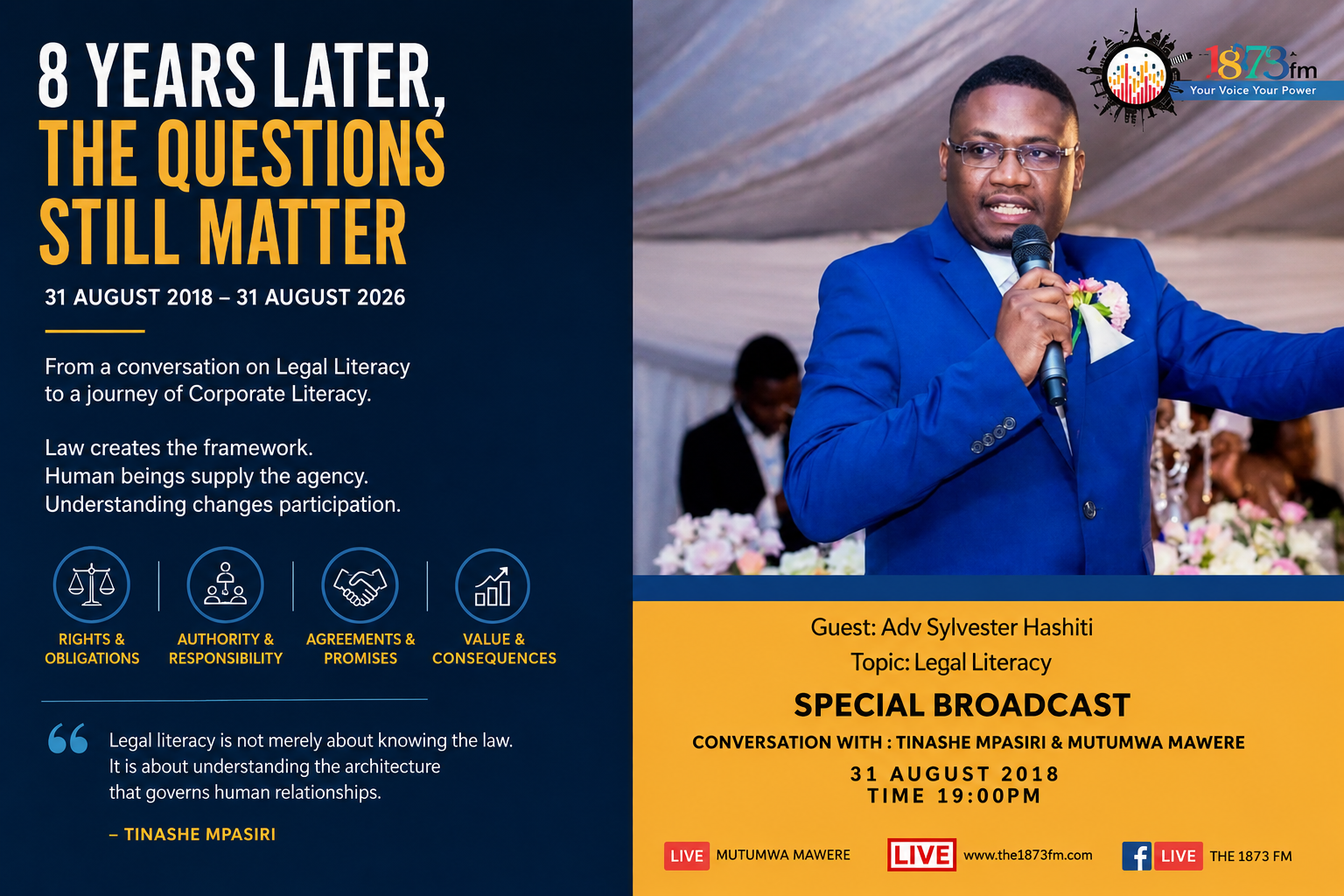
On 31 August 2018, I participated in a special broadcast on The 1873 platform alongside the late Mutumwa Mawere, with Advocate Sylvester Hashiti as our guest.
The subject was Legal Literacy.
Eight years later, Facebook returned the poster to me as a memory. What caught my attention was not simply the passage of time. It was the subject itself and how the questions that occupied my mind then have evolved.
What does it actually mean to be legally literate?
At its simplest, one might say it means understanding the law. I now think that answer is incomplete.
Legal literacy becomes useful when a person understands how law structures relationships, recognises rights and obligations, identifies where authority resides, appreciates the consequences of agreements and knows what remedies may become available when relationships break down.
The law is therefore not merely something encountered in a courtroom.
It is present when people establish companies, enter contracts, lend money, employ others, acquire property, appoint directors, issue shares, create trusts, form partnerships or undertake promises whose consequences extend beyond a handshake.
That 2018 conversation consequently appears different to me today.
It was part of an intellectual journey that eventually led me towards a deeper interest in corporate literacy.
The Company as a Legal Construct
One of the most important consequences of studying corporations is discovering how easily everyday language can obscure legal relationships.
Consider the statement: shareholders own the company.
It sounds obvious. It is repeated constantly. Yet legal literacy requires interrogation of what precisely is meant.
A shareholder holds shares carrying particular rights and obligations within the legal architecture of a company. The company, meanwhile, exists as a juristic person distinct from the human beings associated with it.
That distinction changes the questions that ought to be asked.
Who may act in the company’s name?
Where does decision-making authority originate?
What powers belong to directors?
What rights attach to shares?
What obligations arise from contracts entered into in the company’s name?
What happens when those exercising corporate authority exceed their powers or breach their duties?
These are not merely questions for lawyers. They are questions of economic participation.
Law Provides Architecture; Human Beings Supply Agency
My thinking has also developed around another distinction.
Law can constitute offices, recognise juristic persons, prescribe procedures, allocate rights, impose obligations and provide remedies.
But legal personality should not be confused with human agency.
A board resolution does not write itself.
A contract does not negotiate itself.
Capital does not decide where it should be deployed.
A company does not independently imagine an opportunity.
Behind these legal and institutional arrangements are human beings exercising judgment, possessing knowledge, making decisions and accepting consequences.
The corporation is therefore extraordinary not because it somehow replaces human beings, but because the legal construct enables human activity to be organised through a personality distinct from the individuals participating in it.
That distinction has increasingly shaped my understanding of enterprise.
Literacy Changes Participation
Why should any of this matter outside a law faculty?
Because participation without understanding can become expensive.
A person may hold shares without understanding the rights attached to them.
A director may accept an appointment without appreciating the duties attached to the office.
An entrepreneur may create enormous commercial value without securing contractual rights to participate in the value created.
Two people may believe that a handshake means the same thing to both of them, only to discover during a dispute that their respective expectations were never translated into enforceable obligations.
The problem in each instance is not necessarily the absence of intelligence.
It may be the absence of literacy concerning the architecture governing the relationship.
That is why legal and corporate literacy have practical economic consequences.
Eight Years Later
Looking at the poster from 31 August 2018, I see more than an old broadcast.
I see evidence of questions that have travelled with me.
At the time, the conversation was called Legal Literacy. Eight years of observing enterprises, transactions, boards, disputes, agreements, successes and disappointments have expanded the inquiry.
The question is no longer merely: What does the law say?
It is also:
What relationship has the law created? Who possesses which rights? Who carries which obligations? Where does authority reside? Who is actually acting? What economic interests are at stake?
Those questions matter because sophisticated economic participation requires more than access to capital.
It requires understanding.
A person who does not understand the legal architecture surrounding an economic relationship may participate in creating value while remaining poorly positioned to protect an interest in that value.
Perhaps that is the enduring significance of the conversation held eight years ago.
Legal literacy was never merely about knowing the law.
It was about learning to see the architecture beneath human relationships.
And corporate literacy, as I understand it today, is one continuation of that inquiry.
The archive preserves the moment. Reflection reveals what the moment eventually became.