







Corporate Heritage
11 July: African Anti-Corruption Day — Building the Institutions That Protect Africa’s Future

By Tinashe T. T. Mpasiri | 11 July 2026
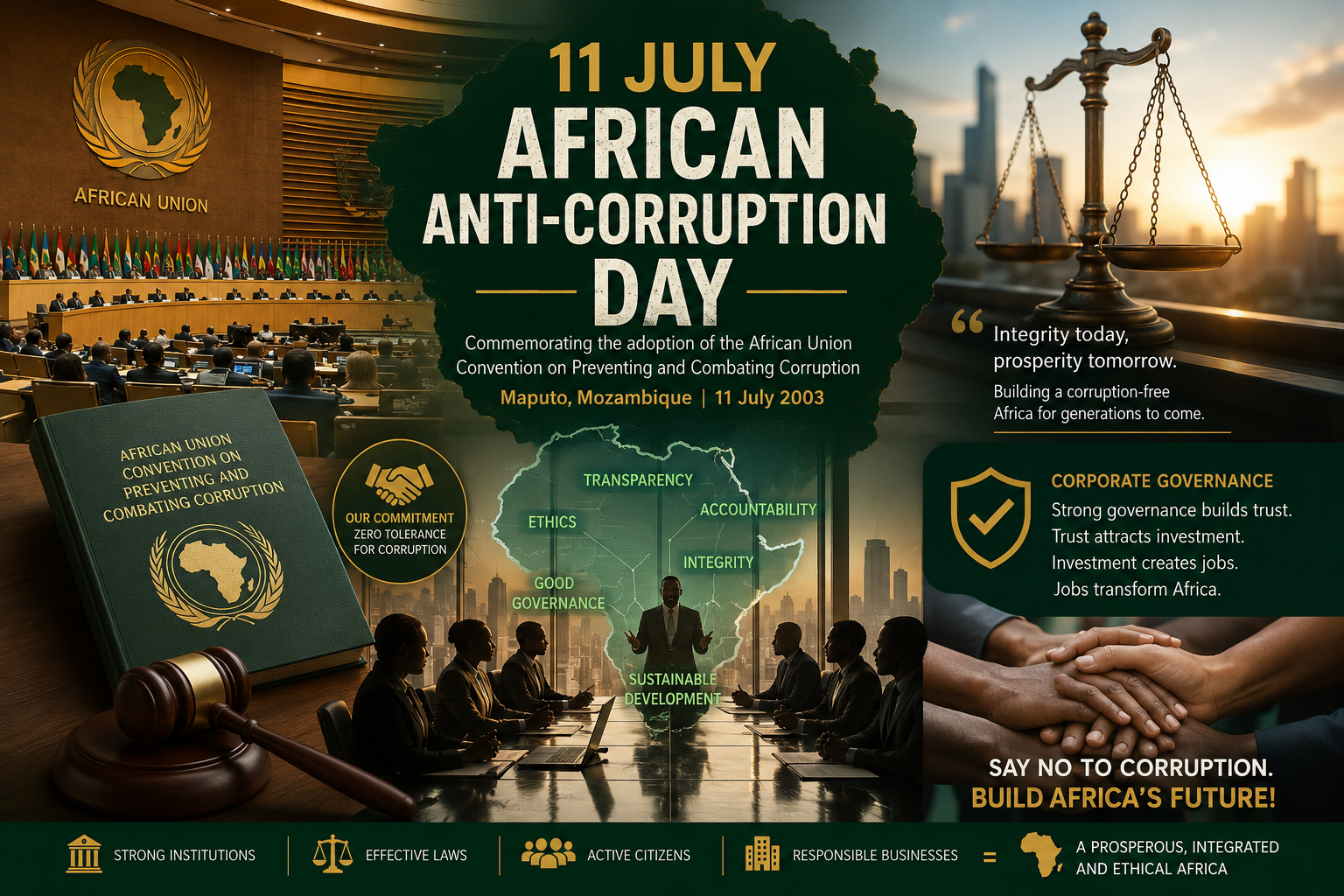
Every year on 11 July, Africa commemorates African Anti-Corruption Day, marking the adoption of the African Union Convention on Preventing and Combating Corruption (AUCPCC) in Maputo, Mozambique, on 11 July 2003. While often regarded as a governance observance, its significance extends much further. It represents one of Africa’s most ambitious attempts to build the institutional foundations required for sustainable economic growth, investor confidence, and corporate integrity.
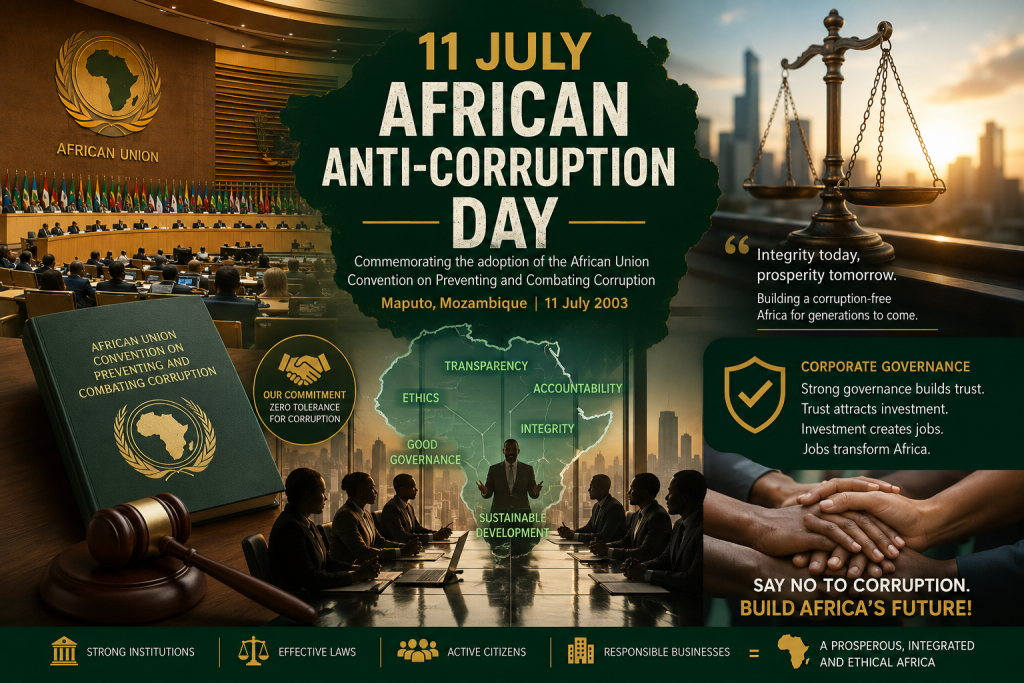
For the Banking On Africa’s Future Corporate Heritage Series, today’s focus is not simply corruption itself, but the institutions Africa has created to confront it, and whether they have been sufficient to unlock the continent’s extraordinary economic potential.
Corruption: Symptom or Cause?
Few issues have shaped international perceptions of Africa as profoundly as corruption. Whenever economic growth stalls, investment retreats, or public services deteriorate, corruption is frequently cited as the principal explanation.
Yet corruption rarely exists in isolation.
Weak institutions, fragile rule of law, inadequate corporate governance, poor procurement systems, limited transparency, ineffective auditing, political patronage, and weak accountability mechanisms all create environments where corruption flourishes.
In other words, corruption is often less the disease than the symptom of institutional weakness.
Why Was the Convention Created?
During the 1990s and early 2000s, African leaders increasingly recognised that corruption was undermining:
•foreign direct investment
•domestic entrepreneurship
•public trust
•infrastructure delivery
•tax collection
•banking stability
•regional integration, and
•poverty reduction efforts.
Consequently, member states of the African Union negotiated the Convention, which was adopted in Maputo on 11 July 2003 and later entered into force after the required number of ratifications.
The Convention was championed collectively by African governments under the newly established African Union, succeeding earlier anti-corruption initiatives begun under the Organization of African Unity.
Rather than merely criminalising corruption, the Convention sought to strengthen governance systems that would prevent corruption before it occurred.
What Is Its Mandate?
The Convention requires participating states to:
•criminalise corruption and related offences
•establish independent anti-corruption agencies
•strengthen public financial management
•improve procurement systems
•protect whistleblowers
•promote judicial independence
•recover stolen assets
•encourage citizen participation
•strengthen parliamentary oversight, and
•cooperate across borders in investigations and prosecutions.
Importantly, it also recognises the private sector as a critical partner in preventing corruption.
Why Does Corporate Governance Matter?
Corporate governance refers to the framework of rules, ethics, accountability, oversight, and decision-making through which organisations are directed and controlled.
It answers fundamental questions:
Who makes decisions?
Who supervises management?
How are conflicts of interest managed?
How are shareholders protected?
How are public resources safeguarded?
How are executives held accountable?
Strong corporate governance builds trust.
Trust attracts investment.
Investment creates jobs.
Jobs reduce poverty.
Thus, corporate governance is not merely a legal obligation, it is an economic development strategy.
Banks lend more confidently where governance is strong.
Investors pay higher valuations for transparent companies.
International businesses are more willing to establish regional headquarters where corruption risks are lower.
Has the Convention Delivered?
The answer is nuanced.
There has been meaningful progress.
Many African countries have:
•enacted anti-corruption legislation
•established specialised anti-corruption commissions
•modernised procurement systems
•introduced electronic government services
•strengthened financial intelligence units
•improved anti-money laundering regulations, and
•increased cooperation with international enforcement agencies.
However, implementation remains uneven.
Several challenges persist:
•political interference
•limited prosecutorial independence
•insufficient funding for oversight bodies
•slow judicial systems
•weak enforcement
•cross-border illicit financial flows
•public procurement fraud
•state capture
•and inconsistent political will.
The Convention created a framework, but institutions require sustained commitment to deliver results.
Who Measures Africa’s Progress?
The effectiveness of anti-corruption efforts is assessed through several mechanisms, including:
•African Union Advisory Board Against Corruption, which monitors implementation of the Convention
•Transparency International through its Corruption Perceptions Index
•World Bank governance indicators
•Mo Ibrahim Foundation through the Ibrahim Index of African Governance
•national auditors-general
•parliamentary public accounts committees, and
•independent civil society organisations.
Together, these institutions provide benchmarks for accountability and reform.
Which African Countries Stand Out?
Although no country is immune to corruption, several African states have consistently demonstrated stronger governance performance.
Among the leading examples are:
Botswana, widely regarded as Africa’s strongest performer due to independent institutions, prudent public financial management, and political commitment.
Rwanda, recognised for digital government services, administrative efficiency, and rigorous enforcement.
Seychelles, which performs strongly on governance and transparency measures.
Cape Verde, known for relatively robust democratic institutions.
Mauritius, whose strong regulatory and financial systems have made it one of Africa’s leading investment destinations.
Their experiences demonstrate that sustained institutional reform, not merely tougher laws, is central to reducing corruption.
Corporate Heritage: Institutions Matter
Corporate heritage is not only about companies.
It is also about the institutions that enable companies to flourish.
Without credible courts, transparent procurement, ethical leadership, reliable regulators, and accountable public institutions, businesses struggle to attract investment and create long-term value.
African Anti-Corruption Day reminds us that the continent’s future will not be determined solely by visionary entrepreneurs or capable political leaders. It will be shaped by the strength of the institutions they build, and by their willingness to submit themselves to those institutions.
As Africa pursues the ambitions of the African Continental Free Trade Area, industrialisation, and sustainable development, integrity will remain one of its greatest competitive advantages.
The promise of Africa’s future therefore rests not only on fighting corruption, but on building institutions that make corruption increasingly difficult, increasingly costly, and ultimately unacceptable.



