Banking On Africa’s Future – Corporate Heritage Series
By Tinashe T. T. Mpasiri | 28 August 2026
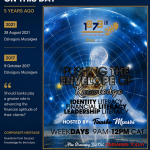
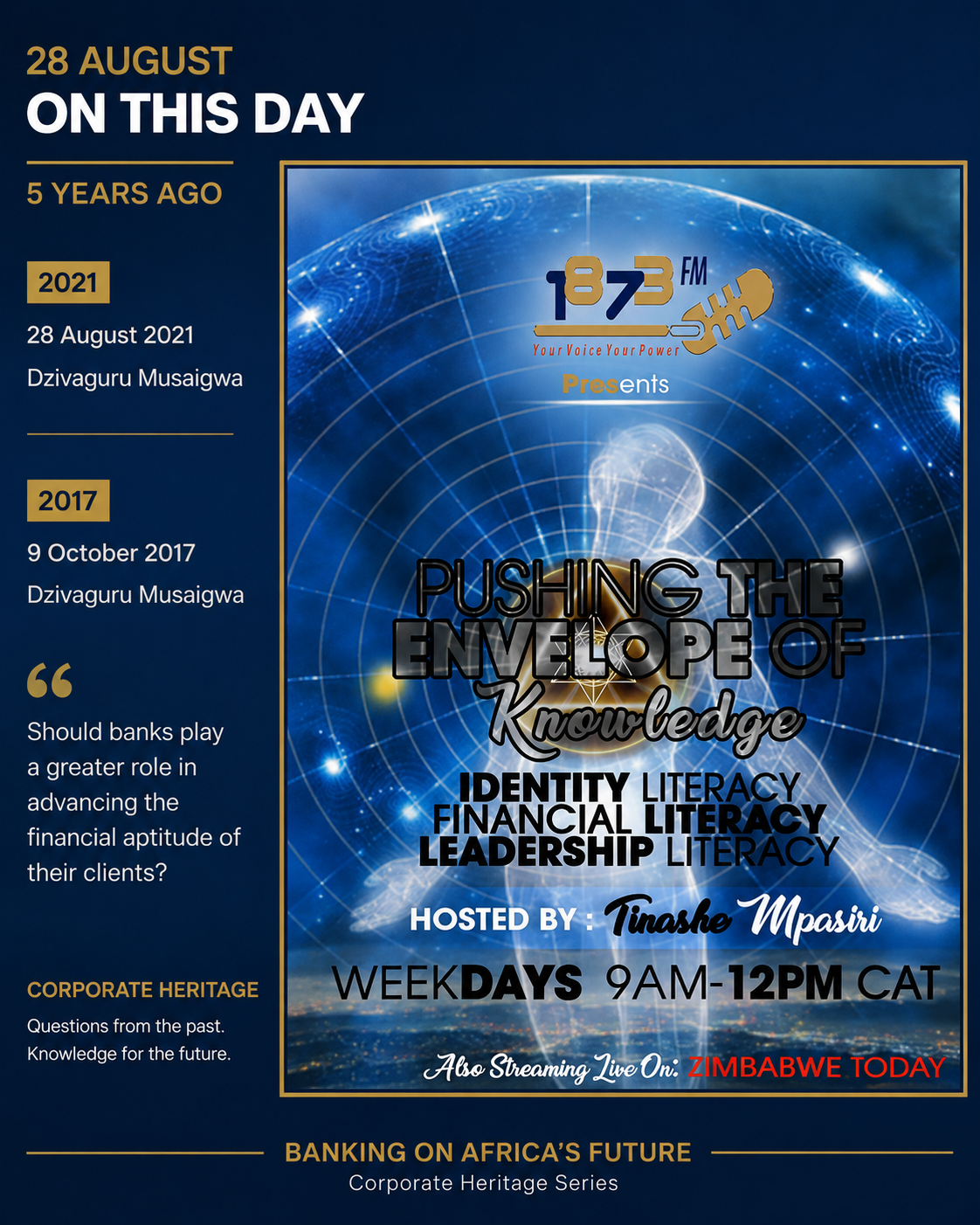
Facebook reminded me today of a question I posed on 9 October 2017 while hosting Pushing the Envelope of Knowledge on 1873 FM:
Should banks play a greater role in advancing the financial aptitude of their clients?
I reposted the question on 28 August 2021. It has returned to me again today, 28 August 2026.
What interests me is not simply that I asked it nearly nine years ago. It is how experience has changed the way I understand the question itself.
At the time, through Pushing the Envelope of Knowledge, I explored identity literacy, financial literacy and and what I then described as leadership literacy. I was interested in whether people possessed sufficient knowledge to navigate the systems within which they lived, worked and pursued enterprise.
Banking presented an obvious area of inquiry.
A person could maintain a bank account for decades, borrow money, make deposits, receive statements and pay charges without necessarily becoming more financially capable.
That observation remains relevant. But today I would interrogate the language of my original question before attempting to answer it.
Locating Agency in Banking
To say that a bank should educate its clients can obscure who actually acts.
A banking corporation does not independently decide to educate a customer, approve a loan, restructure a facility or design a financial product. Those actions arise from decisions made by people operating within a corporate and regulatory framework.
The corporation provides a legal structure for organised activity, but agency remains with the human beings who make decisions and act in its name.
Seen this way, my 2017 question requires refinement:
To what extent should the people who organise and operate banking corporations structure their activities in ways that improve the financial capability of the people with whom those corporations transact?
This formulation takes me somewhere the original question could not.
It moves the inquiry from an abstraction called “the bank” to the conduct, choices and responsibilities of people.
Financial Literacy May Not Be Enough
There is another reason the old question still interests me.
I used the words financial aptitude, rather than simply financial literacy.
Financial literacy is frequently associated with understanding concepts such as interest, inflation, savings, debt, budgeting, credit and investment. That knowledge is useful, but knowing financial vocabulary is not the same as possessing the judgement required to apply it.
An entrepreneur may understand equity yet negotiate away substantial economic rights. A business owner may understand debt yet accept financing that the enterprise cannot sustainably service. A founder may help create considerable value but fail to establish the contractual architecture necessary to participate adequately in that value.
The issue is therefore not merely what a person knows.
It is whether knowledge improves judgement when a financial decision has to be made.
That, to me, is closer to financial aptitude.
What Is a Banking Relationship For?
Banking is often discussed as though money itself were the destination.
It is not.
A person seeks mortgage finance because he or she wants a home. An entrepreneur seeks working capital because an enterprise needs to purchase inputs, employ people or fulfil orders. A farmer may require finance for equipment or production. An investor deploys capital because a future return is anticipated.
The financial transaction is therefore connected to an underlying human objective.
This raises a more interesting question about the banking relationship.
If people working within banking corporations possess specialised knowledge about capital, cash flow, credit and risk, must their interaction with customers remain purely transactional? Or can the transaction itself contribute to improving the customer’s ability to understand the financial consequences of the choices being made?
That does not transfer responsibility for an individual’s decisions to a banker. Nor does it suggest that a customer should surrender judgement to someone sitting behind a banking desk.
It asks something narrower and more useful:
Can knowledge accompany capital?
From Pushing the Envelope of Knowledge to Banking On Africa’s Future
Looking at the 2017 post today, I recognise an intellectual thread that was easier to see in retrospect.
Pushing the Envelope of Knowledge was concerned with literacy: what people know, how they think and how knowledge affects what they are able to do.
Banking On Africa’s Future would later develop from a continuing interrogation of enterprise, corporations, capital, economic agency and the knowledge required to navigate them.
The vocabulary has changed because experience has changed my thinking.
I have become more careful about attributing agency to corporations, institutions, countries and other abstractions when the underlying acts are performed by people. I have also become less interested in knowledge as accumulated terminology and more interested in what knowledge enables a person to understand, negotiate, build or protect.
Perhaps that is part of intellectual development: not merely accumulating answers, but returning to one’s earlier questions with better conceptual tools.
The Question Survives
I would therefore not answer my 2017 question today with a simple yes or no.
I would first interrogate what is meant by financial aptitude, where individual responsibility begins and ends, what responsibilities reasonably accompany the provision of financial services, and whether the architecture of a banking relationship can facilitate both a transaction and greater understanding.
The question has survived. The person asking it has acquired more experience with which to examine it.
So, on 28 August 2026, I would reformulate it:
When people organise themselves through banking corporations to intermediate capital, should the resulting relationship produce only a financial transaction, or can it also leave those involved better equipped to understand and navigate capital?
Nearly nine years later, I am still Pushing the Envelope of Knowledge.
Only now, I understand the question differently.
#CorporateHeritage #CorporateLiteracy #TheAfricaIWant #BOAF