





Corporate Heritage
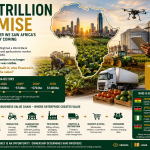
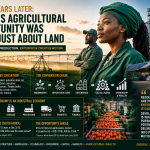
The $1 Trillion Promise: Eleven Years After We Saw Africa’s Food Opportunity Coming

Published
2 months agoon
By Tinashe T. T. Mpasiri | 11 August 2026
On 11 August 2015, I shared a proposition about the future of African agriculture. Africa, I wrote, was urbanising rapidly. As people moved into cities, the relationship between people and food would change. Fewer consumers would produce what they ate themselves. Longer and more sophisticated value chains would be required to feed growing cities.
The opportunity had already been quantified.
A World Bank report published in 2013 projected that agriculture and agribusiness in Sub-Saharan Africa could become a US$1 trillion industry by 2030, compared with approximately US$313 billion in 2010.
Eleven years after my Facebook post, that memory has returned.
But this time I do not want merely to repost it.
I want to audit it.
Because 2030 is now four years away.
We saw the promise.
Who built?
Who financed the builders?
Who owns what was built?
And ultimately, who will capture the trillion dollars?
First, what exactly did the World Bank predict?
The distinction matters.
The World Bank was not predicting that farmers alone would produce US$1 trillion worth of crops.
Its 2013 report, Growing Africa: Unlocking the Potential of Agribusiness, described agriculture and agribusiness together as the opportunity.
The Bank placed the starting value at approximately US$313 billion in 2010 and projected a US$1 trillion industry by 2030.
That meant something much bigger than farming.
It meant production and the economic activity surrounding production: inputs, processing, logistics, storage, distribution and the businesses connecting agricultural production to increasingly urban consumers.
And there was an important condition attached.
The trillion dollars would not arrive automatically.
The World Bank argued that farmers and agribusinesses needed greater access to capital, electricity, technology and irrigation, together with policies and investments capable of connecting producers to markets.
The forecast was therefore never merely a prediction.
It was a challenge to build an ecosystem.
So, are we on track?
Here we must be intellectually disciplined.
There is no directly comparable World Bank number available today that allows us simply to write:
2010: US$313 billion
2026: US$X billion
2030: US$1 trillion
and pretend that all three numbers have been measured using precisely the same methodology.
Agricultural GDP cannot substitute for the missing number because agricultural value added measures something narrower than the agriculture-and-agribusiness market contemplated in the original forecast.
Food imports cannot substitute for it.
Agricultural production alone cannot substitute for it.
Retail food sales alone cannot substitute for it.
They measure different things.
So rather than manufacture precision, let us establish the benchmark.
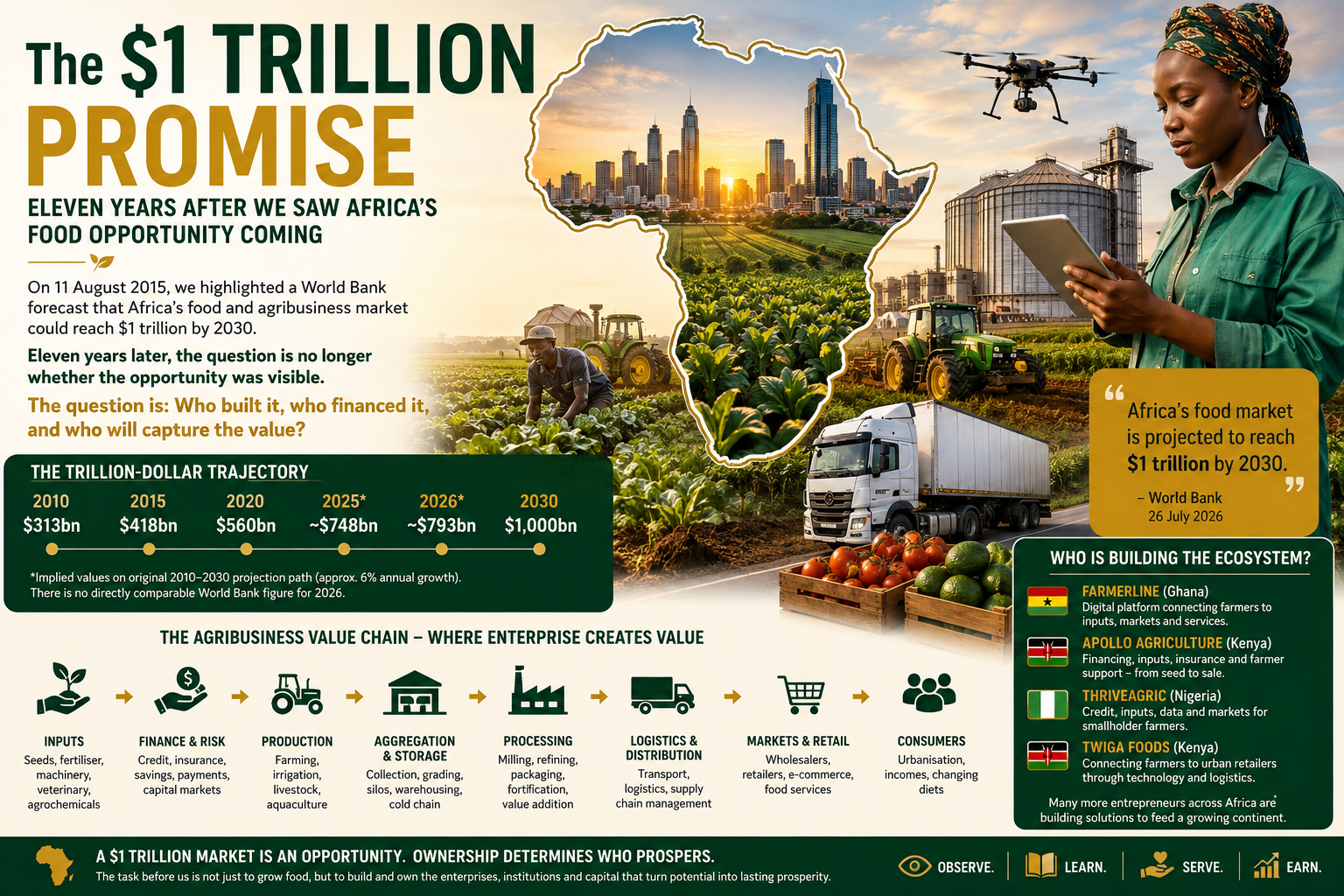
To move from US$313 billion in 2010 to US$1 trillion in 2030 requires compound nominal growth of approximately 6 per cent a year.
A smooth trajectory would look roughly like this:
2010 — US$313 billion
2015 — US$418 billion
2020 — US$560 billion
2025 — US$748 billion
2026 — US$793 billion
2030 — US$1 trillion
Therefore, if the original projection were progressing smoothly, the African agriculture-and-agribusiness market would need to be approaching US$800 billion today.
That US$793 billion is not an estimate of the current market.
It is the 2026 checkpoint implied by the original forecast.
That distinction is important.
The World Bank has not walked away from the trillion
And here the story becomes particularly interesting.
On 26 July 2026, thirteen years after the original report and with fewer than four years remaining before 2030, the World Bank returned to the proposition.
Ndiamé Diop, the Bank’s Vice President for Eastern and Southern Africa, wrote:
Africa’s food market is still projected to reach US$1 trillion by 2030.
The drivers remain familiar: population growth, rising consumer spending and increasing demand for food.
In other words, the institution that helped popularise the trillion-dollar proposition has not abandoned it.
But the language surrounding it has evolved.
Agriculture is increasingly being discussed not simply as a means of producing food, but as a platform for private investment, regional trade and employment.
That is precisely where our audit must begin.
Because the trillion was never sitting in the soil
There is a temptation when discussing Africa’s agricultural potential to look at hectares.
How much arable land exists?
How much rainfall falls?
How many cattle are there?
How much maize can be harvested?
Those questions matter.
But they do not explain where economic value accumulates.
Consider maize.
A farmer plants it.
But somebody supplies the seed.
Somebody manufactures or distributes fertiliser.
Somebody finances the crop.
Somebody insures the risk.
Somebody supplies irrigation equipment.
Somebody harvests or aggregates the grain.
Somebody stores it.
Somebody transports it.
Somebody mills it.
Somebody fortifies it.
Somebody packages it.
Somebody brands it.
Somebody distributes it.
Somebody places it on a supermarket shelf.
And somebody finances almost every stage along the way.
The trillion dollars were never simply sitting on the farm.
They were scattered across the value chain.
So who responded?
This is where the eleven years since my 2015 post become important.
The answer cannot be that Africans simply stood still.
They did not.
Across the continent, entrepreneurs began building enterprises around precisely the frictions identified in the agricultural ecosystem.
In Ghana, Farmerline, founded by Alloysius Attah and Emmanuel Addai, developed an agricultural platform combining digital infrastructure, farmer information, inputs, market access and other services.
In Nigeria, ThriveAgric, established in 2017, built around the problems of smallholder finance, inputs, data and access to markets.
In Kenya, Twiga Foods attacked another part of the chain: connecting agricultural supply with urban retail demand through technology and physical distribution infrastructure.
Apollo Agriculture, established in Kenya in 2016, developed an integrated proposition around agricultural finance, inputs, insurance and farmer support.
Elsewhere, entrepreneurs have built businesses around precision agriculture, agricultural marketplaces, processing, cold-chain infrastructure and supply-chain management.
These enterprises reveal something important.
Many of the entrepreneurs who recognised the agricultural opportunity did not necessarily buy farms.
They built around the farmer.
That may be one of the most important lessons of the trillion-dollar proposition.
Every friction can become an enterprise
If farmers cannot access capital, there is an agricultural-finance opportunity.
If they cannot obtain quality seed, there is an input-distribution opportunity.
If tractors are unaffordable, there is a mechanisation-service opportunity.
If crops spoil after harvest, there is a storage and cold-chain opportunity.
If farmers cannot find buyers, there is an aggregation and marketplace opportunity.
If processors cannot obtain consistent raw materials, there is a procurement and supply-chain opportunity.
If lenders cannot price agricultural risk, there is a data opportunity.
If agricultural commodities leave communities without processing, there is a manufacturing opportunity.
If retailers cannot obtain predictable supplies, there is a logistics opportunity.
The problem itself becomes the invitation to enterprise.
That is what ecosystem entrepreneurship looks like.
But now comes the harder question
Who financed these enterprises?
This matters because establishing an African company and financing an African company are different economic functions.
Several of the enterprises that emerged or expanded during this period have relied on combinations of international venture capital, development-finance institutions, impact investors and other foreign pools of capital.
There is nothing inherently undesirable about that.
Capital should cross borders.
Foreign investment can provide expertise, networks, technology and the resources required to scale enterprises far faster than internally generated cash flows would permit.
But Banking On Africa’s Future requires us to ask another question:
Where is African capital in the ownership of Africa’s agricultural transformation?
Pension funds.
Insurance companies.
Banks.
Stock exchanges.
Private-equity funds.
Family offices.
Development-finance institutions.
Cooperatives.
Individual investors.
These are not peripheral to agriculture.
They are part of its infrastructure.
Because if African entrepreneurs identify opportunities but must consistently look elsewhere for the risk capital required to exploit them, then the agricultural challenge is also a capital-formation challenge.
Build before we borrow — but build institutions capable of investing
This is why productive economies require more than entrepreneurs.
They require institutions capable of converting savings into investment.
A pension contribution appears far removed from a maize field.
But properly intermediated, savings can finance a processing plant.
Insurance premiums can become institutional capital.
Bank deposits can support productive lending.
A stock exchange can allow a growing agricultural company to raise equity from thousands of investors.
Private capital can finance warehouses, logistics fleets, irrigation infrastructure and food-processing facilities.
The agricultural ecosystem therefore extends all the way into the financial system.
Capital chases confidence.
And confidence depends on governance, property rights, enforceable contracts, credible financial statements, functioning institutions and entrepreneurs capable of demonstrating that capital entrusted to them can produce sustainable returns.
Corporate literacy therefore belongs in the agricultural conversation.
The decisive battle may be beyond the farm gate
Africa can increase agricultural production substantially and still fail to capture the full promise.
Why?
Because the highest-value activities do not necessarily occur where the commodity is grown.
Cocoa illustrates the problem beautifully.
Growing cocoa is agriculture.
Transforming cocoa into chocolate introduces manufacturing.
Creating a trusted chocolate brand adds intellectual property.
Distributing it internationally adds logistics.
Selling it through retail captures another margin.
The same principle applies elsewhere.
Milk becomes yoghurt, butter and cheese.
Tomatoes become paste, sauces and packaged products.
Maize becomes meal, breakfast cereals, animal feed and industrial inputs.
Fruit becomes juice, concentrates, dried products and ingredients.
Cotton becomes textiles and garments.
Processing multiplies the economic possibilities of production.
The challenge therefore cannot simply be to increase yields.
It must be to build enterprises capable of carrying commodities further along the value chain.
Urbanisation was the signal
This brings us back to what caught my attention in 2015.
Urbanisation.
When people move into cities, food does not follow them automatically.
Enterprise must move it.
Farmers must become connected to aggregators.
Aggregators must become connected to processors.
Processors require packaging.
Products require warehouses.
Warehouses require logistics.
Retailers require reliable inventory.
Consumers require affordability, safety and convenience.
Finance runs through the entire system.
Technology increasingly coordinates it.
The growth of African cities therefore creates not one agricultural opportunity, but thousands of interconnected enterprise opportunities.
That was the deeper promise hiding inside the trillion-dollar number.
And yet there is a paradox
A continent can possess enormous agricultural potential while importing enormous quantities of food.
It can possess farmers while lacking processors.
It can possess commodities while lacking brands.
It can possess entrepreneurs while lacking patient capital.
It can possess consumers while foreign enterprises capture significant portions of their expenditure.
It can even achieve a trillion-dollar food market without necessarily producing a trillion-dollar transformation for its farmers and entrepreneurs.
That is why simply reaching US$1 trillion cannot be our only measure of success.
We need two scoreboards
When 2030 arrives, the first scoreboard should be straightforward:
How large did the market become?
Did the US$313 billion industry of 2010 reach the trillion-dollar threshold?
But there must be a second scoreboard.
And perhaps it matters more.
Who captured the value?
Who owns the seed companies?
Who develops the genetics?
Who manufactures agricultural machinery?
Who provides agricultural finance?
Who owns the warehouses?
Who controls cold chains?
Who processes the commodities?
Who owns the logistics networks?
Who owns the food brands?
Who controls distribution?
Who owns the technology connecting the ecosystem?
Who owns equity in the companies solving these problems?
Those questions distinguish market growth from wealth creation.
The prediction can come true while the promise remains unfulfilled
This is perhaps the most important conclusion of this eleven-year reflection.
The World Bank could be completely correct.
Africa’s food market could reach US$1 trillion by 2030.
And yet African farmers, entrepreneurs and investors could still capture too little of the resulting value.
Those propositions are not contradictory.
A large market tells us how much economic activity exists.
It does not tell us who owns the productive assets participating in it.
It does not tell us where profits accumulate.
It does not tell us who owns the intellectual property.
It does not tell us who supplied the capital.
And it certainly does not tell us whether wealth generated by the market is being converted into new African productive capacity.
A trillion-dollar market is an opportunity. Ownership determines who benefits from it.
Eleven years later, the memory has become a receipt
When Facebook returned my post of 11 August 2015, at first I saw a memory.
Looking at it again, I see something else.
It is a receipt.
It records that the opportunity was visible.
The demographic transition was visible.
Urbanisation was visible.
The growing consumer market was visible.
The constraints were known.
The potential value had even been quantified.
US$313 billion.
US$1 trillion.
Twenty years.
Some people acted.
Entrepreneurs built companies.
Investors supplied capital.
Technology entered the value chain.
New models of finance, aggregation, distribution and market access emerged.
But the audit is not finished.
In fact, with four years remaining, it has become more urgent.
The World Bank itself is still standing behind the trillion-dollar proposition in 2026.
The implied checkpoint from the original projection is now approximately US$793 billion.
We cannot yet say, using a directly comparable authoritative dataset, whether the market has crossed that precise point.
But perhaps that uncertainty teaches us something too.
For more than a decade, we have become very good at repeating the size of the opportunity.
Now we need to become equally serious about measuring who is building it and who owns it.
When 2030 arrives, let us therefore ask more than whether the forecast was right.
Let us ask:
Who saw?
Who acted?
Who built?
Who financed?
Who owns?
Who earned?
Because neither land, nor rainfall, nor population, nor a World Bank forecast can create prosperity by themselves.
People do.
People observe opportunities.
People organise resources.
People solve problems.
People establish enterprises.
People invest capital.
People build institutions.
And people transform promise into productive capacity.
The US$1 trillion was never the destination.
The enterprises we build and own on the journey towards it are the real story.
Observe. Learn. Serve. Earn.
#CorporateHeritage #CorporateLiteracy #TheAfricaIWant #BOAF
Over the years, I have found it challenging to define myself solely by an academic qualification, trade, or occupation. My eagerness to learn, especially about how to build and deploy capital, has allowed me to accumulate diverse experiences in a short span of time. Through this journey, I have discovered that at my core, I am a storyteller. I tell the stories of corporations, their heritage, and the individuals who act in their name. I explore the role of these institutions in fulfilling the promise of a better Africa, and, most importantly, the causal link between the rule of law and economic development. As a fellow believer in Africa’s potential, can I count on you to be a point of light in securing our continent’s future?



