






Corporate Heritage
16 July 1995: The First Book That Changed the World — Why Every Great Institution Begins with One Customer

By Tinashe T. T. Mpasiri | 16 July 2026
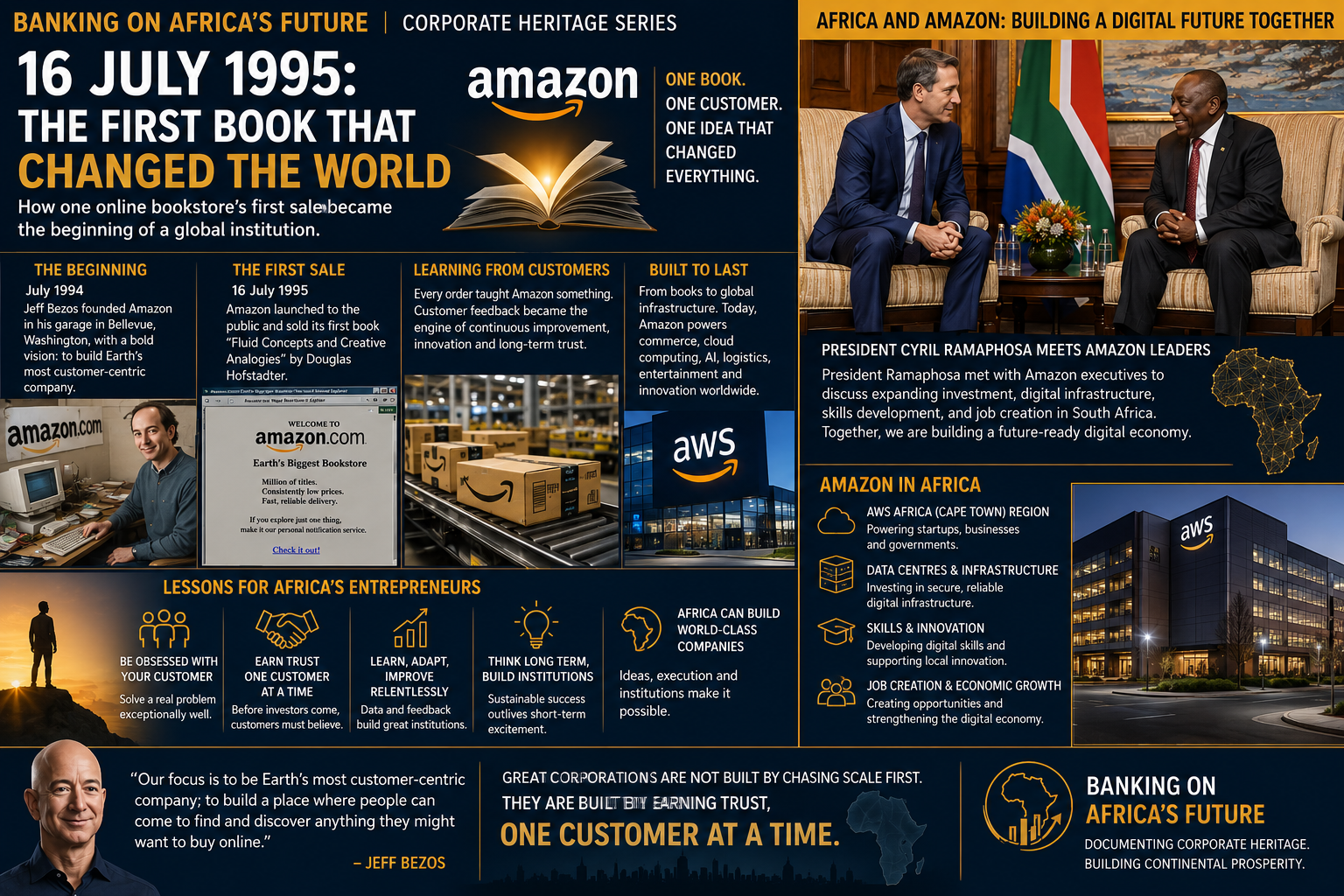
Thirty-one years ago today, on 16 July 1995, a little-known online bookstore opened its virtual doors to the public. On that day, Amazon sold its first book, Fluid Concepts and Creative Analogies by Douglas Hofstadter.
By any commercial measure, it was an insignificant transaction. One book. One customer. One order.
Yet history would remember it as one of the most consequential sales in modern business.
Today, Amazon serves hundreds of millions of customers, operates one of the world’s largest cloud computing businesses, powers artificial intelligence infrastructure, produces award-winning entertainment, designs logistics systems that span continents, and has become one of the most valuable corporations ever created.
Corporate heritage reminds us that every institution, no matter how large, begins with someone willing to become its first customer.
Before Investors, There Must Be Customers
In our Corporate Heritage Series, we previously examined Amazon’s Initial Public Offering on 14 May 1997, when the company accessed public capital to finance its expansion.
But long before Wall Street believed in Amazon, someone else had to believe first.
A customer.
That first purchase did more than generate revenue.
It validated an idea.
Entrepreneurs often believe they have solved an important problem. Markets are less interested in belief than they are in proof. The first paying customer provides that proof. They transform an idea into a business and a concept into an institution.
The first sale is therefore one of the most important milestones in corporate history.
Revenue is not merely income.
It is evidence that value has been created.
Why Books?
Jeff Bezos did not begin by trying to build the world’s largest retailer.
He began with books.
The decision was remarkably strategic.
Books offered millions of titles, standardised products, relatively predictable distribution, and a catalogue far larger than any physical bookstore could carry.
More importantly, books allowed Amazon to learn.
Every order generated information.
Which books were people buying?
How long were deliveries taking?
What recommendations worked?
How could the customer experience improve?
Every transaction became a lesson.
This illustrates an important principle of corporate literacy,
Great institutions are built through continuous learning rather than perfect planning.
Amazon did not launch as the company we know today.
It evolved because it listened.
The Power of the First Customer
The first customer does something that no investor, consultant or business plan can accomplish.
They assume risk.
When someone purchases from an unknown company, they are placing trust in people they have never met and systems that have not yet been proven.
That trust becomes the foundation upon which institutions are built.
Every globally recognised company has had a first customer.
Every multinational corporation once wondered whether anyone would buy its product.
Every iconic brand began with uncertainty.
Corporate heritage teaches us that the journey from startup to institution begins not with scale, but with trust.
Customer Obsession as a Philosophy
One of Jeff Bezos’ defining leadership principles was that Amazon should remain relentlessly focused on customers rather than competitors.
Competitors matter.
Customers matter more.
This philosophy shaped everything Amazon built:
•personalised recommendations
•fast and reliable delivery
•transparent reviews
•simplified online payments
•continuous product improvement.
The objective was never simply to sell products.
It was to earn trust repeatedly.
Over time, that trust became one of Amazon’s greatest competitive advantages.
From One Book to Global Infrastructure
The first book sale did not merely launch an online bookstore.
It began the construction of an institution.
Today Amazon encompasses:
•global e-commerce
•Amazon Web Services (AWS), which powers governments, startups and multinational corporations
•artificial intelligence platforms
•logistics and fulfilment networks
•streaming and digital entertainment
•smart devices and automation technologies.
Remarkably, much of the modern internet now depends upon infrastructure built by a company whose first customer simply wanted to purchase a book.
This reminds us that great institutions often emerge from solving one problem exceptionally well before expanding into adjacent opportunities.
Africa’s Lesson
For Africa, Amazon’s journey offers an important lesson.
Across the continent, entrepreneurs often focus on raising investment, securing grants or attracting venture capital.
These are important.
But before capital comes customers.
No amount of funding can compensate for a product or service that creates little value.
The first customer validates the entrepreneur.
The hundredth customer validates the business model.
The millionth customer validates the institution.
African entrepreneurs should therefore spend as much time understanding customer problems as they do preparing investor presentations.
Institutions are built by consistently solving real problems for real people.
A Partnership Looking Forward
Amazon’s story is no longer distant from Africa.
Its cloud infrastructure supports thousands of African businesses, governments and innovators through AWS investments on the continent.
Recently, President Cyril Ramaphosa met with Amazon executives as South Africa continues positioning itself as a regional digital and technology hub. The discussions centred on expanding investment, strengthening digital infrastructure, developing skills and creating employment opportunities.
This engagement reflects an important reality, Africa’s future competitiveness will increasingly depend on partnerships that strengthen local innovation while building world-class digital infrastructure.
The Heritage of Enterprise
The significance of 16 July 1995 is not that Amazon sold a book.
It is that someone believed enough in an unknown company to become its first customer.
That single act of trust helped validate a vision that would eventually reshape global commerce.
Corporate heritage reminds us that every enduring institution begins quietly.
Before there are stock exchanges, there are customers.
Before there are billion-dollar valuations, there is value creation.
Before there are multinational corporations, there is a founder willing to solve one problem well—and one customer willing to say, “Yes.”
As we continue documenting the institutions shaping our world, Amazon teaches us a timeless lesson for Africa, great corporations are not built by chasing scale first. They are built by earning trust, one customer at a time.



