



Health
Polonium and poisoning: What Zimbabweans should know to protect themselves
Polonium’s deadly reputation has fuelled fear, speculation and political intrigue. But what does the evidence establish, and what should Zimbabweans do when poisoning is suspected? Mandla Wedu separates documented cases from disputed claims, explores practical precautions and explains why prompt medical care, reliable information and accountable leadership matter.

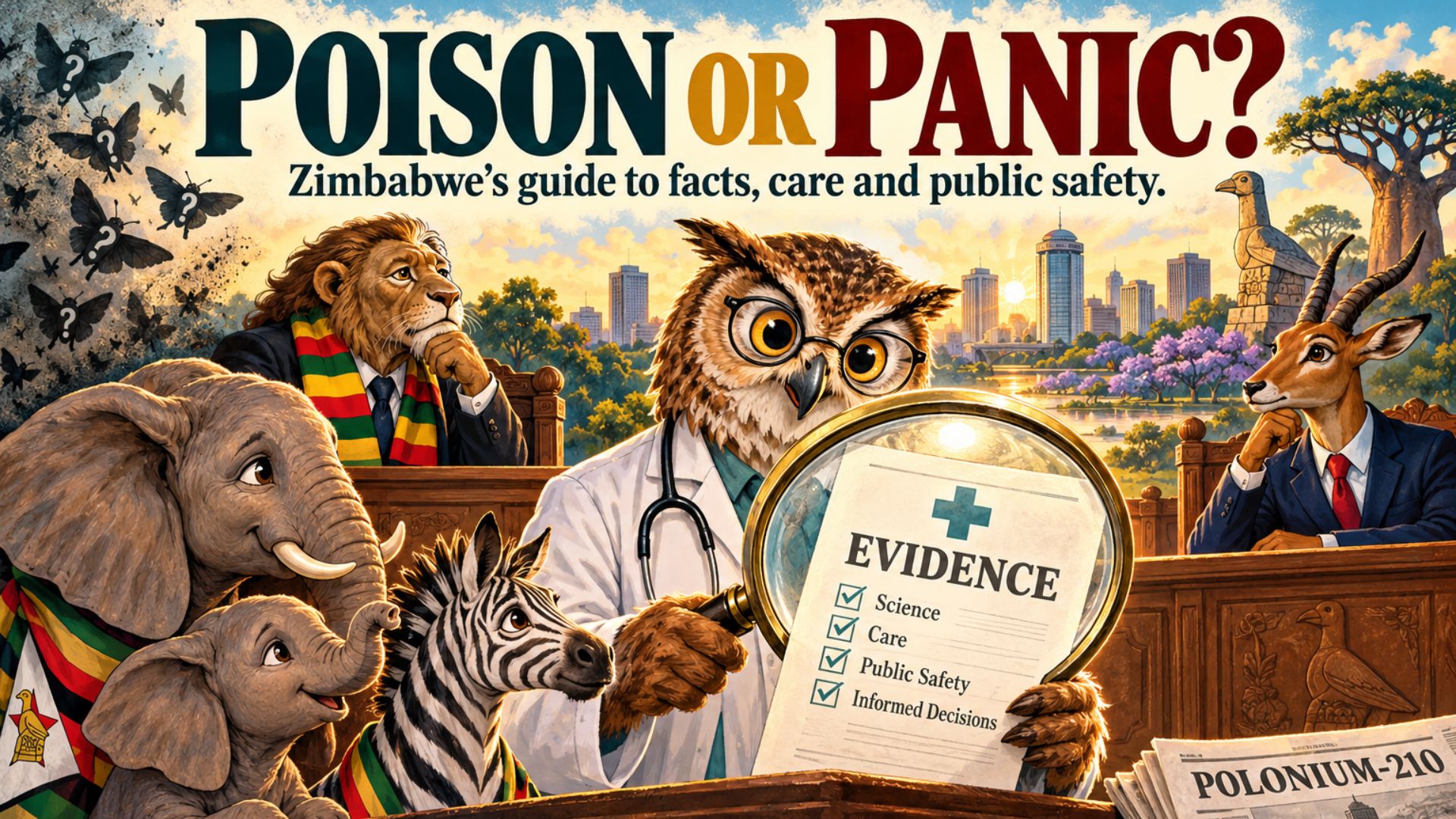
A sourced public-awareness feature about what is known, what remains disputed, how to seek help, and why a society’s strongest protection is a working chain of care, evidence and accountability.
This feature combines verified public records, identified analysis and fictional teaching scenarios. It does not establish a polonium attack in Zimbabwe. No article can guarantee survival after poisoning or substitute for emergency assessment.
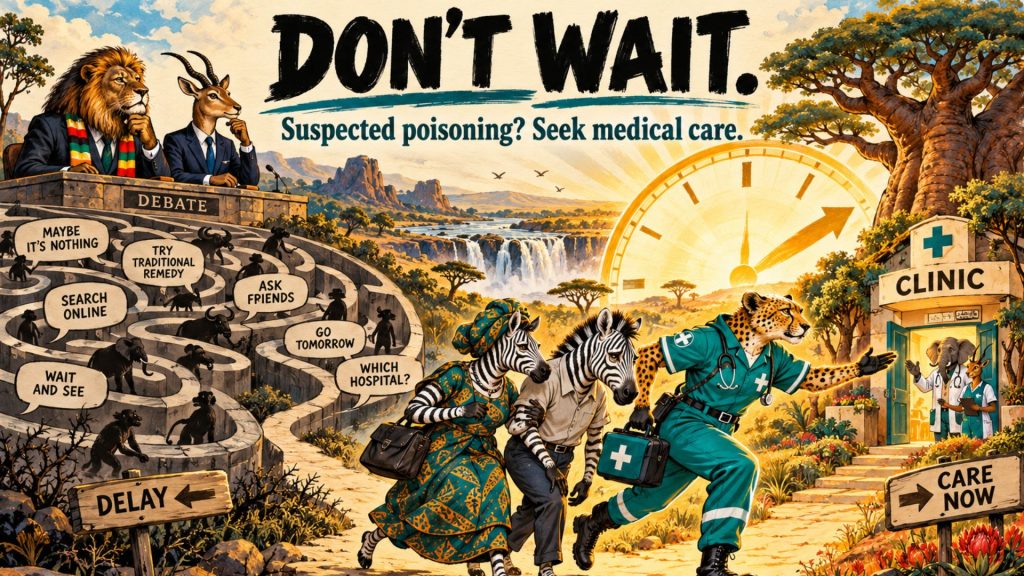
If exposure may be happening now: stop contact with the suspected substance, move to safety without exposing yourself further, and seek urgent professional help. Breathing difficulty, seizures, collapse or unconsciousness require immediate emergency assistance. Do not wait for this article, a laboratory result or agreement about who might be responsible.
1. The first decision: care before certainty
Before a poisoning becomes a headline, it is someone’s interruption. A meeting stops. A child reaches for a bottle. A worker feels unwell. A relative asks whether they should leave now or wait. The public usually encounters the dramatic story after the difficult decisions have already been made. Awareness should move in the other direction: back toward the ordinary moment when someone can still choose a safer response.
Imagine a family conversation in which five people are speaking at once. One suspects food. Another suspects politics. A third remembers a remedy. Someone wants a photograph. Someone wants to phone a cousin overseas. None of these people necessarily wishes harm. Yet the conversation can acquire its own momentum, with the patient’s needs becoming one more opinion in a crowded room. This is an illustrative situation, not a report of an actual Zimbabwean case. Its lesson is about priorities.
The useful question is not initially whether the family can identify a poison. It is whether there is a credible exposure concern or a serious illness that needs assessment. Those questions belong close to the patient. They should not be postponed until a family reaches agreement about an explanation. Healthcare can begin under uncertainty. Public accusations require a much more demanding standard.
The NHS poisoning guidance explains that symptoms can be delayed and recommends seeking advice quickly when exposure is possible. It advises against inducing vomiting or giving food or drink while awaiting advice. If someone is unconscious but breathing, recovery positioning is appropriate; if they are unresponsive and not breathing normally, emergency resuscitation instructions matter. Its UK telephone numbers do not apply in Zimbabwe. The transferable message is prompt assessment and appropriate first aid, not importing another country’s contact system.
This distinction between care and accusation is the organising principle of the feature. A person can say, “I need help because something may have happened,” without saying, “I know who did it.” A clinician can take a concern seriously without accepting a political allegation. A journalist can investigate a suspicion without printing it as a finding. A regulator can temporarily examine a product without announcing that every product of that kind is dangerous.
When these distinctions are lost, the patient can become trapped between two bad choices: silence until certainty, or an accusation in order to be believed. Neither should be necessary. A well-designed public response makes room for uncertainty. It allows the facts to develop while people receive care. That is a practical form of dignity, particularly where the patient is frightened, confused or dependent on others to reach a health facility.
There is also a difference between helping and performing help. Filming a distressed person might produce attention, but it does not provide transport, make an emergency call or communicate an exposure history. Repeating an unverified message might feel protective, but it can direct a family toward the wrong action. The test of useful assistance is concrete: does it get the person closer to competent care, reduce further exposure, or improve the information professionals receive?
This article therefore treats survival as a goal supported by systems, rather than a promise offered by a headline. It will not prescribe a universal antidote, identify a substance from symptoms, or pretend that every frightening event has a political explanation. Its practical ambition is to help readers recognise which decisions are theirs to make, which decisions require specialists, and which questions should remain open until evidence can answer them.
That ambition includes people who are rarely imagined in dramatic poisoning stories: the grandmother who manages several medicines, the school employee who purchases cleaning supplies, the farm supervisor who approves storage, the journalist who chooses a headline, and the neighbour who has access to a vehicle. Public protection is built from their decisions too. A functioning response does not wait for a famous victim before becoming useful.
There is no need to turn an ordinary household into a suspicious fortress. Nor is there wisdom in dismissing every concern as anxiety. A measured approach gives credible concerns a route to care and gives sensational claims a route to verification. It asks for alertness without encouraging permanent fear. It makes prevention a shared responsibility without pretending that every citizen must become a toxicologist or detective.
The strongest awareness message fits in a simple relationship: act on a credible safety concern, but scale the certainty of your public claims to the certainty of your evidence. A low threshold for seeking help can coexist with a high threshold for blaming another person. Understanding that relationship is more useful than memorising the names of notorious substances.
2. What polonium is, and why the name carries such power
Polonium is a chemical element. Polonium-210 is a radioactive isotope of that element. It is not palladium, the precious metal, and it is not plutonium. The similarity of unfamiliar names can make them interchangeable in conversation, but they describe different substances. A responsible account starts by getting the name right, because a misnamed danger can lead readers to search for the wrong information.
The Nobel Prize’s historical account of Marie and Pierre Curie places the discovery of polonium in 1898. The name honoured Marie Curie’s native Poland. That history matters because the substance did not begin as an assassination device. It emerged from scientific investigation into radioactivity, long before the political crime that brought it into popular language.
According to the CDC’s polonium facts, polonium-210 occurs naturally at very low levels and has a physical half-life of about 138 days. A half-life describes radioactive decay: the time in which half the radioactive atoms in a sample decay. It is not the time an exposed person will live, and it is not a period after which a dangerous incident can be assumed irrelevant.
The CDC’s clinical overview identifies internal exposure, especially swallowing or inhalation, as the central hazard. Polonium-210 emits alpha radiation. The scientific concern is the damage radioactive material can cause when it is inside the body, rather than a cinematic glow surrounding a contaminated object. The existence of natural background exposure also means that a trace finding needs interpretation.
For a public reader, the essential separation is between an element, an exposure and an injury. Knowing that a material exists does not establish that someone encountered it. Establishing exposure does not automatically establish serious illness. Establishing illness does not by itself explain whether the event was accidental, environmental, occupational or deliberate. These are connected questions, but they are not substitutes for one another.
Popular storytelling often collapses the entire sequence. A rumour names a substance; the named substance becomes the cause; the presumed cause becomes proof of intent; intent becomes proof of a particular actor. The resulting account can sound complete while containing almost no reliable evidence. Its confidence comes from narrative structure rather than from investigation. The more frightening the material, the easier it is for that confidence to pass as knowledge.
There is a powerful visual temptation here. A glowing cup is instantly recognisable as poison in a cartoon. Yet it teaches the wrong expectation if readers take it literally. A sinister face beside a bottle supplies an easy villain, but it can turn an allegory into an unsupported accusation. Good awareness art should make the decision visible: seeking care, checking information, questioning promises or demanding evidence. It should not pretend that the substance announces itself theatrically.
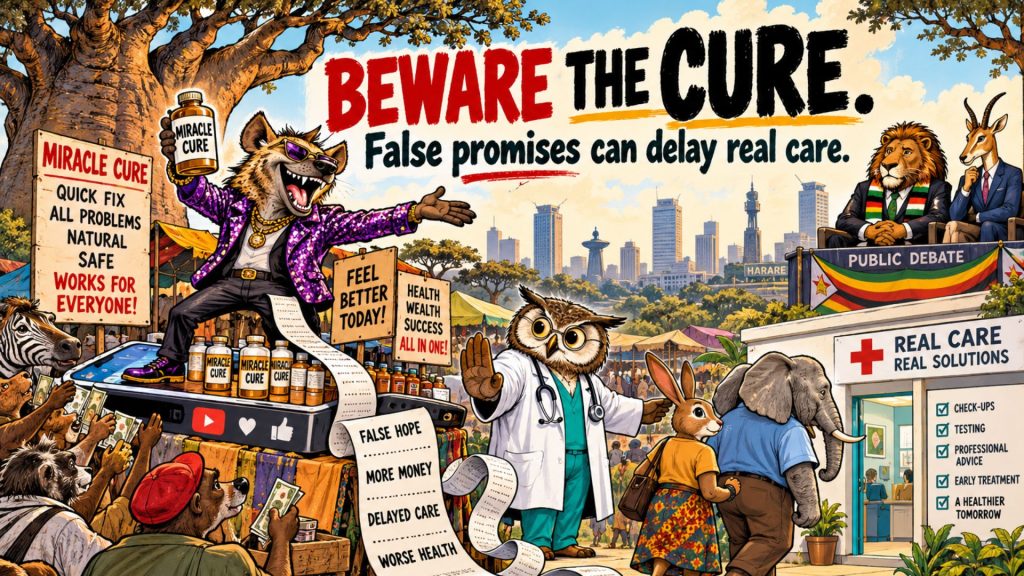
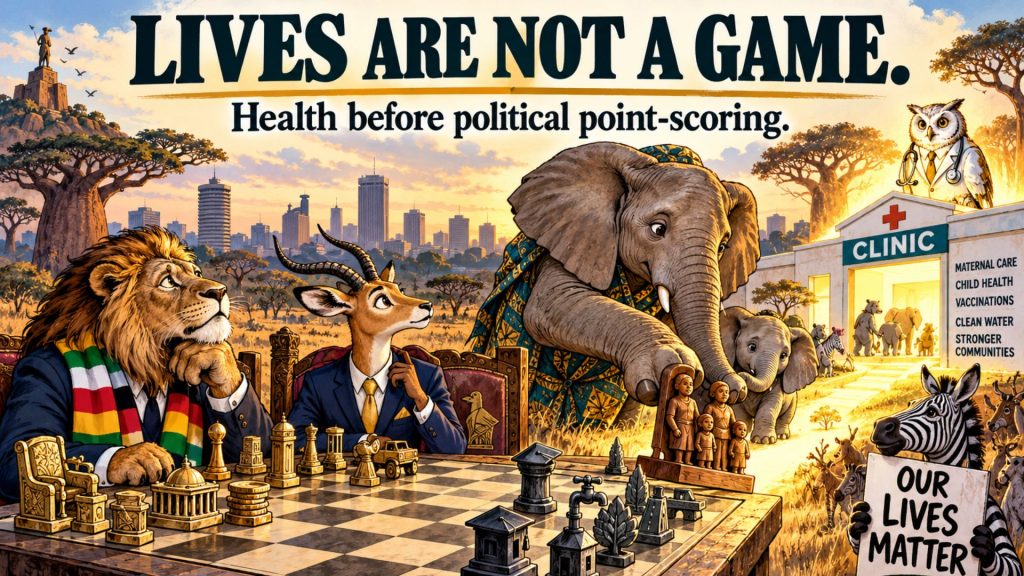
That is why the animal cartoons accompanying this feature use the owl, the elephant family, the debate bench and the magnifying glass. They are visual arguments about responsibility. The owl’s authority comes from examining a record. The family’s vulnerability comes from needing a workable response. The political figures are being asked to listen. Their presence is commentary on public leadership, not evidence that a depicted politician administered anything.
Science also has a language of limits that public debate can find frustrating. A report may say that results are consistent with a hypothesis, provide some support for it, or fail to establish it. Each phrase carries a different claim. These formulations are not necessarily evasions. They may be the most honest way to describe what the samples and methods permit. An audience that demands certainty from every result can push investigators toward claims stronger than the evidence deserves.
For the reader, uncertainty should prompt the next question rather than end the conversation. What kind of sample was examined? When was it collected? What comparisons were used? What alternative explanations were considered? Who interpreted the measurements? Is the relevant report public? These are questions for evaluating a published account. They are not instructions to collect hazardous samples independently or to interfere with medical work.
There is a corresponding danger in going too far the other way. Because an allegation can be unproven, some commentators treat investigation as unnecessary. That also misuses uncertainty. A serious concern can justify inquiry without justifying a conclusion. The public task is to hold those two positions together: do not invent proof, and do not demand proof before any responsible investigation may begin.
Polonium’s notoriety should therefore be used carefully. It can open a conversation about forensic capacity, cross-border accountability and the protection of people who speak publicly. It should not crowd out the daily safety questions that a reader can actually influence. The name is the entrance to the article, not the answer to every illness discussed within it.
3. London: the killing that made the world learn the name
Alexander Litvinenko died in London on 23 November 2006. The British public inquiry’s report, published in January 2016, established fatal poisoning with polonium-210 and identified Andrey Lugovoy and Dmitry Kovtun as the men who deliberately poisoned him. The inquiry located the fatal exposure at a meeting on 1 November 2006 at London’s Millennium Hotel. Its findings should be attributed to that inquiry, rather than silently recast as a criminal jury verdict.
The Home Secretary’s statement on the inquiry preserved an important distinction. The inquiry expressed a strong probability of direction by Russia’s Federal Security Service and concluded that senior approval, including that of Vladimir Putin and Nikolai Patrushev, was probable. The qualification is part of the finding. Removing it would change what the inquiry actually said.
In 2021, the European Court of Human Rights judgment in Carter v. Russia addressed Russian state responsibility for the killing. Reuters’ report of the judgment also records the denials by Russia and the two men. A human-rights judgment about state responsibility is not the same legal proceeding as a criminal trial of a head of state. Readers deserve that precision even when the underlying findings are grave.
The isotope identification rests on scientific evidence as well as public testimony. A 2017 case report indexed by PubMed describes findings in tissue, blood and urine, with hair analysis supporting an earlier exposure in October 2006. Those results contradict the popular description of polonium as simply impossible to detect. The point for this article is that specialist work identified the material and contributed to reconstructing events.
The case offers an uncomfortable answer to the phrase “used successfully.” If success means that a person was killed, the outcome was fatal. If it means that a crime remained invisible or permanently beyond scrutiny, the description is misleading. Investigators identified the substance, examined the wider incident and produced findings that became part of an enduring public record. There is no reason for an awareness article to adopt the perpetrator’s imagined measure of success.
Language shapes the moral centre of reporting. Saying that a poison “worked” moves attention toward the capabilities of a killer. Saying that a man was killed and that an investigation established what happened moves attention toward the victim, evidence and accountability. Both can refer to the same event, but they invite very different forms of curiosity. This feature chooses the second frame.
Another lesson concerns the relationship between forensic findings and political context. Litvinenko’s public criticism of the Kremlin was relevant background, but background alone would not identify a radioactive isotope. Political conflict can explain why an investigation matters; it cannot replace the examination of physical evidence. Conversely, a purely technical account can become incomplete if it refuses to consider the social and political questions that the evidence raises.
The job of serious reporting is to connect those kinds of information without merging them. A scientific report can support a cause of death. An inquiry can consider responsibility through a wider record. A court can decide a legal claim under a particular framework. The reader should be able to see which institution answered which question. That is a stronger account than a single paragraph in which every level of certainty is flattened.
For Zimbabwean audiences, the case is not useful because it supplies a ready-made explanation for local events. It is useful because it demonstrates the importance of a chain: medical recognition, specialist analysis, documentation, investigation and legal scrutiny. A break anywhere in that chain can make later questions harder to answer. Strengthening the chain helps ordinary cases as well as politically sensitive ones.
There is also a lesson in patience. Public accountability can depend on records and processes that outlast the first wave of attention. A dramatic photograph travels quickly; a carefully tested claim takes longer. Newsrooms should resist measuring the value of an investigation only by whether it produces instant closure. A family’s need for answers deserves sustained attention even when the story no longer dominates public conversation.
That does not mean every long investigation is automatically reliable. Time can produce better scrutiny, but it can also produce repetition, institutional defensiveness or lost records. The quality of a process depends on the evidence it preserves, the questions it asks and the reasons it provides. Duration is not a substitute for integrity, just as speed is not a substitute for competence.
The confirmed London case belongs at the centre of any honest polonium history. Yet it should remain a documented case with its own circumstances, not a template pressed onto every unexpected illness. Its strongest contribution to public awareness is not the romance of clandestine violence. It is the demonstration that a terrifying event can be examined through science and law, and that responsible conclusions can be strong without becoming careless.
4. When one person’s exposure becomes everyone’s question
The UK government’s account of the London radiological incident describes monitoring and decontamination work across affected premises. The Health Protection Agency’s individual-monitoring report records processing urine samples from 753 people, with 139 measurements above the reporting level chosen for the incident. That does not mean 139 people were intentional targets or developed radiation sickness. It is a monitoring result, not a victim count.
This is a useful example of how numbers change meaning when detached from their labels. “People tested,” “measurements above a threshold,” “people with symptoms,” “confirmed poisoning” and “fatalities” describe different groups. A headline that substitutes one for another may make an incident look larger or smaller than the evidence supports. Good public communication makes the category visible beside the number.
The same discipline applies outside radiological incidents. A clinic attendance figure does not necessarily measure confirmed cases. A product complaint does not necessarily measure injuries. Several reports may describe the same person. An initial estimate may later change after review. Citizens should not have to become statisticians to understand a bulletin, but the bulletin should make its own definitions clear enough that an ordinary reader is not misled.
An incident involving a shared environment also creates a question about the boundary of responsibility. A patient needs medical care. A workplace needs guidance. A business needs to know what can safely reopen. Staff need information that protects them without exposing a patient’s private records. The public needs a useful update. These needs can compete if every institution communicates separately and uses different terminology.
The editorial proposal developed later in this feature is a coordinated safety network. It would not erase the responsibilities of hospitals, regulators or emergency responders. It would make their interfaces clearer: who receives a concern, who advises the next step, who coordinates specialist support and who communicates verified public information. Confusion at those interfaces can be as consequential as a gap within a single institution.
The wider response also reminds us that bystanders deserve attention. A workplace employee can be affected by an incident they did not cause and did not know about. The costs may include anxiety, absence, uncertainty about their livelihood or difficulty obtaining follow-up advice. Public protection should account for these consequences without automatically labelling every concerned person a poisoned victim.
For a reader, the practical lesson is to resist both exaggeration and dismissal. A measured exposure assessment can reassure some people and identify others who need further attention. Reassurance becomes credible when it explains the basis of the assessment. It becomes weak when it simply tells everyone to calm down. Precision and empathy are allies, not competing styles of communication.
5. Yasser Arafat: the duty to preserve an unresolved question
Yasser Arafat died in France in November 2004. Later examinations of belongings and exhumed remains brought polonium into public debate. The Swiss investigators’ own explanatory document says their results moderately supported the poisoning proposition, while emphasising uncertainty and the difficulty created by the samples and eight-year delay. It also rejects treating its analysis as a numerical probability that poisoning occurred. That caution matters when repeating the much-publicised “83 per cent” claim.
The European Court of Human Rights summary of El Kodwa Arafat v. France records a different French expert conclusion, an additional report confirming it, the discontinuance of the investigation, and a later procedural challenge. The court’s 2021 decision concerned the fairness of proceedings. It was not a new laboratory determination of cause of death.
Those two records are enough to establish the editorial classification used here: disputed suspected poisoning. They are not enough to establish a confirmed polonium assassination or name a perpetrator. The distinction does not make the underlying questions unimportant. It makes them unresolved on the public evidence reviewed for this feature.
An unresolved question can be difficult to live with. A family may need a coherent account. A political community may see a leader’s death as a turning point. A public audience may feel that uncertainty benefits powerful actors. Those concerns are understandable. Yet a strong emotional need for an answer cannot determine what a laboratory result proves. Responsible inquiry must respect the need while preserving the boundary.
There are two familiar mistakes in coverage of disputed cases. One is to declare that a supportive result settles everything. The other is to declare that the absence of a settled conclusion makes every concern irrational. Both mistakes transform a complex record into a slogan. They can also make subsequent evidence harder to evaluate, because each audience has already committed itself to a final story.
The better journalistic question is comparative: what did each team observe, what did each team infer, and where did the interpretations diverge? Measurements and interpretations are not identical. A disagreement can arise over what a finding means, rather than whether any finding exists. Readers should be given enough structure to understand that distinction without being invited to resolve specialist questions through personal intuition.
The time between an event and testing also deserves attention, but it should not be used as a dramatic flourish. A delay can affect what is available to examine and how confidently a result can be connected to an earlier event. The precise consequences belong to the specialist record. An article should identify that limitation rather than improvise a mathematical argument that overstates what later samples can reconstruct.
This is where public science communication becomes a civic skill. Phrases such as “supports the hypothesis,” “does not establish,” and “cannot exclude” need patient explanation. They do not mean the same thing. If an editor uses whichever phrase produces the strongest headline, the audience receives a distorted map of the evidence. If an editor explains the differences, readers become better equipped for the next controversy.
Zimbabwean readers should also be alert to the transfer of suspicion between cases. A confirmed murder in one country can make an allegation in another seem more plausible, but plausibility is not case-specific proof. Historical possibility widens the range of questions an investigation may consider. It does not remove the need to investigate the particular person, event, samples and circumstances under discussion.
The distinction between an open question and an accusation is especially important when named people are involved. “This deserves examination” is a different statement from “this person did it.” The first may be justified by credible uncertainty; the second requires evidence of responsibility. A reporter who keeps that boundary intact protects both the integrity of the investigation and the rights of those who might be accused.
There is dignity in admitting what cannot yet be established. It leaves room for records to be reviewed, methods to be questioned and claims to be tested. Certainty manufactured for political effect leaves less room. It encourages every later finding to be read as vindication or betrayal, rather than as information that might improve the account.
The public should not be asked to choose between indifference and absolute confidence. There is a third position: sustained, disciplined interest. It follows the evidence, asks for transparency, respects uncertainty and refuses to turn a gap into proof. That position is less theatrical, but it is the one most capable of supporting a credible investigation.
6. Other names do not automatically become other confirmed cases
Roman Tsepov’s death in 2004 is often mentioned in polonium discussions. The public accounts reviewed here do not supply a reliable, publicly verifiable isotope identification. A secondary compilation of the incident records conflicting accounts of the material. The publication-safe description is therefore reported suspected poisoning with an uncertain substance, rather than confirmed polonium assassination.
Mario Scaramella’s reported exposure after meeting Litvinenko is another example of category discipline. A contemporary Associated Press report described detected exposure and no symptoms at that time. That is not, by itself, evidence of a separate targeted killing. A report of contamination can be significant without supporting every claim later attached to it.
The OPCW’s Salisbury technical-assistance report and its report concerning Navalny’s 2020 poisoning concern toxic chemicals and nerve-agent-related findings, not polonium. They belong in the broader history of political poisoning, but they should not inflate a polonium case list. This discussion refers specifically to Navalny’s 2020 poisoning, not an assessment of his later death.
Why does this bookkeeping matter to an ordinary reader? Because a long list can create an impression of frequency even when its entries describe different substances, uncertain claims, exposure without illness, or multiple aspects of the same incident. Once the list circulates, the distinctions tend to disappear. It becomes a visual argument that the threat is everywhere.
A responsible case list should therefore be boring in the right places. It should contain labels, dates, places, source types and limitations. Its purpose is to help readers compare, not to create a sense of inevitability. A short confirmed list and a longer disputed list are more informative than one dramatic collection of names with the word “poisoned” beside each.
The same caution applies to the word “mercenary.” It has a forceful public meaning and can suggest private killers available for hire. The central polonium case reviewed here concerns findings of state involvement. A general statement that elite mercenaries routinely use the substance is not established by these sources. The article should not borrow that label merely because it sounds like an appropriate setting for a rare poison.
This is not a request to soften a documented crime. It is a request to describe it accurately. Precision helps readers see the nature of the allegation, the source of a finding and the institutions involved. An inaccurate description can be attacked even when the underlying event is well supported, giving careless reporting a way to weaken a serious account.
For Zimbabwe, the boundary is explicit. This feature has not established a verified local polonium assassination. It should not be shared with a caption claiming that such a campaign has been proved. The absence of a verified case in this review is not a claim of universal impossibility. It is a statement about the evidence available to this piece.
Every public-safety article needs that kind of scope statement. Readers should know whether they are looking at a case investigation, a general guide, an opinion argument or an emergency bulletin. This feature is a sourced awareness guide with civic analysis and proposed improvements. It is not a secret-intelligence assessment, and it should not be presented as one.
7. The ladder of evidence: from a message to a finding
The following ladder is an editorial framework proposed for readers and journalists. It is not a formal laboratory grading system or a substitute for legal standards. Its purpose is to make the distance between different claims visible.
At the first rung is a circulating claim. A voice note, a screenshot or an anonymous message says that something happened. The existence of the message proves that a claim is circulating. It does not prove the event described. That may seem obvious, but repeated circulation can make a statement feel independently confirmed even when every copy points back to the same unidentified source.
At the second rung is a first-hand account. Someone describes what they saw, felt or heard directly. That can be valuable evidence of an experience. Its limits still matter. A person may reliably report feeling unwell after a meal without being able to identify the cause. A witness may reliably report seeing a container without knowing its contents. An honest account can remain incomplete.
At the third rung are contemporaneous records. Medical notes, time-stamped communications, purchase records or workplace documentation may help establish chronology and context. Their value depends on relevance, authenticity and interpretation. A record should not be selectively quoted to make it answer a question it was never designed to address.
At the fourth rung is competent specialist examination. Qualified professionals assess appropriate material or clinical information. The presence of expertise does not eliminate limitations, but it changes the kind of claim that can be made. Readers should ask what was examined, what the result says and whether the interpretation comes from the actual specialists or from someone paraphrasing them.
At the fifth rung is an explained investigative conclusion. A responsible body combines relevant evidence and states its reasoning. The conclusion may address an accident, a product failure, an exposure pattern or a possible crime. Its authority should be assessed through process and evidence, not solely through the status of the organisation that issues it.
At the sixth rung is a legal finding under a specified framework. Courts and inquiries do not all answer the same questions or use identical procedures. A human-rights judgment, a public inquiry, a criminal conviction and a regulatory decision should be named accurately. Their differences do not make one worthless; they make each claim more specific.
Movement up this ladder is not guaranteed. Some events remain at a lower rung because records are unavailable, samples are unsuitable, witnesses disagree or an investigation cannot establish the necessary link. A reporter should show that limitation instead of inventing the missing step. A family should not have to pretend that a rumour is a laboratory result in order to ask for assistance.
There can also be several ladders within one story. The cause of illness may be supported strongly while responsibility remains uncertain. The occurrence of an exposure may be clear while its source remains unknown. A legal finding may establish an institutional failure without identifying every individual involved. A single overall label can obscure this unevenness.
The most useful editorial habit is to attach a verb to the evidence. “Reported” is different from “measured.” “Alleged” is different from “found.” “Consistent with” is different from “confirmed.” “Dismissed a procedural challenge” is different from “established a medical cause.” Choosing the correct verb is not a small stylistic detail. It is part of the accuracy of the claim.
Another habit is to ask whether a denial is being used correctly. A denial is relevant when an allegation or finding concerns a person or state. It records their position. It does not automatically overturn a scientific result or court judgment. Equally, the existence of a serious finding does not license a journalist to omit relevant qualifications. Fairness and evidential weight should both be visible.
Readers can use this ladder without becoming suspicious of everything. The aim is not to reject every account until it reaches a court. Immediate safety decisions may be justified at a much earlier point. The ladder concerns what can responsibly be claimed in public. Seeking help and publishing blame remain different activities with different thresholds.
This framework also helps prevent the misuse of questions. A headline phrased as a question can still imply a grave accusation. “Did this named person poison someone?” may plant a claim while pretending only to inquire. The presence of a question mark is not an ethical shield. Editors should evaluate the implication of the whole presentation, including images and captions.
The public benefit is cumulative. When newsrooms, community leaders and ordinary readers use careful evidence language, uncertainty becomes easier to communicate. Institutions have less excuse to rely on vague reassurances, and rumour merchants have less room to disguise speculation as an official result. A shared vocabulary can improve the quality of the entire conversation.

8. The rare name should not hide the ordinary bottle
Polonium attracts attention because it sits at the intersection of science, secrecy and political violence. Yet awareness that stops at the rare substance can leave a household no safer. The question for a public-interest article is what readers can use after the opening has passed.
The World Health Organization’s poisoning overview identifies pharmaceuticals, industrial chemicals, pesticides, chemical products and natural toxins as important categories. Its prevention guidance addresses awareness, storage, labelling and community programmes. These sources support a broad prevention lens; they do not supply a current ranking of poisoning causes in Zimbabwe.
That limitation is important. This article does not claim that one named substance accounts for a particular share of Zimbabwean illness. It does not invent a national case count. Instead, it considers familiar environments in which a safer process could reduce confusion or exposure: the home, a school store, a farm, a small workshop, a medicine purchase and a public gathering.
The ordinary bottle deserves attention because meaning is part of safety. A labelled container tells an adult what the product is meant to be. A beverage bottle used for something else carries a different message, especially to a child or visitor. Preventing the confusion is a design problem, not merely a warning to “be careful.”
The same design principle applies to a cupboard. A family can agree that hazardous products should be kept securely, yet still leave no clear place for them. The agreement then depends on each person’s memory and convenience. A defined storage arrangement turns the intention into a routine. The household does not need expensive technology to clarify who checks it and who can access it.
For a school, the problem may be purchasing and handover. Supplies arrive, someone accepts them, another person stores them, and a third uses them. If nobody checks labels or records what was received, the safety responsibility becomes diffuse. A short receiving routine can help make the product, purpose and responsible person clear. This is a proposed management practice, not a statement of a specific legal requirement.
For a farm or workshop, familiarity can become its own blind spot. A person who has used a product many times may underestimate the need for a clear label, instructions or supervision. A new employee may feel unable to ask questions. An awareness programme should treat that silence as something to design around. It should make a question acceptable before an incident makes the question urgent.
There is also a financial dimension. Safety advice that assumes every family can immediately replace equipment, install new storage or purchase specialist services can sound correct while remaining impractical. A useful guide identifies low-cost organisational improvements alongside investments that may require resources. Clear labels, accountable handovers and verified contact information are not substitutes for infrastructure, but they are worthwhile steps within reach of many settings.
Prevention is most credible when it respects daily life. People need to cook, work, travel, farm, clean and take medicines. An article that presents all these activities as threats can make readers fearful without making them more capable. The aim is to improve the ordinary activity, not to tell people to withdraw from it.
This is the shift from fascination to usefulness. The dramatic name draws the eye; the ordinary routine protects the next person. A public-awareness campaign should be judged by whether it leaves behind better decisions, better questions and clearer routes to assistance. Its success is not the number of people who can repeat “polonium-210.” It is the number who know what to do with a credible concern.
9. A home should have a safety system, not a collection of warnings
Consider a fictional household with three generations sharing space. One person buys cleaning supplies. Another manages medicines. A visiting relative occasionally brings farm products. Children move between rooms, and the adults assume that everyone knows which objects belong where. Nothing about this description establishes an actual exposure. It illustrates how a home can accumulate responsibilities without ever assigning them.
The proposed household system begins with a conversation, not a shopping list. What products are present? Which require secure storage? Who is responsible for checking that the storage remains orderly? Who should be contacted if an uncertain situation arises? These questions make the household’s assumptions visible. They can be answered without turning the family meeting into a frightening lecture.
An effective discussion should include the people who actually use and organise the space. A rule announced by one adult may fail because another adult has to work around it. A high shelf might be inaccessible to the person who needs a product. A cupboard might also contain items used daily. Listening to those practical objections makes the arrangement more workable. Safety improves when the routine fits the people expected to follow it.
The first management decision is to define categories. Food, medicines, cleaning products and work-related chemicals should not become one indistinguishable group of containers. The purpose is clarity. A visitor should not need family folklore to understand why a particular bottle is in a particular place. The label and storage arrangement should do most of that work.
The second decision is ownership of the routine. “Everyone is responsible” can become “nobody checks.” A named adult can coordinate a periodic review without becoming the household police. The role might include noticing missing labels, checking whether old supplies are accumulating, and identifying situations that require advice from a pharmacist or appropriate service. The family should agree how to handle disposal rather than improvising it.
The third decision is how to handle changes. A new medicine, a new product or a visiting child can make the old arrangement incomplete. Safety should be reconsidered when the household changes, rather than only after something goes wrong. This is especially relevant to homes where a caregiving arrangement changes quickly and people inherit responsibilities without a formal handover.
The fourth decision is how information survives an emergency. A family contact sheet can list locally verified medical contacts, a nearby facility, transport options and a person who can assist dependants. It should be available in a form that does not rely entirely on one locked phone. No generic article can verify every reader’s local service, so the useful task is for the household to confirm its own route in advance.
This sheet should not become an archive of private information shared widely. Only necessary details belong on a household-accessible version. More sensitive medical information should be handled with the person’s consent and appropriate care. Preparedness and privacy are compatible if the family distinguishes between what a helper needs immediately and what belongs in a private medical record.
A child’s role is simpler. The family can teach children not to consume unknown products and to tell a trusted adult when something worries them. The tone should make disclosure safe. A child who fears punishment may hide an accident or uncertainty. A household that rewards honesty is better positioned to obtain an accurate account when it matters.
Adults need the same permission. A person who has made a storage mistake should be able to correct it without being humiliated. A relative who cannot read a label should be able to ask. A grandparent who is uncertain about a medicine should not be dismissed as troublesome. A safety culture is visible in how a family responds to small admissions, not only in how it behaves during a crisis.
There is room for imagination here. A household can use a simple colour-coded storage map, a pictorial reminder or a short monthly check. These are suggested communication aids, not substitutes for original labels or professional advice. The point is to make the arrangement easy to remember and easy to inspect. Elaborate systems that nobody uses are less valuable than modest routines that persist.
The household review should end with actions small enough to complete. Choose the responsible person. Separate a confusing group of products. Verify a contact. Agree on a transport alternative. Ask a pharmacist about an uncertain medicine. Each completed action reduces a particular gap. A general declaration that the family will “be safer” leaves the gap unnamed.
The deeper lesson is that prevention is a form of hospitality. A well-organised home protects the visitor, the child, the caregiver and the person who does not know the family’s habits. It does not depend on everyone being equally informed. It makes the safer choice easier for the least informed person in the room.
10. Children, elders and caregivers: design for the person with the least control
A public-safety message often imagines an independent adult with a phone, transport and the confidence to ask questions. Many people do not occupy that position. Children rely on adults to interpret risk. Some older people rely on others for medicine management or transport. A person with a disability may need a different communication format or physical assistance. Good awareness begins by noticing those dependencies.
This section proposes an inclusion test: can the person with the least control still reach help through the arrangement? It is a civic and household design question, not a medical risk score. A plan that works only for the most mobile, literate or connected adult is incomplete.
For children, the route is a trusted adult and a clear instruction that uncertainty should be disclosed promptly. A campaign should not give them frightening tasks such as identifying a poison or investigating an object. The child’s responsibility is to communicate, not to become the household’s detector. The adult’s responsibility is to take the concern seriously and respond appropriately.
For an older person, the question may be continuity. Several relatives can assist, but their advice may conflict. A medicine list reviewed with a healthcare professional can support a clearer conversation. The editorial recommendation is to agree who coordinates that information and how changes are recorded. It is not a recommendation for relatives to alter doses or discontinue prescribed treatment themselves.
For a caregiver, the question may be authority. Can they call for help without waiting for an absent employer or family decision-maker? Do they know where the relevant information is kept? Have they been told which contacts are current? If the caregiver is expected to act but not permitted to make any practical decision, the arrangement creates a predictable bottleneck.
For people with limited reading ability, a long written guide may offer little immediate assistance. Communities can develop illustrated reminders and spoken explanations reviewed by competent professionals. The material should preserve the same core distinctions across formats. A picture should not imply that a particular symptom identifies a particular substance merely because the written version is more cautious.
For people who communicate differently, families should plan a way to obtain an accurate account. The patient might need an interpreter, accessible questions or a familiar support person. This is about making information available, not allowing a helper to answer everything on the person’s behalf. Whenever possible, the patient’s own account should remain central.
For anyone dependent on transport, the plan should include alternatives. One driver may be unavailable. One phone may lose power. One facility may not provide the service assumed. A family cannot eliminate every obstacle, but it can avoid making a single person the entire emergency system. Redundancy in a modest plan means having another workable route, not collecting a long list nobody has checked.
There is also the problem of blame within caregiving. After an incident, the least powerful person can become the easiest target: the child who touched something, the worker who stored a product, or the relative who happened to be present. A responsible response first obtains care and an accurate account. Assigning fault before understanding the circumstances can silence the people who know most about what happened.
An inclusive system should make near misses discussable. A caregiver who spots a confusing label has provided useful information. A school employee who notices an unlocked store has identified a gap. These observations should lead to correction rather than embarrassment. The community learns more when it treats early warnings as contributions.
The practical measure is whether a vulnerable person’s needs have been translated into a real arrangement. “We care about children” is a statement of value. A secure storage routine, a trusted disclosure route and an adult who can act are the arrangement. The value matters, but the arrangement is what makes it visible.
11. Medicine safety: the label, the seller and the promise
The WHO fact sheet on substandard and falsified medical products explains that poor-quality or falsified products can fail to treat illness and may contain harmful contaminants or incorrect ingredients. It identifies unauthorised sources and weak access to legitimate care among the relevant concerns. That is a global warning, not a claim that a particular Zimbabwean seller or product is counterfeit.
Zimbabwean readers have a specific verification resource: the Medicines Control Authority of Zimbabwe’s online registers. These include approved medicines and licensed people and premises. The human medicines register is a useful starting point for checking regulatory information. A register entry is not a laboratory test of the individual packet in someone’s hand; unresolved questions should be taken to a pharmacist or the regulator.
This distinction between a product name and a physical packet matters. A familiar trade name can make a purchase seem safe, yet the reader still needs a legitimate supply route and competent advice. Conversely, uncertainty about a register search should not prompt an automatic public accusation. A spelling difference, an incomplete search or a misunderstood record may require clarification.
The practical consumer questions are modest: who is selling the product, what information accompanies it, and what professional can answer a concern? The aim is not to train every buyer in pharmaceutical inspection. It is to avoid treating confidence, popularity or a persuasive testimonial as a substitute for a trustworthy supply chain.
Online sales make the promise especially important. A claim that a product cures many unrelated conditions should invite scrutiny. So should pressure to pay immediately, hostility toward ordinary medical care, or a refusal to identify ingredients and provenance. These are proposed consumer caution signals. They do not, by themselves, establish that a named product is falsified or that a seller has committed a crime.
The social proof can be powerful. A friend says it helped. A respected community figure endorses it. A long list of testimonials appears beneath a post. None of those experiences can establish what is in every packet or whether it is appropriate for the next person. Respecting a friend’s experience does not require accepting the seller’s general claim.
There is a cultural question too. Awareness should not insult people for seeking comfort, spiritual support or familiar traditions. The important boundary is that such support should not delay professional care after suspected poisoning or encourage unsafe self-treatment. A family can value prayer and still arrange transport. A community can respect elders and still ask for qualified medical assessment.
Cost makes the issue more difficult. Advice to “use a legitimate pharmacy” can sound detached if the person is struggling to afford treatment. The public response should recognise that difficulty without presenting an unsafe alternative as a solution. A medicines-safety programme should address access, information and affordability together. Awareness alone cannot repair every supply or financial barrier.
For community leaders, the relevant responsibility is endorsement. Before attaching a name or platform to a health product, ask what can actually be verified. A large audience multiplies the consequences of an error. The same applies to news organisations accepting advertisements that resemble medical reporting. Editorial trust should not be transferred to a product merely because it has paid for placement.
For employers and institutions, the responsibility is purchasing. A school, residence or workplace should have an appropriate procurement process for health products and access to professional advice. Informal recommendations can be a starting point for a question, but they should not become the whole process. Whoever approves a purchase should know what assurance has and has not been obtained.
For households, the responsibility is communication. Keep enough information to discuss a medicine accurately with a professional. If a concern arises, explain what was taken and where it came from without guessing at its contents. Do not independently stop essential prescribed treatment because an alarming message has appeared online; seek qualified guidance about the specific concern.
The underlying principle is that a medicine is not just a promise. It is a product in a regulated and clinical context. The buyer should be able to trace the seller, ask questions and obtain accountable advice. A miracle story without those supports asks the patient to carry the risk while the seller keeps the certainty.
12. False cures are a second emergency waiting to happen
After a frightening event, people want something they can do. The urge is human. A bottle, powder, tablet or ritual can feel more tangible than waiting for a professional assessment. That is the space in which a false cure can become persuasive: it offers an action before it offers evidence.
The clearest correction concerns iodine. Medical-countermeasure guidance on potassium iodide explains that it protects the thyroid in specific radioactive-iodine circumstances. It is not general protection against all radioactive materials and is not a polonium antidote. A phrase such as “radiation tablets” can hide that crucial specificity.
There is no household remedy that this article can recommend as a guaranteed way to survive polonium poisoning. Treatment decisions require specialist assessment. A reader should not treat an internet checklist as authority to administer charcoal, supplements or a purported detox product. The relevant action is to reach competent care and follow advice appropriate to the actual exposure.
The editorial challenge is to correct false cures without creating a catalogue of them. Listing many supposed remedies can unintentionally make them memorable or searchable. A better awareness message teaches the pattern: sweeping promises, certainty without assessment, pressure to buy, and advice to abandon legitimate care. The pattern travels across products even when the product names change.
Another challenge is shame. A person who has already used a questionable product may become reluctant to disclose it. A clinician needs the information, not a performance of moral superiority. Families can help by keeping the conversation factual. What was used? When? Where did it come from? What instructions were given? The patient should not have to hide information to avoid ridicule.
The same principle applies to a community correction. If an influential person shared an unsupported remedy, a useful response identifies the error and gives the verified next step. It need not humiliate every person who forwarded the original message. The objective is to stop the harmful instruction, not to make people defensive about their participation.
For platforms and publishers, there is a design question about where corrections appear. A warning buried below an attractive advertisement may not reach the same audience. A correction should be visible where the original claim gained attention, use plain language, and link to the relevant professional source. It should explain what is wrong with the claim rather than simply calling it misinformation.
The most powerful alternative to a false cure is a credible route to help. If the official route is obscure, slow to explain itself or dismissive, the seller of certainty gains an advantage. Public institutions should therefore see clarity as part of prevention. A person who knows where to ask is less dependent on whoever sounds most confident.
There is room for a hopeful message. People do not need to memorise toxicology to avoid being captured by a miracle promise. They can learn to ask whether a claim is specific, supported and appropriate to the situation. They can also learn that taking a concern to a professional is an action, not a failure to act. The false cure trades on impatience; a good response offers purposeful urgency.
A society that wants better health information should reward correction. Changing one’s mind after checking a source is a strength. Withdrawing an inaccurate post is useful. Admitting that a testimonial does not establish a treatment is responsible. These habits make it easier for the next frightened person to find something better than a persuasive promise.
13. On the farm: safety must survive an ordinary working day
Agricultural work belongs in this feature because chemical safety is also a workplace question. The WHO pesticide-residue fact sheet discusses the potential toxicity of pesticides and the importance of protection for people working with them. It does not justify treating every farm product or every trace residue as evidence of poisoning. Exposure circumstances and professional interpretation matter.
The management proposals here are about making work more accountable. They do not replace product instructions, occupational requirements or specialist training. A farm should know what products it holds, who is authorised and trained to use them, and how workers obtain advice when something is unclear. Those responsibilities should be explicit before the busy season, not negotiated during an incident.
The first challenge is the handover between purchasing and use. A product can move through several people: the buyer, the transporter, the storekeeper, the supervisor and the user. Each may assume that someone else has checked the relevant information. The proposed receiving routine records what arrived, where its instructions are kept and who controls access. It is an administrative task with a specific purpose.
The second challenge is language. If the person using a product cannot understand its instructions, handing them the package is not an adequate explanation. Training should be accessible and should allow questions without embarrassment. A signature on a form is weak evidence of understanding if the person never had a realistic opportunity to ask what the words meant.
The third challenge is informal substitution. A worker may be asked to use something described only as “the usual one.” Familiarity can obscure differences between products or instructions. The management lesson is to identify the actual product rather than rely on a nickname. This article deliberately does not provide mixing, application or chemical-handling procedures; those belong to the verified instructions and competent workplace training.
The fourth challenge is pressure. A worker who feels unwell may worry about losing wages, appearing weak or delaying the task. A reporting arrangement should make it acceptable to raise a concern. The employer’s response should focus on assessment and safety, not on proving commitment to the job. Otherwise, the workplace creates an incentive for uncertainty to remain hidden.
The fifth challenge is visitors. Children, relatives, delivery personnel and contractors may not know which areas or materials require restrictions. A safety arrangement that depends on insider knowledge is incomplete. Clear access controls and explanations help protect the person who knows least about the site. That is a management principle, not a claim that a particular farm has failed.
The sixth challenge is the incident record. If a concern arises, the workplace should be able to provide professionals with the relevant product identity and circumstances without asking the worker to improvise a memory test. The information should support care. It should not be used to coach witnesses into a shared account or to suppress a report that might be inconvenient.
An employer can measure readiness through questions rather than slogans. Can a new worker locate the instructions? Can a supervisor explain the reporting route? Is there a verified medical contact? Is transport planning realistic? Do people know who can authorise urgent assistance? These are proposed audit questions, not a national compliance checklist. They make preparedness observable.
There is also a procurement lesson for agricultural suppliers. Clear labels, legitimate product information and a route for questions are part of customer safety. A supplier should not treat every query as a nuisance or assume the buyer has the expertise to interpret everything independently. Trust grows when information accompanies the product in a usable form.
Community education can reinforce these habits without portraying agriculture as a menace. Farming is a livelihood, and safety programmes should respect that. The useful tone is practical: protect the worker, preserve the information, ask before improvising, and make assistance reachable. A farmer should leave an awareness session with a clearer process, not a general sense that every task is dangerous.
The broader public-interest question is whether chemical safety is treated as part of productive work or as an interruption to it. The proposed answer is that it belongs inside the routine. When the safety responsibility is visible in purchasing, storage, training and reporting, the workplace is better prepared to respond to uncertainty without turning every concern into a confrontation.
14. Workshops, schools and small enterprises: the overlooked safety managers
A small enterprise may have no employee with “safety” in their title. Yet someone still makes decisions about products, storage, equipment and access. The absence of a formal title does not remove the function. It makes the function easier to overlook.
For this reason, the proposed small-enterprise approach begins by naming the practical responsibilities. Who receives supplies? Who approves their use? Who explains instructions to a new worker? Who checks that an uncertain item is not left in a shared area? Who contacts a professional when a concern exceeds the team’s knowledge? An organisation can clarify these duties before it can afford a specialist department.
Schools require particular care because adults and children share a setting but do not share the same understanding or authority. A cleaning store, maintenance area or laboratory should not depend on pupils recognising what not to touch. The design of access and supervision is an adult responsibility. Awareness messages for children should support that design, not replace it.
A school can use a receiving checklist, a responsible storekeeper and a clear reporting route. These are proposed operational practices. The article does not claim that they satisfy every legal or educational requirement. Their purpose is to make basic information and decisions traceable, so that the institution can identify and correct a gap rather than only repeat a warning after something goes wrong.
Small workshops face a different communication problem. Experienced people may pass knowledge verbally, while newcomers learn by observation. That can work for some tasks, but it leaves uncertainty about what was actually explained. A brief written or pictorial task reference, reviewed by a competent person, can support the conversation. It should use the correct product information rather than invent simplified chemistry.
Suppliers also matter. A business that buys something without usable information transfers uncertainty to its workers. Asking questions at purchase is therefore part of management. The buyer should know whether they have received a product, a label, instructions and a legitimate route for further advice. A price comparison alone does not answer those questions.
The proposed reporting culture is especially important in a small team, where a worker may have to raise a concern directly with the owner. A respectful owner can make that easier by explicitly inviting questions and responding constructively to near misses. “Tell me if something is unclear” becomes credible when the first person who does so is thanked rather than ridiculed.
The same culture protects the business. A concern identified early may allow a process to be corrected before it affects someone else. That benefit should not be confused with a guarantee that every incident can be prevented. The realistic goal is to reduce avoidable confusion and improve the response when uncertainty remains.
For parents evaluating a school or residence, the useful questions are about arrangements. Where are hazardous supplies kept? Who can access them? What happens if a pupil reports an exposure concern? How are parents contacted? Which local medical route has been verified? These questions should be asked calmly and fairly, without implying that the institution has already experienced a poisoning.
For managers, the corresponding answer should be specific enough to inspect. “We take safety seriously” is not a description of a process. A named responsibility, a current contact and a defined handover are stronger. The difference is the same one that runs through this article: values become useful when they are translated into actions and records.
15. Food and water: protect the public without confusing categories
The WHO food-safety fact sheet explains that unsafe food can involve infectious agents, chemical substances and naturally occurring toxins. These are different mechanisms, and an illness after a meal does not identify which one is responsible. This article does not treat every foodborne illness as deliberate poisoning or advise readers to diagnose the mechanism themselves.
Zimbabwe has a documented reason to take water and sanitation seriously. In August 2024, WHO’s African regional office reported the end of Zimbabwe’s cholera outbreak. That is a historical report, not a statement about outbreak conditions in October 2026. The WHO cholera overview identifies safe water, sanitation and hygiene as central to prevention.
The editorial implication is that dramatic poisoning stories should not displace established public-health priorities. A community can discuss polonium while continuing to demand reliable water, workable sanitation and safe food systems. These issues compete only if public attention is treated as a single spotlight that cannot illuminate more than one problem.
There is a terminology trap around “food poisoning.” In ordinary language, it often refers to foodborne illness. Suspected ingestion of a hazardous chemical is a different situation. The NHS food-poisoning guidance includes hydration advice for ordinary foodborne illness. That should not be confused with first-aid instructions for suspected toxic-substance ingestion. If the situation is unclear or serious, professional advice should guide the response.
For an event organiser, the proposed safety questions are operational. Who supplies the food? Who manages the service? How can a guest report a concern? Who can stop use of a suspect item while appropriate advice is sought? How will an accurate attendance or supplier record be retained if professionals need it? These questions are more useful than a vague assurance that nothing can go wrong.
For the guest, reasonable precautions can be modest. Keep your own drink with you. If you believe it has been interfered with, stop consuming it and seek help. Visible packaging damage may justify a question, but an intact seal does not guarantee safety. These are general precautionary suggestions, not a method for detecting polonium or a promise that deliberate tampering can always be prevented.
For a caterer or vendor, clarity protects both customers and livelihoods. A concern should have a route that does not immediately turn into a public accusation. The vendor should be able to explain the supply and service arrangements, cooperate with appropriate inquiry and avoid guessing about a customer’s illness. The customer should be able to raise a concern without being dismissed or threatened.
When several people become unwell after a gathering, accurate reporting becomes particularly important. Shared attendance may suggest a reason to investigate a common exposure, but it does not settle the cause. A community should obtain professional assistance and preserve relevant information. It should not assume that a political dispute, a particular dish or a named person explains the pattern before assessment.
Social media can damage that process quickly. A photograph of a restaurant may circulate with an allegation that has not been examined. Workers can lose income, guests can become frightened and witnesses can be influenced by a public story. None of that makes the original health concern less important. It makes careful communication more important.
A responsible provisional message can say that people have reported illness, assessment is under way and further verified information will follow. It can tell affected people where to seek assistance without declaring a cause. The message should distinguish an observation from a conclusion. This is a proposed communication model, not a report of any current event.
Food and water safety should also be discussed without contempt for informal traders or rural communities. A campaign that begins by insulting the people it hopes to reach will have limited usefulness. Ask what arrangements can be improved, what information is missing and what resources are needed. The purpose is safer practice, not a hierarchy of respectability.
The public-health argument is that routine safeguards deserve sustained attention even when they lack the drama of a political mystery. Reliable systems prevent uncertainty from becoming crisis. They also create a better record when an unusual event does occur. Ordinary preparedness and extraordinary investigation support each other.
16. Carbon monoxide: an invisible hazard without a political plot
The CDC’s carbon-monoxide overview describes an odourless, colourless gas produced by fuel-burning equipment. It advises against using generators indoors or in garages, even with doors or windows open, and recommends placing them outdoors more than 20 feet from windows, doors and vents. That is about six metres. It also recommends functioning carbon-monoxide alarms and warns against burning charcoal indoors.
These recommendations belong here because public awareness should not reserve the word “poison” for an intentional attack. A hazardous environment can produce serious illness without a malicious actor. Recognising that possibility broadens a family’s attention beyond interpersonal suspicion and toward the conditions in which people live and work.
The article is not claiming a current Zimbabwean carbon-monoxide outbreak or assigning a local rate. It is identifying a well-established hazard relevant to any setting where fuel-burning equipment is used. A reader should consult appropriate professionals about equipment and installation rather than improvise technical modifications from an article.
The management lesson concerns procurement and placement. A family or business buying backup equipment should ask where it will be operated, who understands the instructions and how safety information will be shared. The equipment should not arrive before anyone has considered those questions. Convenience should not become the sole design criterion.
Rental settings add another layer. The person using an appliance may not have chosen or installed it. A landlord, employer or accommodation provider therefore has a responsibility to make the arrangement understandable and obtain competent servicing where needed. This is a proposed standard of care and transparency, not an analysis of Zimbabwean tenancy law.
The communication lesson is that invisible hazards require clear advice rather than theatrical imagery. A person cannot rely on a frightening smell to identify every danger. An awareness campaign should explain the relevant source and safer practice in plain language. It should avoid suggesting that ordinary caution consists of sniffing the environment or waiting for unmistakable symptoms.
The civic lesson is larger. A society’s safety culture becomes stronger when it can hold several explanations in mind without forcing every event into a single story. Political violence can exist. Accidental exposures can exist. Equipment failures can exist. Foodborne illness can exist. The appropriate response is to assess the actual situation, not choose the most dramatic category in advance.
17. The handover: what professionals need from the people around the patient
An emergency response is partly a movement of people and partly a movement of information. A family may arrange transport successfully but arrive with an account that has already become confused. Someone remembers one time, another remembers a different product, and a third repeats a theory from a message. The proposed handover framework aims to keep observations separate from speculation.
The useful information is concise: what may have happened, when it happened, what symptoms were observed, what products or medicines might be involved, and whether anyone else has a related concern. Give professionals the facts available. Say when something is uncertain. A missing detail should be identified as missing, not replaced with a confident guess.
If there is a credible possibility of chemical or radioactive contamination, tell responders or the receiving facility so they can prepare. Do not independently carry a suspected radioactive item into a clinic. The St John Ambulance poisoning guidance supports obtaining urgent assistance and avoiding improvised ingestion remedies; the safe handling of an unusual material should be directed by competent responders.
This feature recommends a household role division for emergencies. One person coordinates assistance. Another, if available, writes down observations and times. Someone helps children or dependants. These are organisational suggestions, not medical instructions. The purpose is to prevent five people from repeating the same task while another necessary task is left undone.
The record should be simple enough to complete under stress. It does not need a polished narrative. It should avoid the language of blame unless reporting a direct threat or observation relevant to assessment. A statement such as “a message threatened harm yesterday” communicates a fact. “Therefore I know the substance was polonium” adds an inference that professionals must evaluate separately.
Accurate disclosure includes anything already taken or done. A patient or relative who tried a remedy should tell the clinician rather than hide it. The information may matter to assessment. A supportive family can make that disclosure easier by avoiding shame. The immediate purpose is care, not proving that everyone made the correct choice.
After the initial handover, ask how follow-up information should be communicated. A family may find another relevant record later. It should have a defined way to provide it, rather than repeatedly calling unrelated staff or publishing private documents online. The patient’s privacy and the professionals’ working process deserve respect.
The handover should also protect the patient’s voice. If the person can communicate, they should be heard directly. Relatives may add observations, but they should not replace the patient’s account with a preferred explanation. A frightened person may need time and support to describe what happened without being guided toward an accusation.
Good handovers are not glamorous. They do not produce the most striking social-media image. Yet they are one of the places where a community’s preparedness becomes practical. A clear chronology, a relevant product identity and an honest statement of uncertainty can be more useful than a long debate about motive.
18. Radiological contamination: keep the response proportionate
Radiological advice should not be applied indiscriminately to every illness or suspicious object. This section concerns a credible possibility that radioactive material is on clothing, skin or another external surface. It is not a reason for readers to strip or wash repeatedly because a frightening message names polonium.
The CDC’s self-decontamination guidance advises careful removal of outer clothing without shaking, placing it in a sealable container away from others, and gentle washing with soap and lukewarm water. It warns against scrubbing or scratching skin and advises keeping cuts covered while washing. Follow responders’ instructions and do not delay urgent care to complete washing. Removing external material does not reverse internal exposure.
The distinction between contamination and radiation exposure is explained in CDC’s overview of contamination and exposure. Radioactive material can be on the body or inside it; exposure to radiation is a related but different concept. These distinctions affect the response. A person should not be labelled “radioactive” simply because a rumour or a medical investigation mentions radiation.
For a community, the main practical task is to let trained people assess and manage an unusual hazard. Do not open an unknown package, investigate a spill or collect a suspect powder out of curiosity. An article cannot tell a reader whether a particular item is safe to handle. The absence of a dramatic appearance is not an assurance.
The communication challenge is avoiding a second crisis created by fear. A hospital worker, cleaner or neighbour may become anxious after hearing that an incident involves radiation. They deserve accurate information and a route for questions. Dismissal can intensify uncertainty; sensational language can do the same. A useful explanation states what is known about the situation and what actions are appropriate.
There is a privacy challenge too. A person undergoing assessment should not become an object of public avoidance or ridicule. The necessary precautions should be explained by competent professionals and should be appropriate to the actual concern. Social exclusion based on a label can harm the patient without improving anyone’s safety.
The public should distinguish a specialist response from an amateur performance. Buying a device, watching a video or sharing a technical phrase does not make someone qualified to assess an unusual material. Professional competence includes knowing the limits of the method and the safe way to obtain information. The public’s useful role is to report observations and follow appropriate advice.
An awareness campaign can therefore use a simple boundary: ordinary readers should recognise when they need help, not take over the specialist operation. This boundary preserves agency. Calling, communicating and keeping others away from a suspect area can be useful actions. Independent sampling or cleanup can create new risks and disturb information professionals may need.
The principle extends to institutions. A school or business should know how to request assistance rather than improvise a radiological plan after receiving an alarming message. The proposed safety network later in the article would maintain current referral information and tested communication pathways. It would support professional response, not create a citizen army of detectors.
Radiological incidents can be rare and still deserve preparation. Preparation need not mean assuming that an attack is imminent. It means knowing which institution has the expertise, how a concern is communicated and how the public receives verified guidance. The value of that arrangement is clarity under uncertainty.
19. Zimbabwe’s specialist institutions: verify the route, not merely the name
The IAEA’s review of Zimbabwe’s radiation-safety progress, published in 2022, identifies the Radiation Protection Authority of Zimbabwe and discusses regulatory and emergency-planning work. It is evidence of the authority’s role and that historical review, not proof of every service available at every facility today.
A public guide should be careful with contact information. Old directory entries may remain searchable long after numbers or addresses change. A responsible editor should verify the current route before printing an emergency number. This article deliberately does not present an unverified national poisoning hotline. Readers should confirm their local emergency and hospital contacts through current official channels before an incident occurs.
That may feel less convenient than a prominent number in a box, but an inaccurate number can become a harmful promise. The solution is not to abandon contact information. It is to assign responsibility for checking it, dating it and updating it. A published guide should make those maintenance obligations visible to its own editors.
The same principle applies to claims about laboratories. Naming an institution does not establish that it can perform a specific test on a particular sample at a particular time. Availability, referral criteria and specialist support should be confirmed by the relevant professionals. A patient should not delay treatment while independently searching for the most exotic test.
For civic groups, the practical opportunity is a verified local directory with a maintenance owner. It can distinguish emergency assistance, routine advice, medicine regulation and specialist referral. These are not interchangeable services. A caller should be able to identify which route suits the question without having to understand the entire national administrative structure.
The proposed directory should work offline as well as online. A printed contact sheet at a school or community centre can be useful if it is current. A downloadable low-data version can help a family prepare. Each should show when the information was checked and where updates are available. The maintenance date is part of the reliability, not an optional decoration.
There is a governance issue behind this practical detail. Public institutions often have different mandates, and a citizen can be sent between them. A referral arrangement should clarify who takes responsibility for helping the person reach the next competent service. A bare instruction to “contact another office” is weaker than an explained and workable handover.
Institutions should also make their limits clear. Explaining that a service cannot answer a particular question is more useful when paired with the appropriate next step. Honest limits prevent false expectations. They should not become a way of abandoning the person who raised the concern.
The larger proposal is a public-facing map of competence. It would show who can advise, who can regulate, who can investigate and who can treat. It would not imply that every office can perform every function. Such a map could make rare incidents easier to route while improving ordinary product and exposure questions as well.
20. The WhatsApp republic: when a forward becomes an authority
A message can sound official without coming from an official source. It may use a logo, technical language, an urgent tone or the name of a respected person. Each cue can encourage trust. None, by itself, establishes authenticity. The proposed reader test is to ask where the message originated and whether its claims can be checked through a current, accountable source.
Repetition creates a particular problem. Ten forwards can be ten copies of one rumour. A message sent by a trusted relative can still contain a claim that the relative has not verified. The social relationship and the evidential relationship are different. Trusting the person’s intention does not require accepting the message’s accuracy.
The most useful correction is often short. Identify the specific unsupported claim, link to the relevant source and give the appropriate practical next step. Avoid repeating every dramatic detail of the rumour in the process. A correction that recreates the original story in vivid language can give it another opportunity to travel.
Group administrators have a role, but it should be defined carefully. They are not laboratory experts or medical triage staff. They can set a rule against unsupported accusations, pinned unverified treatment instructions and unnecessary sharing of private patient information. They can also keep a current link to reliable sources and encourage urgent concerns to reach professionals.
An administrator should not promise to diagnose members or investigate named suspects. The group’s role is information hygiene. If a message reports an immediate concern, the response can direct the person toward care and appropriate reporting, then limit public speculation. The order matters: remove the distraction without silencing the need for assistance.
Voice notes deserve particular scrutiny because their tone can carry confidence that their sourcing does not support. A speaker may sound knowledgeable, frightened or connected. The reader should still ask whether the speaker identifies a verifiable event, report or institution. Anonymous certainty is not the same thing as accountable expertise.
Screenshots introduce another problem: context. A cropped statement may remove its date, qualification or original purpose. A medical note can be misunderstood when circulated without explanation. A source link is usually more useful than a decontextualised image, but even a link should be checked to see whether it supports the claim attached to it.
Political groups can intensify the problem by treating health information as a loyalty test. A person who asks for evidence may be accused of defending an opponent. A person who seeks care may be accused of confirming a plot. Awareness should create space for a different identity: the citizen who wants people protected and claims examined accurately.
This is why the animal cartoon about rumours uses parrots, a printing mechanism and a brake. The image does not accuse a named politician of starting a particular falsehood. It asks the reader to notice amplification and interruption. The act of stopping a forward can be a small public service when the forward would otherwise spread harmful instructions or unsupported blame.
Communities should make correction socially acceptable. A group member who says, “I checked and that message was wrong,” has improved the conversation. An administrator who updates a pinned post has done useful work. A public figure who withdraws an unsupported claim has protected their audience. Ridiculing every correction can make people cling to the original mistake.
The goal is not a silent group in which nobody discusses risk. It is a group in which claims carry their sources, urgent needs reach care and uncertainty is allowed. Such a group can remain lively and politically engaged while becoming less vulnerable to the person who sells certainty without evidence.
21. Journalism: the headline must not outrun the reporting
The headline is often all a reader sees. That gives it a responsibility different from a private discussion or working note. An article whose body is careful can still mislead if its headline asserts what the text treats as disputed. The qualifier should not be hidden in the final paragraph after a sensational claim has done its work.
For this feature, “Poison or Panic?” is a hook, not a binary diagnosis. A person can face a real health concern and also encounter exaggerated rumours. Anxiety and credible uncertainty can coexist. The body explains that complexity. The title should be accompanied by a standfirst that makes the article’s public-awareness purpose clear.
Editors should review images with the same care as words. A politician depicted pouring something into a citizen’s drink can imply an accusation even if the caption says “satire.” The cartoons here instead depict leaders on debate benches or at public tables, with citizens asking for attention, care and evidence. That is political criticism about priorities rather than a visual allegation of a specific poisoning.
The byline also carries meaning. Mandla Wedu is the requested author name for this feature. It does not imply a medical qualification, an eyewitness role or access to classified information. The article should not invent those credentials to strengthen its authority. It should earn credibility through accurate sourcing, clear distinctions and visible limitations.
A newsroom needs a source log that records what each link supports. “Official source” is not enough. A court summary may support a procedural history. A clinical guidance page may support a first-aid point. A historical article may support a discovery date. The writer should not use the existence of a reputable domain as permission to attach unrelated claims to it.
There is also a difference between a source’s words and the writer’s analysis. This feature identifies proposals as proposals and fictional scenarios as fictional. Those labels protect the reader from mistaking an imagined community programme for an existing national service. They also make it easier to evaluate the ideas on their merits.
Interviews, if added later, should be genuine and attributed with consent and context. The editor should not create a plausible quote from a doctor or a grieving relative merely because it would improve the narrative. A sourced article without interviews is stronger than a vivid article containing invented testimony. Creative writing belongs in the structure and metaphor, not in fabricated evidence.
The newsroom should make corrections visible. If a contact changes, a source is superseded or an interpretation needs revision, the page should be updated with an honest note. Quietly changing a material claim can leave readers with incompatible versions and no explanation. An update record helps preserve trust across time.
The practical editorial test is to ask what a hurried reader might conclude. Would they believe a local attack has been verified? Would they think symptoms identify polonium? Would they mistake a proposed programme for a functioning hotline? Would they infer that a cartoon supplies evidence against a politician? If so, the presentation needs revision even when each isolated sentence appears defensible.
22. Independence means more than a reassuring statement
When a death or exposure becomes politically sensitive, people often call for an independent investigation. The phrase is important, but it needs content. Independence should be evaluated through arrangements: who appoints the investigators, who controls access to records, who can review methods, who pays for the work, and how conclusions are communicated. These are proposed civic questions, not an assessment of a specific Zimbabwean investigation.
An institution can have technical expertise and still need safeguards against conflicts of interest. Conversely, an institution can describe itself as independent while providing little explanation of its process. The public should be given enough information to understand why the arrangement is credible. A title alone does not answer that question.
The first safeguard is role clarity. Medical care, laboratory analysis, regulatory action and criminal investigation are related but distinct. A clinician should not be expected to resolve a political allegation while treating a patient. A journalist should not be expected to certify a sample. A regulator should not be treated as interchangeable with a court. Clear roles protect the work from being judged against the wrong expectation.
The second safeguard is documentation. A credible process should explain what information was considered, what limitations were encountered and what reasons support the conclusion. Not every private or sensitive detail belongs in a public report. Yet a blanket appeal to secrecy should not become a substitute for an intelligible explanation.
The third safeguard is review. Complex findings may need competent independent examination. A review should identify the question it is testing rather than simply announce agreement or disagreement. The public learns more from a reasoned account of a limitation than from competing declarations of authority.
The fourth safeguard is respectful communication with affected people. A family may have questions that do not fit neatly into a press release. A process should provide an appropriate way to ask them and receive an explained response. Respect does not require promising the desired conclusion. It requires taking the questions seriously and describing what can be answered.
The fifth safeguard is protection against premature political capture. A process can be damaged if every intermediate finding is announced as victory for one side. Institutions should communicate verified information at a useful pace while making the provisional status clear. Public pressure for answers is legitimate; pressure to produce a particular answer is different.
The sixth safeguard is the capacity to correct. If a conclusion changes after further information, the institution should explain why. Revision does not automatically prove incompetence or bad faith. It can show that the process is responsive to evidence. The explanation is what distinguishes a reasoned update from arbitrary change.
Citizens can demand these safeguards without assuming that every official account is false. Skepticism should be specific enough to improve the process. Ask about a missing record, an unexplained method or an apparent conflict. General distrust is emotionally understandable in some contexts, but it becomes less useful when it cannot identify what would make an answer more credible.
The public-interest standard is therefore neither obedience nor permanent suspicion. It is accountable scrutiny. Institutions should explain their work; citizens should assess the explanation; journalists should report the evidence and limits; affected people should have a meaningful route to questions. That relationship is the foundation of durable trust.
23. A proposed Zimbabwe safety network: make the route visible
The following network is an editorial proposal. It is not an announcement of an existing Zimbabwean service, a government commitment or a verified description of current national capability. Its starting point is simple: the public should not have to solve an administrative puzzle before reaching competent help.
The WHO guidance on establishing a poison centre describes the value of specialised expertise and organised services. Its explanation of poison-centre roles notes that health professionals cannot be expected to know the toxicity of every substance and product. Those principles support planning for expertise. They do not establish which services Zimbabwe currently operates or how any local referral should occur.
The proposed network would connect five functions: immediate medical assessment, specialist advice, product and environmental regulation, appropriate investigation, and public communication. These functions need not all sit inside one organisation. The important feature is that their boundaries and handovers are understood. A person should not be bounced between offices because each recognises only one part of the concern.
The first component is a verified public entry map. It would identify the appropriate route for urgent assistance and distinguish it from routine regulatory questions. The map would show when contacts were checked, who owns maintenance and what happens if a route is unavailable. It would avoid claiming that a public information line can perform a diagnosis.
The second component is a professional referral map. Healthcare workers need a route for questions beyond their immediate expertise. That map could include agreed specialist contacts, escalation arrangements and guidance about the kind of information needed. Its development should be led by competent institutions, not improvised by a public-awareness campaign.
The third component is a product-information bridge. A clinician facing an uncertain exposure may need accurate information about a commercial product. Regulators, suppliers and employers can help make that information retrievable. The proposal is to clarify authorised professional access and response responsibilities, not to publish sensitive patient data or hazardous technical instructions openly.
The fourth component is a communication desk with an accountable mandate. During a significant incident, the public should know where verified updates will appear. The desk should coordinate language across relevant institutions, distinguish provisional from confirmed information and explain practical actions. It should not become a political platform or suppress legitimate questions.
The fifth component is follow-up. A patient, worker or family may have concerns after the immediate event. The network should explain where those questions go, how new information is received and how privacy is protected. An emergency response that ends at discharge can leave people uncertain about what happens next. Follow-up should be part of the design.
The sixth component is learning from incidents and near misses. Institutions can review what information was missing, what handover failed or what confusion arose. An anonymised learning process can improve prevention without turning every event into a public spectacle. The purpose is to identify correctable gaps, not produce a list of people to shame.
The seventh component is local access. A national framework should be usable by a rural school, a small employer and a family without reliable internet. Low-data pages, printed materials, radio explanations and locally reviewed translations can help. These are proposed delivery channels. Their effectiveness should be tested with the people expected to use them.
The eighth component is regular rehearsal. An institution can conduct a discussion exercise about an uncertain exposure without using hazardous materials or pretending to carry out a medical treatment. The exercise can test who calls, who records observations, who supports dependants and who verifies updates. It should reveal unclear responsibilities before a real situation does.
The ninth component is public accountability for the network itself. A service should publish what it is designed to do, its limitations and how concerns about its performance can be raised. A safety system deserves scrutiny too. Otherwise, the existence of a new platform or logo can become a substitute for evidence that the route works.
The tenth component is sustainable ownership. Contact lists expire, staff change, budgets shift and public information becomes outdated. The proposal therefore requires ongoing maintenance rather than a one-off launch. A small reliable service is preferable to a large announcement whose routes stop working after attention moves elsewhere.
This network would not guarantee a diagnosis, eliminate every incident or make disputed cases simple. Its value would be to reduce avoidable confusion and make the next competent step easier to reach. That is an achievable public-interest ambition. It can serve ordinary exposure concerns while leaving specialised investigation to the people qualified to conduct it.
24. Technology should shorten the route, not impersonate the expert
Digital tools can make a safety system easier to navigate. They can also create a convincing illusion of competence. The difference depends on the task assigned to the tool. A platform that helps a person find a verified contact is doing a different job from one that claims to diagnose an exposure from a chat message.
The proposed digital companion to this feature would begin with a prominent emergency notice and simple navigation. It would ask whether the reader needs urgent professional assistance, general prevention information or a source explanation. It would not ask a distressed person to complete a long quiz before showing the appropriate route.
A verified-contact layer could display local services only after the relevant information has been checked. Each record would have an owner and review date. An unavailable or uncertain route would be labelled as such, rather than hidden behind a reassuring interface. The interface should make the reliability of the information visible.
A source library could connect each public claim to the document that supports it. A reader interested in Litvinenko could reach the inquiry. A reader checking a medicine could reach the appropriate register. A reader studying Arafat could see that the record is disputed. The technology’s role would be to organise the evidence, not erase its limitations.
A plain-language layer could explain unfamiliar terms. Definitions of exposure, contamination, isotope, allegation and legal finding could be available beside the relevant sections. These explanations should be reviewed for accuracy and should not silently convert technical uncertainty into a simple yes-or-no answer.
A correction layer could record substantive changes. If a contact is updated, a source changes or an error is corrected, the reader should be able to see the nature and date of the revision. This would make the page a maintained public resource rather than an abandoned article that continues to rank in search.
A privacy layer would minimise collection. Reading general advice should not require a person to disclose a name, location, political affiliation or medical history. If a separate service accepts reports, it should explain why information is needed, who can access it and how it is protected. An awareness website should not collect sensitive stories merely because it can.
An accessibility layer would support low-bandwidth reading, clear contrast, descriptive image text and usable section navigation. It should work on an ordinary phone without burying the emergency notice under animation. Creative presentation should help the reader reach the content, not compete with the urgency of the situation.
Artificial intelligence, if used, should have a bounded role. It might assist an editor in finding broken links or identifying inconsistent terminology for human review. It should not be presented as a substitute for clinical assessment or as a detector of secret poisoning. A confident answer generated from incomplete information can be especially dangerous when the user is frightened.
An intelligent platform should know when to stop answering. It can state that the situation requires professional help, display the verified route and avoid continuing a speculative conversation. That restraint is a design capability, not a limitation to be hidden. In a safety context, useful boundaries are part of quality.
The article’s creative ambition therefore extends beyond imagery. It proposes a resource that remains understandable, checkable and current. The most innovative feature may be a clear maintenance date, an honest uncertainty label or a contact that has actually been tested. Public safety rewards reliability more than spectacle.
25. Measure what changes, not merely what attracts attention
A campaign can generate many views without changing any safety arrangement. It can also reach a smaller audience and produce several concrete improvements. The proposed measurement framework distinguishes attention from readiness. Neither should be ignored, but they answer different questions.
Attention metrics include visits, shares and time spent reading. They can help an editor understand whether the hook works. They do not establish that readers interpreted the article correctly or know what to do with a credible concern. A provocative political cartoon may attract people for reasons unrelated to the practical guidance.
Readiness metrics should focus on observable actions. Has a participating school named a responsible person? Has a household verified its local contact? Has a workplace clarified the handover? Has an organisation reviewed product information? These are proposed indicators, not claims of measured campaign outcomes.
Understanding can be assessed through carefully designed questions. Ask a participant to distinguish a confirmed case from an allegation, explain where an urgent concern should go, or identify why a register entry does not certify a particular packet. The questions should test the useful distinction rather than reward memorisation of the rarest substance names.
Usability can be tested by observing whether a person can find the relevant section and contact route. The exercise should not involve a real emergency or delay actual care. A simulated navigation task can reveal unclear language, small buttons, inaccessible formats or an overcomplicated page. The findings should lead to practical revisions.
Trust should be measured carefully. A campaign should not aim for unquestioning belief in the publisher. It should aim for confidence that claims can be checked, corrections are visible and limitations are honestly stated. Readers who learn to examine a source are a success, even if they challenge the article in the process.
Equity matters in evaluation. If all feedback comes from connected urban professionals, the resource may remain difficult for other audiences. A programme should seek input from rural readers, caregivers, workers and people who need accessible formats. The objective is not symbolic inclusion but better understanding of how the guide works outside the editor’s assumptions.
Privacy matters too. Evaluation does not require collecting detailed medical stories from everyone who reads a page. A campaign can learn about navigation and comprehension without building a database of sensitive personal concerns. Data collection should be proportionate to the question being asked.
The final measurement is maintenance. A resource that improves at launch and decays afterwards needs a review process. Check links, contacts, dates and claims on a defined schedule. Record corrections. Retire outdated material when appropriate. The audience’s trust is a continuing responsibility, not a reward permanently earned by the first publication.

26. Fictional scenarios: practise the decisions without inventing cases
The following scenes are fictional teaching examples. They are not accounts of actual Zimbabwean incidents, interviews or allegations. No scene identifies a substance from symptoms or establishes that anyone committed a crime. Their purpose is to help readers discuss responsibilities and information.
Scenario one: the family group has an answer before the patient has a doctor
A relative reports feeling unwell after a gathering. Within minutes, the family chat produces three explanations and a fourth message naming polonium. One person proposes a remedy. Another begins drafting an accusation. The patient is still at home, waiting for the discussion to settle.
The useful intervention is to separate the tasks. A family member focuses on obtaining professional assessment. Another notes the actual observations and times. The group pauses public speculation. Nobody needs to win the argument about cause before assistance can be arranged. The episode illustrates how certainty can become a distraction when care is the immediate need.
Afterwards, the family can review its process. Did anyone know the local route? Was transport dependent on one person? Did the patient feel able to speak directly? Which details were observations and which arrived through messages? These questions improve preparedness without turning the exercise into a search for a family villain.
The discussion prompt is: what could the household decide in advance so that its next concern produces a clear response instead of competing theories? The answer might include a verified contact sheet, named roles and permission to seek help without obtaining everyone’s agreement. The scenario’s lesson is organisational, not diagnostic.
Scenario two: the school store contains a bottle without a history
A school employee finds an unlabelled container among maintenance supplies. Several people think they know what it is, but nobody can identify who brought it or where its instructions are. Pupils use the nearby corridor. No exposure is reported, and nobody has examined the contents.
The useful response is to restrict access and seek competent guidance, rather than test the material through smell, taste or improvisation. The management review asks how the item entered the store and why the receiving routine did not preserve its identity. The goal is correction of a process, not immediate public blame.
The school can use the scene to examine responsibilities. Is there a person accountable for the store? Does every new supply arrive with usable information? Can an employee raise uncertainty without being dismissed? Is there a route for specialist advice? These questions can be answered without assuming that the container is poisonous or that an attack occurred.
The discussion prompt is: how can a school make the safest decision easy for the person who discovers an uncertain item? A simple reporting arrangement and clear access control may be more useful than a poster telling everyone to “be vigilant.” The scenario makes the difference between a warning and a working system visible.
Scenario three: a farm worker is afraid to interrupt the task
A new worker is asked to use a product identified by a nickname. The instructions are in a language they do not understand well. They are unsure about the task but do not want to appear difficult. The supervisor assumes that the worker has experience because they have watched someone else do it.
The prevention question appears before any illness. What would make it acceptable for the worker to ask for an explanation? Who should confirm understanding? How is the actual product identified? The scenario illustrates a communication gap, not a particular chemical hazard or a report of occupational poisoning.
The proposed improvement is a clear training and supervision process based on the correct product information. The worker should not be expected to invent a safe method from general awareness material. The employer should not use a signature as the sole evidence that instructions were understood.
The discussion prompt is: what does the organisation do when a worker says, “I am not sure”? Its answer reveals the safety culture more clearly than its slogan. A respectful response can surface uncertainty early. A humiliating response teaches workers to hide it until the consequences are harder to manage.
Scenario four: a trusted person advertises a miracle
A respected community personality shares a product promising protection from every poison. The post is warm, confident and full of testimonials. It does not identify a credible clinical basis. A follower asks whether it can replace urgent medical care after an exposure concern.
The useful answer is to reject the replacement claim and point toward professional assistance. The personality can correct the post without treating the correction as a loss of dignity. Their audience needs accurate information more than an uninterrupted appearance of certainty.
The review asks how the endorsement occurred. Was the product’s claim checked? Was an advertisement presented as personal advice? Did the person understand what their platform would imply? The scenario is fictional and does not accuse any real figure of selling a dangerous product.
The discussion prompt is: what should an influential person verify before lending their name to a health claim? The question applies to politicians, faith leaders, entertainers, journalists and ordinary group administrators. Influence creates a responsibility to be careful about promises made to people who may be frightened or vulnerable.
Scenario five: the diaspora relative becomes the remote decision-maker
A person abroad receives a message that a family member at home is unwell. They have internet access and begin researching possible causes. They also control funds needed for transport. The conversation becomes focused on obtaining a particular test, although no local professional has assessed the patient yet.
The useful role is to help the family reach competent care, support practical costs where possible, and keep the information organised. Remote research should not become authority to override the patient or direct treatment. The person abroad can contribute without turning the family into a branch of their online investigation.
Afterwards, the family can agree what support is useful from a distance. Which contact should receive updates? Who consents to sharing medical information? How can funds be made available without delaying action? The scenario illustrates coordination and consent, not a claim about a real diaspora family.
The discussion prompt is: when does remote assistance help, and when does it become another bottleneck? The answer lies in whether it shortens the route to care, supports the patient’s voice and respects professional assessment. More information is not automatically better if it arrives as pressure to follow an unverified explanation.
Scenario six: the workplace wants reassurance before it has information
A small business hears that an employee may have encountered an unknown substance. Management wants to reassure customers immediately. Staff want to know whether they can continue working. The employee wants care and privacy. Nobody yet has a verified assessment of the workplace concern.
The useful response separates those needs. The employee is supported in reaching care. Appropriate professionals are consulted about the setting. A provisional public message avoids declaring a cause or making an unsupported guarantee. Staff receive a clear route for questions. Reassurance should follow information, not replace it.
The discussion prompt is: what can the business honestly say now, and what must remain pending? A good answer might explain that a concern is being assessed and that verified guidance will follow. It should not expose the employee’s medical record or name a suspect to demonstrate decisiveness. The scenario concerns communication under uncertainty, not an actual incident.
Scenario seven: a newspaper has a dramatic illustration and an uncertain story
An editor receives a report of an unexplained death. The available facts are limited. A cartoon proposal depicts a recognisable politician holding a poison bottle. The artist argues that the picture is metaphorical. The editor knows that many readers will see only the image and headline.
The useful decision is to revise the image so that its political criticism concerns accountability rather than an unsupported act. A debate table, an unanswered document or a family seeking information can communicate scrutiny without depicting a named person administering harm. The reporting should label the evidence honestly.
The discussion prompt is: what would a hurried reader infer? The answer should guide the presentation. A question mark or the word “satire” does not automatically undo a visual allegation. Creative freedom is strongest when it finds an accurate metaphor, not when it relies on a serious claim the reporting cannot support.
Scenario eight: a community has collected many contacts but verified none
A civic group prints a safety poster containing numbers found in old online directories. The poster looks professional and receives praise. During a discussion exercise, participants discover that some numbers cannot be reached and others belong to services different from those described.
The useful correction is to verify the routes, identify a maintenance owner and date the information. The group should withdraw or amend the unreliable version rather than defend it because production was expensive. The purpose of the poster is assistance, not preserving the appearance of a successful launch.
The discussion prompt is: who is responsible for the information after publication? A campaign without a maintenance plan can become less reliable while retaining its authority. This fictional scene shows why an update date, tested route and clear owner belong in the design from the beginning.
27. Questions readers deserve to have answered clearly
Is polonium the same as palladium?
No. They are different elements. Palladium is a precious metal; polonium-210 is the radioactive isotope discussed in this feature. The distinction matters when searching for reliable information. A familiar-sounding name should not be used interchangeably with another substance. Start with the correct term, then check whether the source actually answers the question you have.
Does this article prove a polonium threat in Zimbabwe?
No. It has not established a verified Zimbabwean polonium assassination or a local campaign. It uses documented international history to open a wider discussion about prevention, care and evidence. Share it as an awareness resource, not as proof that a named person, party, business or institution has been involved in poisoning.
Why discuss a rare substance at such length?
Because its history exposes useful questions about how societies respond to frightening uncertainty. The feature then turns toward practical systems that can help with broader exposure concerns. Readers who need immediate guidance should use the opening notice and relevant section, rather than read the entire historical discussion before seeking assistance.
Can symptoms identify polonium?
Symptoms alone cannot provide the identification this article discusses. Serious or credible exposure concerns require professional assessment, and specialist investigations answer specific questions. Do not use a list of symptoms to assign a substance or accuse a person. The evidence ladder explains why experience, examination and attribution are separate steps.
Does finding a trace prove deliberate poisoning?
Not automatically. A result needs appropriate interpretation, including its context and limitations. This feature distinguishes trace presence, exposure, injury, intent and responsibility. A public claim should state which of those has actually been established. The fact that a test sounds technical does not make every interpretation attached to it reliable.
Should someone wait until they can prove what happened?
The opening section distinguishes the threshold for care from the threshold for accusation. A credible safety concern can justify assessment while the explanation remains uncertain. The patient should not be required to solve the investigation first. At the same time, uncertainty should be described honestly when speaking publicly about the event.
Can this article guarantee survival?
No. An awareness guide can support prevention, timely assistance and better information. It cannot determine an individual outcome or replace clinical judgment. Claims of guaranteed protection should be treated carefully, especially when they are tied to a purchase. The feature’s aim is to improve decisions, not offer certainty that the evidence cannot support.
Is there one antidote for every poison?
This article offers no universal treatment and no instructions for administering antidotes. The appropriate assessment depends on the actual situation. The false-cure section explains why a product advertised as protection against everything is a warning sign. Ask a qualified professional rather than turning a broad internet promise into a treatment plan.
Should I buy iodine tablets because I read about polonium?
The potassium-iodide distinction is explained in the false-cure section and linked to the relevant professional source. Do not treat a product associated with one radiological circumstance as protection against every radioactive substance. The useful next step after a credible concern is professional guidance, not a purchase based on a loosely used word such as “radiation.”
Can a sealed drink guarantee safety?
No precaution can provide the guarantee implied by that question. The article recommends reasonable awareness and stopping consumption when interference is credibly suspected. It does not present packaging as a detector. The food and gathering section places personal precautions alongside organisers’ responsibilities and the need for assessment when concerns arise.
What should a family tell the clinician?
Use the handover section to organise observations, times, possible products and uncertainty. The family does not need to create a polished theory. A clear account of what is actually known is more useful than a confident narrative assembled from several forwards. Include relevant information without suppressing details out of embarrassment.
Should suspected material be brought to a hospital?
Do not independently transport a suspected radioactive item into a facility. The article directs readers to tell responders where the concern is and obtain advice about handling. A photograph or product detail may be useful in some circumstances, but safety comes first and no one should approach a hazard merely to document it.
Does a medicine register prove my packet is genuine?
The medicine section explains the limit. A register can help check regulatory information about products or premises. It does not test the individual packet. Use legitimate supply routes and ask a pharmacist or regulator about a specific concern. Avoid turning a search result, or failure to find one, into a public accusation without clarification.
Is every illness after a meal deliberate poisoning?
No. This feature separates foodborne illness, chemical exposure and allegations of intent. Timing can be relevant to an account without proving a mechanism. Do not use the dramatic reputation of one substance to fill every gap. The food-safety discussion links to professional sources and explains why the categories matter.
Can a cartoon be evidence?
No. The animal images are editorial allegories. Their political figures represent scrutiny of public priorities, not proof of a specific harmful act. A caption should preserve that distinction. The image can invite a reader into the article; it cannot establish the claim that the article itself does not establish.
Why report denials when there are serious findings?
Because the position of an accused party can be relevant, while the finding’s source and weight must also be made clear. Fair reporting does not require treating every statement as equally persuasive. It requires accurate attribution and an account that lets readers distinguish evidence, legal reasoning and response.
Does “unresolved” mean “nothing happened”?
No. It means the reviewed record does not justify the particular conclusion being asserted. A question can remain important and unresolved at the same time. Arafat’s case illustrates why responsible reporting must preserve both the concern and the limitation, rather than force a result into certainty or dismissal.
How can someone abroad help relatives at home?
The diaspora scenario recommends practical coordination, support for reaching care and respect for the patient’s voice. Remote research should not become a substitute for local assessment. A person abroad can help maintain verified contacts, organise information and reduce practical obstacles without claiming authority to diagnose through messages.
What is a sensible first community project?
Choose a manageable gap. Verify local routes, clarify a school’s reporting arrangement, review a workplace handover or prepare an accessible awareness session. The community programme proposes a sequence. The best starting point is something the group can own and maintain, rather than a dramatic launch it cannot sustain.
How should I share this article?
Use a caption that describes its purpose accurately: facts, precautions, care and accountability. Do not attach a claim that local attacks have been proved. Link readers to the complete piece and retain its qualifications. If someone is facing an immediate concern, direct them toward professional help rather than asking them to read the whole feature first.
28. A practical community programme: thirty days to clearer responsibility
This is a proposed programme for a civic group, school network, workplace association or community publisher. It is not a clinical protocol or a substitute for statutory responsibilities. Its goal is to turn awareness into a few maintained arrangements that people can actually use.
Days one to five: listen before designing
Begin with a small group of people who represent different practical settings: caregivers, workers, teachers, local health professionals and readers with accessibility needs. Ask where confusion arises. Do not invite participants to name alleged poisoners or disclose private medical histories for public discussion. The purpose is to identify barriers to information and assistance.
Separate barriers the group can address from those requiring institutional action. A confusing article layout can be improved locally. A specialist service gap needs competent authorities and resources. The programme should avoid promising that a community meeting can solve every part of the response. Honest scope makes the actions more credible.
Days six to ten: verify the routes
Confirm current local contacts and the functions they serve through appropriate official channels. Record who checked each route and when. Distinguish urgent assistance from routine product questions. If a route cannot be verified, mark it pending rather than fill the space with an old directory entry. The verified version should be easier to find than the preliminary draft.
Agree who will maintain the information after the programme ends. A contact sheet without an owner will eventually become uncertain. Choose a realistic review schedule and a correction process. This maintenance decision should be made before printing, not added only after a number fails.
Days eleven to fifteen: make the material usable
Prepare a concise public version with a clear emergency notice, prevention sections and links to the full source desk. Develop accessible formats as needed, with competent review of health wording. Test whether readers understand the difference between a concern that requires care and an allegation that requires evidence. Revise any wording that blurs those thresholds.
Use the cartoons to open discussion, not to frighten participants. Ask what each metaphor communicates. The owl points toward examination; the family points toward practical needs; the debate bench points toward public responsibility. If viewers infer an unsupported claim against a real person, revise the caption or presentation.
Days sixteen to twenty: test the handovers
Run fictional discussion exercises, clearly identified as such. Test who coordinates assistance, who records observations and who supports dependants. Do not use real hazardous materials or simulate medical treatments. The exercise should reveal unclear responsibilities and information gaps. Its success is finding something to improve, not demonstrating that everyone already knows everything.
Document the organisational changes agreed after the exercise. A school might clarify store access. A workplace might define receiving responsibilities. A group administrator might revise sharing rules. The changes should be specific enough to revisit. “Increase awareness” is an intention; “assign and verify the contact-maintenance role” is an action.
Days twenty-one to twenty-five: publish with accountability
Release the verified material with a review date, source links and a clear way to report errors. Explain what the programme does and does not establish. Avoid claiming nationwide coverage from a local exercise. A modest description that matches the work is stronger than a sweeping announcement.
Invite feedback about clarity, navigation and accessibility. Do not turn feedback collection into an informal diagnostic service. If people disclose an urgent concern, direct them to the verified professional route. The public-awareness team should retain its boundary and avoid being drawn into speculative case investigations it is not qualified to conduct.
Days twenty-six to thirty: review and assign the next cycle
Assess the completed actions. Which routes were verified? Which material changed after testing? Which responsibilities now have owners? Which gaps remain outside the group’s control? Publish a concise account that recognises both progress and limitations. The report should not confuse engagement numbers with demonstrated medical outcomes.
Set the next review date and retain a usable record of updates. Ask whether the programme can be maintained with the people and resources available. If not, reduce its scope rather than leave an impressive but unreliable resource in circulation. Durability is part of public service.
29. A citizen’s charter for evidence and care
The following charter is an editorial proposal, not a statement of legal rights or an assurance about current services. It offers a standard that citizens, institutions and publishers can use in discussion.
A person with a credible safety concern should have a clear route to professional assessment. They should not have to identify a rare substance or make a public accusation before being heard. The route should be understandable to an ordinary reader and should recognise practical access barriers.
A patient’s account should be treated respectfully. Uncertainty is not dishonesty. A person should be able to disclose a mistake, a product used or a concern without being humiliated. Relatives and institutions should support accurate information rather than pressure the patient into a preferred narrative.
Public claims should match the evidence. A report, a test and a judgment should be described according to what each actually establishes. An unresolved allegation should not be sold as a confirmed fact, and an important question should not be dismissed merely because it is not yet resolved.
Institutions should explain their work and limits. A credible answer identifies the basis of its conclusion, the remaining uncertainties and the next relevant step. Privacy and legitimate sensitivities should be respected without turning every question into an appeal to secrecy.
Publishers should correct material errors visibly. A byline, attractive design or strong headline does not remove the responsibility to maintain accuracy. Readers deserve current links, clear dates and an explanation when an important claim changes.
Communities should protect people without manufacturing enemies. Assistance, careful reporting and practical prevention can happen while responsibility is still being investigated. A frightening label should not become permission to harass a patient, threaten a suspect or condemn an entire community.
These standards can be discussed across political divisions because they concern the conditions of trustworthy public life. A person need not agree with a politician to insist that a claim about them be accurate. A person need not trust every institution to demand a clear, accountable process. Evidence and care are shared interests precisely because any family may one day need them.

30. The choice that belongs to all of us
The lasting image should not be a mysterious bottle in a powerful person’s hand. It should be a family able to reach help, a professional able to obtain relevant information, a journalist able to explain a finding and an institution willing to show its reasoning. Those images are less theatrical, but they describe a stronger public response.
The history of polonium contains a documented murder and disputed allegations. Zimbabwe’s practical challenge in this feature is to turn that history into useful awareness without borrowing certainty that the evidence does not provide. The rare name should lead readers toward better questions and clearer action, not permanent suspicion of everyday life.
A household can clarify storage and contacts. A workplace can make uncertainty reportable. A school can assign responsibilities. A publisher can link the evidence and correct mistakes. Public institutions can explain referral routes and their limits. None of these steps solves everything. Each can remove a particular obstacle between a concern and a competent response.
That is the public meaning of “people before politics.” It does not ask citizens to stop caring about power. It asks power, institutions and public conversation to remain answerable to human needs. The person who needs care should not become a chess piece while everyone else competes to control the story.
The invitation is practical: read critically, prepare modestly, act promptly on credible concerns and claim only what the evidence supports. A society that learns those habits becomes better equipped to investigate unusual events and to prevent ordinary confusion from becoming harm. Its strength lies in the chain it builds between care, facts and accountability.
Source desk: check the claim, not just the domain
The article above is 20,000 words using a whitespace count of reader-visible text, including its title, byline, navigation and scope note, excluding HTML anchor tags and Markdown link destinations. This source desk and publishing package are additional editorial material. The feature is a public-source awareness article, not an original laboratory investigation. Proposed systems and fictional scenarios are explicitly labelled in the text.
Polonium, documented cases and disputed findings
| Source | What it supports | Important boundary |
|---|---|---|
| CDC: Facts About Polonium-210 | Natural background occurrence, approximate physical half-life and public information | Does not diagnose an individual exposure. |
| CDC: Polonium-210 clinical overview | Internal-exposure hazard | Not a home-treatment protocol. |
| Nobel Prize: Discovery of polonium and radium | Scientific history | Not an assassination source. |
| The Litvinenko Inquiry, full report | Inquiry findings about fatal poisoning and perpetrators | A public inquiry is not a criminal jury verdict. |
| Home Secretary’s inquiry statement | Qualifications about FSB direction and senior approval | Preserve the language of probability. |
| Carter v. Russia, ECHR | Human-rights judgment concerning state responsibility | Not a criminal conviction of Putin. |
| Reuters on the ECHR judgment | Contemporary account and relevant denials | Secondary reporting used alongside primary records. |
| Scientific case report, 2017 | Biological findings and evidence of an earlier exposure | Operational amounts are intentionally outside the public-awareness article. |
| UK government: London radiological incident | Monitoring and decontamination response | Not evidence that every bystander was harmed. |
| HPA: Individual monitoring report | Final incident-monitoring figures | Measurements above a reporting level are not assassination-victim counts. |
| CHUV: Arafat FAQ, corrected 2016 | Swiss team’s conclusions, limitations and probability clarification | Does not establish a confirmed assassination or perpetrator. |
| ECHR: El Kodwa Arafat v. France summary | French expert disagreement, investigation and procedural decision | Not a new medical determination by the court. |
| Johnston’s Archive: Tsepov incident | Secondary record of conflicting public accounts | Weak source used to explain why the allegation remains unconfirmed. |
| AP report on Scaramella exposure | Contemporary reported exposure and absence of symptoms at that time | Not proof of another targeted assassination. |
| OPCW: Salisbury, 2018 | Chemical-analysis context | Not a polonium case. |
| OPCW: Navalny, 2020 | Analysis concerning his 2020 poisoning | Not a statement about the cause of his later death. |
Prevention, response and Zimbabwe-specific resources
| Source | What it supports | Important boundary |
|---|---|---|
| NHS: Poisoning | Prompt assessment, warning signs and first aid | UK contact numbers are not Zimbabwe contacts. |
| St John Ambulance: Poisoning | First-aid principles | Follow professional advice for the actual incident. |
| NHS: Food poisoning | Distinction from suspected toxic-substance ingestion | Routine foodborne-illness hydration advice is a different context. |
| CDC: Self-decontamination | Removal of external radioactive contamination | Washing does not reverse internal exposure; do not delay urgent care. |
| CDC: Contamination versus exposure | Terminology and response context | Specialist assessment remains necessary. |
| ORAU: Potassium iodide | Radioactive-iodine-specific purpose | Not a polonium antidote or universal radiation protection. |
| WHO: Poisoning prevention and management | Broader hazard categories and poison-centre roles | Does not establish a current Zimbabwe service inventory. |
| WHO: Prevention of toxic exposures | Public education, product information and prevention programmes | Older foundational guidance; no current local statistics inferred. |
| WHO: Poison-centre guidelines | Organised specialist services | Used to inform proposals, not announce a service. |
| WHO: Poison-centre explanation | Need for specialised expertise | Not evidence of nationwide Zimbabwe availability. |
| WHO: Substandard and falsified medical products | Global medicine-quality risks | No named local seller is accused. |
| MCAZ: Online registers | Approved products, licensed people and premises | A listing does not authenticate a physical packet. |
| MCAZ: Human medicines register | Product regulatory information | Ask the authority or a pharmacist when uncertain. |
| WHO: Pesticide residues | Potential toxicity and worker protection context | No application or mixing instructions provided. |
| WHO: Food safety | Multiple food-hazard categories | No cause inferred from timing alone. |
| WHO Africa: Zimbabwe cholera outbreak ended, 2024 | Historical Zimbabwe public-health context | Not a current outbreak declaration. |
| WHO: Cholera | Water, sanitation and hygiene importance | No 2026 Zimbabwe case count asserted. |
| CDC: Carbon-monoxide basics | Established equipment and household hazard | No local incidence estimate supplied. |
| IAEA: Zimbabwe radiation-safety review, 2022 | RPAZ role and historical regulatory review | Current contact and specific testing availability require confirmation. |













You must be logged in to post a comment Login