






Health & Wellness
Africa Is Banning Skin Bleaching: The Countries Taking Action Against a Dangerous Beauty Industry
African countries are cracking down on dangerous skin-bleaching products, but illegal cosmetics remain on sale. From Ghana and Rwanda to South Africa and Kenya, iniAfrica examines the bans, the health risks and the deeper struggle against colourism.

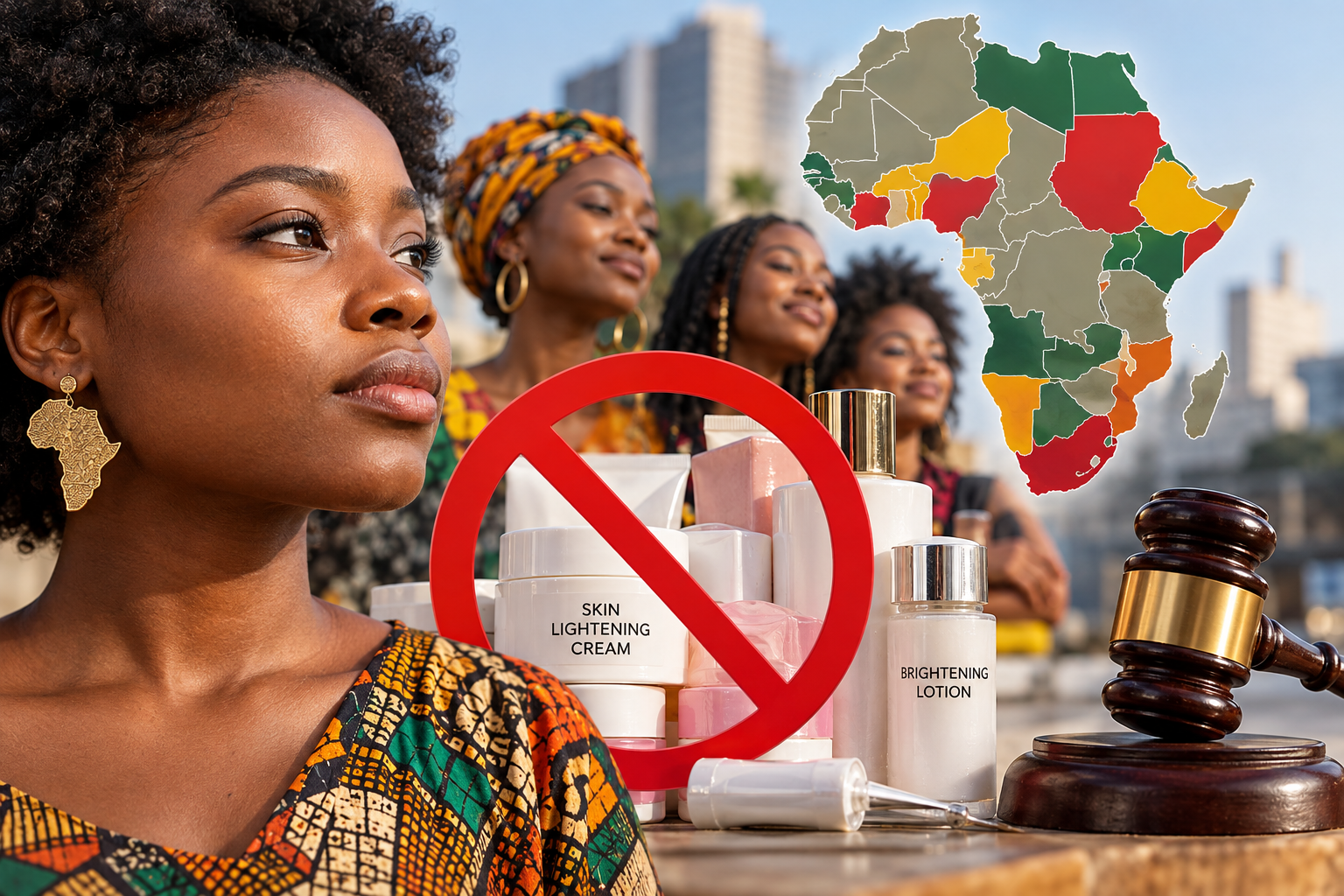
From South Africa and Ghana to Rwanda, Kenya and Côte d’Ivoire, African governments are confronting the trade in potentially dangerous skin-lightening products. But as restrictions spread, a bigger question emerges: can legislation change a beauty culture that has spent generations teaching Africans that lighter skin is more desirable?
Across Africa, a quiet but consequential struggle is taking place in cosmetics shops, informal markets, pharmacies, border crossings and increasingly on social media.
At the centre of it is a multibillion-dollar global beauty industry, a persistent demand for lighter skin, and growing concern about the chemicals used to achieve it.
For decades, skin bleaching has been marketed as a pathway to beauty, confidence, social acceptance and opportunity. Products promise brighter complexions, flawless appearances and rapid transformations. Some contain substances that can cause lasting harm.
Now, African governments are responding.
South Africa introduced restrictions decades ago. Côte d’Ivoire acted in 2015. Ghana strengthened its enforcement in 2017. Rwanda has confiscated prohibited cosmetics and prosecuted sellers. Kenya has also adopted restrictions on harmful skin-lightening agents.
Yet there is an important distinction often lost in headlines: most countries have not banned every product that brightens skin or treats pigmentation. Their laws generally target particular harmful ingredients, product categories, or unapproved cosmetics.
That distinction matters for consumers, legitimate manufacturers, medical professionals and anyone seeking to understand the continent’s regulatory response.
The African countries that have taken action
The following countries have documented bans or restrictions on certain skin-bleaching cosmetics, although the scope and enforcement differ.
| Country | Documented action |
|---|---|
| South Africa | Regulations introduced in 1990 prohibit cosmetic skin bleachers and specified depigmenting ingredients, including mercury compounds. |
| Ghana | In 2017, the Food and Drugs Authority implemented restrictions on the importation and sale of skin-bleaching cosmetics containing hydroquinone. |
| Rwanda | Prohibits cosmetics containing specified harmful ingredients, including hydroquinone and mercury, and publishes lists of banned products. |
| Kenya | Has adopted restrictions on harmful skin-lightening products and their ingredients. |
| Côte d’Ivoire | Introduced restrictions in 2015 on skin-lightening cosmetics containing specified dangerous substances. |
| Uganda | Has restrictions on cosmetics containing harmful skin-lightening ingredients, including hydroquinone and mercury. |
| Tanzania | Has taken regulatory action against cosmetics containing prohibited skin-lightening substances. |
| Nigeria | Regulates harmful ingredients in cosmetics, including mercury and hydroquinone; this should not be confused with a universal ban on all brightening products. |
| Zimbabwe | Has been identified in published research as restricting the importation and sale of certain skin-bleaching products containing harmful ingredients. |
Sources: South African Department of Health, East African Legislative Assembly, Rwanda FDA and peer-reviewed research. This is a documented-action overview, not a complete legal register or confirmation that every historical restriction remains unchanged.
National Department of Health
+3
South Africa: A ban that dates back to 1990
South Africa was among the earlier countries to introduce strong restrictions on skin-bleaching cosmetics.
Its regulations, amended in August 1990, prohibit the cosmetic category of skin bleachers, lighteners and whiteners, together with specified depigmenting ingredients, lead and mercury compounds.
These restrictions emerged against a complex historical background in which skin colour was closely associated with racial classification, social hierarchy and discrimination.
However, legislation did not eliminate demand. Researchers have documented continued circulation of unlawful products, particularly through informal markets.
The South African experience offers an important lesson: banning a dangerous product does not automatically remove the social pressures that make people want to use it.
National Department of Health
+1
Ghana: Taking hydroquinone off cosmetic shelves
Ghana’s Food and Drugs Authority began implementing a ban on the importation and sale of skin-bleaching cosmetics containing hydroquinone in 2017.
The authority stopped registering cosmetics containing the substance for skin bleaching and described laboratory testing and public education as part of its enforcement strategy.
The policy was directed at potentially harmful cosmetic use, not a blanket prohibition on every medically supervised treatment for hyperpigmentation.
Ghana’s approach demonstrates why regulators need more than legislation. Laboratory capacity, import inspections and monitoring of product claims are essential when a prohibited ingredient can be concealed behind attractive packaging.
Africanews
Rwanda: When a beauty product becomes a policing issue
Rwanda provides one of the clearest examples of active enforcement.
The Rwanda Food and Drugs Authority has published lists identifying prohibited cosmetic products and the ingredients responsible for their restriction.
Rwandan police have also reported arrests and seizures involving sellers of unlawful skin-lightening cosmetics.
In one official account, the authorities described a list of 1,342 prohibited cream and oil brands associated with ingredients including hydroquinone and mercury.
This is no longer simply a consumer-awareness issue. Rwanda has treated the commercial distribution of prohibited cosmetics as a matter of public health enforcement.
Rwanda National Police
+1
Kenya and Uganda: From cosmetic restrictions to consumer protection
Kenya’s restrictions are older than many people realise.
The Kenya Bureau of Standards confirms that cosmetic use of hydroquinone, steroids and hormonal preparations was prohibited through gazette notices issued in 1998 and 2000.
These substances may still have legitimate medical uses under appropriate professional supervision, but that is different from selling them as ordinary beauty creams.
Kenya Bureau of Standards
Uganda banned the manufacture, importation and sale of cosmetics containing mercury and hydroquinone in 2016.
In December 2023, the Uganda National Bureau of Standards reaffirmed that prohibition and reported that 31% of samples in a previous market survey contained hydroquinone.
That finding illustrates a central weakness in prohibition-only approaches: a product can remain commercially available long after its ingredients have been outlawed.
UNBS
+1
Côte d’Ivoire, Tanzania and Nigeria: Different laws, a common concern
Côte d’Ivoire’s government announced restrictions in April 2015, including on cosmetic products containing mercury, corticosteroids and hydroquinone above 2%.
The distinction is significant: Côte d’Ivoire’s announced rule used a concentration threshold for hydroquinone, rather than the zero-tolerance approach applied to that ingredient in certain other countries.
Actualités
Tanzania’s Bureau of Standards maintains a list of prohibited cosmetics, including named skin-lightening products containing hydroquinone.
Tanzania Bureau of Standards
Nigeria’s cosmetics regulations likewise distinguish between prohibited bleaching agents and hydroquinone concentration limits. Its 2019 regulations prohibit specified agents, including mercury compounds and corticosteroids, and restrict cosmetics containing more than 2% hydroquinone alone or 1% in combination with other lightening ingredients.
NAFDAC
These differences make one thing clear: Africa is not operating under a single, uniform skin-bleaching law.
The chemicals behind the warnings

Mercury
A toxic heavy metal that may be added to skin-lightening products. Exposure can damage the kidneys and nervous system and poses particular risks during pregnancy.

Hydroquinone
A depigmenting agent used in certain medically supervised treatments. Inappropriate or prolonged use can cause irritation and exogenous ochronosis, a potentially persistent blue-black skin discolouration.

Potent corticosteroids
These medicines can treat inflammatory skin conditions when appropriately prescribed. Misuse for skin lightening can lead to thinning skin, stretch marks, acne, infections and, with extensive exposure, systemic effects.
The World Health Organization identifies mercury-containing skin-lightening products as a significant health hazard and warns that prohibited products remain accessible through online and informal distribution channels.
World Health Organization
+2
Why skin bleaching remains popular despite the risks
To understand the persistence of skin bleaching, it is necessary to look beyond chemistry.
Across many societies, lighter complexions have historically been associated with privilege, beauty and higher social standing. Colonial racial hierarchies reinforced some of these perceptions, while modern advertising and celebrity culture have helped reproduce them.
The phenomenon is often described as colourism: differential treatment or prejudice based on skin shade, including within the same racial or ethnic community.
But individual motivations are diverse. Some consumers seek treatment for acne marks, melasma or uneven pigmentation. Others seek a lighter overall complexion. These are not interchangeable medical or social circumstances.
The distinction is essential because treating a diagnosed pigmentation condition under dermatological supervision should not be confused with using unregulated bleaching mixtures.
The deeper challenge is therefore twofold: protect consumers from dangerous products while confronting the social conditions that create demand for them.
A continental response is emerging
22 JANUARY 2025
The Libreville Commitment
Representatives and experts from 13 African countries participated in a regional initiative in Gabon that culminated in a commitment to strengthen cooperation against mercury-containing skin-lightening cosmetics.
The Libreville Commitment calls for better regulations, enforcement, laboratory testing and public awareness.
It builds on the Minamata Convention on Mercury, an international treaty addressing mercury pollution and mercury-added products.
The treaty framework prohibits mercury in cosmetics, with the convention’s original product controls including a 1-part-per-million threshold and subsequent amendments strengthening the prohibition.
Importantly, signing an international commitment is not the same as having a fully enforced domestic ban. Each country must still translate its obligations into effective national controls.
Global Mercury Partnership
+2
A further UNEP-supported initiative approved for development in 2025 identified 13 African countries for additional work against mercury-added skin-lightening products:
Burkina Faso, Comoros, Côte d’Ivoire, Ethiopia, Guinea, Madagascar, Mauritania, Niger, Nigeria, Sierra Leone, South Africa, Togo and Uganda.
Their inclusion does not mean all 13 introduced new bans in 2025. Rather, it demonstrates a coordinated effort to remove dangerous products from physical and online markets.
Global Mercury Partnership
The problem with banning products that people can still buy
Imagine a country banning a dangerous cosmetic in its formal retail stores.
A consumer can no longer find it in a registered supermarket. Yet the same product might remain available through an informal trader, a cross-border supplier or an online seller operating beyond effective inspection.
This is the regulatory problem facing African authorities.
The WHO has warned that mercury-containing products remain accessible even where restrictions exist. Uganda’s testing findings and Rwanda’s enforcement operations provide concrete examples of that challenge.
World Health Organization
+2
For bans to achieve their intended public-health benefits, governments need functioning testing laboratories, customs cooperation, product traceability, online marketplace enforcement and credible penalties.
They also need to communicate the difference between prohibited bleaching products and legitimate dermatological treatments.
Otherwise, consumers may simply move from regulated products to potentially more dangerous unregulated alternatives.
What African consumers should know
A product’s attractive packaging, celebrity endorsement or claim of being natural is not proof of safety.
Consumers should be particularly cautious of creams promising dramatic changes in complexion within days, products with incomplete ingredient lists, unlabelled mixtures and cosmetics containing prescription-strength substances without medical oversight.
Mercury may appear under different chemical names, while hydroquinone may also be identified as 1,4-benzenediol or benzene-1,4-diol. The absence of these names from a label does not guarantee that a product is free from prohibited substances.
Anyone experiencing persistent burning, unusual darkening, skin thinning or other adverse reactions after using a lightening product should stop using it and seek professional medical advice. People using prescribed pigmentation treatments should consult their clinician before making changes.
Beyond the ban: Reclaiming African beauty
There is a cultural question at the heart of this debate.
What happens when a continent with an extraordinary diversity of skin tones continues to receive messages that associate beauty, professionalism or success with lighter complexions?
Who benefits economically from those messages?
And how can African societies challenge colourism without shaming people who have used skin-lightening products?
The answers require more than legislation.
They require schools that teach self-worth without colour hierarchies, media that represent darker complexions without stereotypes, advertising that does not exploit insecurity, and healthcare systems that make evidence-based skin treatment accessible.
They also require an African cosmetics industry capable of developing safe, effective products for the full diversity of African skin.
There is nothing inherently wrong with wanting healthy skin, treating dark spots or managing a diagnosed pigmentation disorder. The problem arises when unsafe chemicals are sold without adequate controls, or when people are pressured to change their natural complexion to feel acceptable.
Conclusion: Africa can ban the chemicals. Can it challenge the prejudice?
From Johannesburg to Accra, Kigali to Nairobi, and Abidjan to Kampala, governments have demonstrated that the risks associated with certain skin-bleaching products warrant regulation.
The next challenge is ensuring those regulations work.
A law cannot protect consumers if prohibited products continue crossing borders unchecked. A public-health campaign cannot succeed if people lack access to reliable information. And a cultural conversation cannot progress if it condemns individuals rather than examining the pressures influencing their choices.
The future of African beauty should not depend on how much melanin a person can remove. It should depend on health, choice, dignity and the freedom to feel beautiful without being exposed to dangerous chemicals.
Africa’s fight against harmful skin bleaching is ultimately a test of consumer protection, public health and the continent’s ability to challenge inherited standards of beauty.








You must be logged in to post a comment Login