


Business & Economy
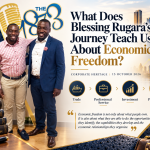
What Does Blessing Rugara’s Journey Teach Us About Economic Freedom?

Published
3 days agoon
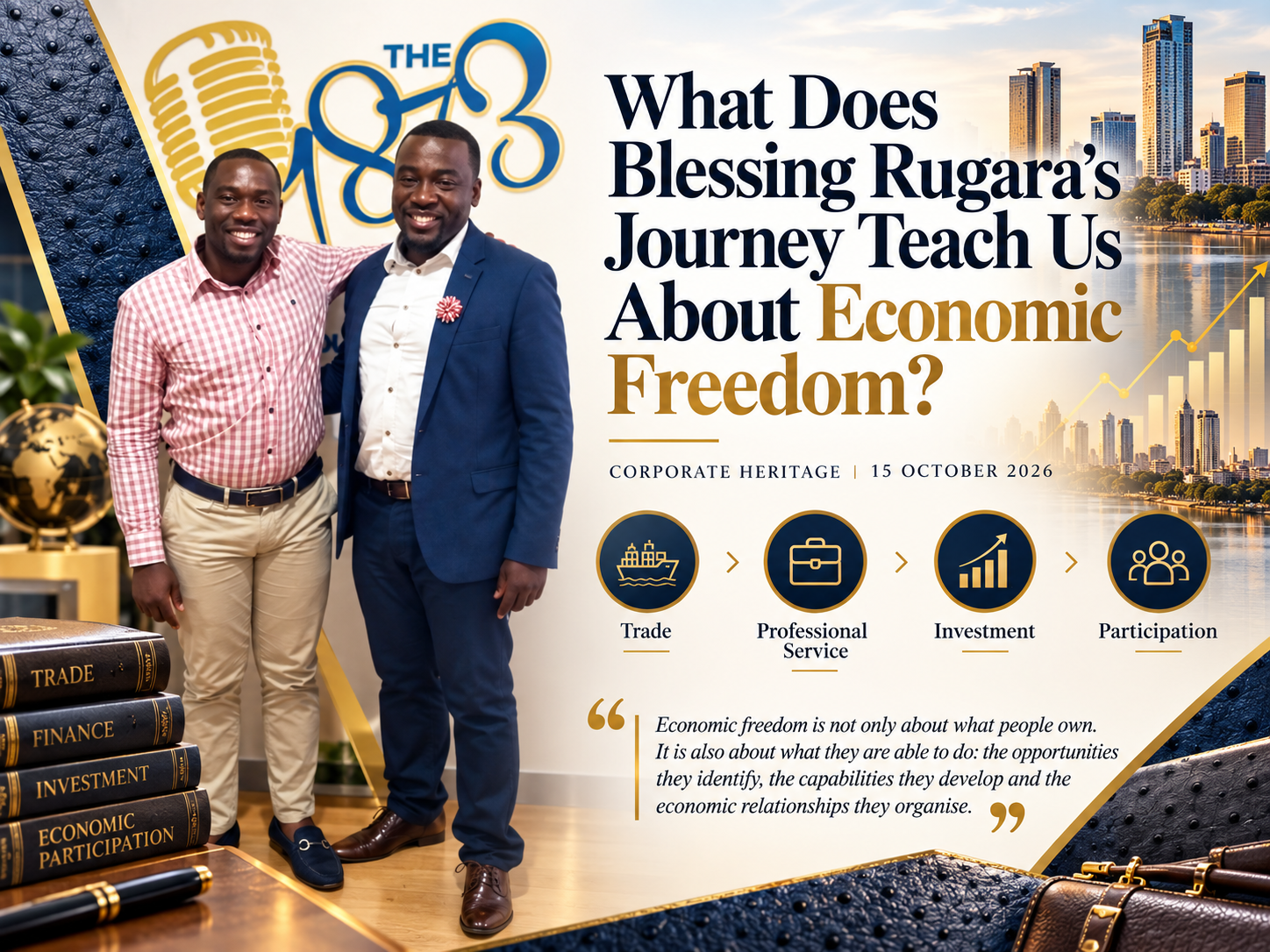
Economic freedom is not only about what people own. It is also about what they are able to do: the opportunities they identify, the capabilities they develop and the economic relationships they organise. Blessing Rugara’s journey, from importing ostrich skins as a university student in Canada to co-founding an investment company involved in major corporate transactions, offers a practical illustration.
Ten years ago today, on 15 October 2016, I shared a Facebook post inviting people to a Master Class on Economic Freedom with Rugara on The 1873 FM. The question I posed was:
“Some individuals say that we attained political freedom and not economic freedom. What is your understanding of Economic Freedom?”
Rugara was one of the founding members of The 1873 Network, and I had several conversations with him about his entrepreneurial journey and work in corporate finance. Revisiting those conversations alongside publicly available corporate records provides an opportunity to examine economic freedom through his experiences.
When an African Product Finds a Market in Canada
During one of our conversations, Rugara described an experience from his university years in Canada. While studying, he identified a commercial opportunity involving ostrich skins sourced from Africa. He imported them and supplied Canadian manufacturers who used them to make belts, handbags, shoes and other leather products.
What interests me is the set of economic relationships that made this trade possible.
Somewhere in Africa, people were supplying ostrich skins. In Canada, manufacturers needed materials for their products. Rugara recognised an opportunity to connect the two markets.
He did not need to own an ostrich farm or a factory manufacturing finished leather products. His contribution was identifying demand, sourcing the product, establishing commercial relationships and arranging supply.
The existence of ostriches in Africa did not, by itself, create a business supplying Canadian manufacturers. Human action was necessary to convert the availability of a product into a commercial exchange.
Here was an African student exercising economic agency through international trade before entering corporate finance. His experience raises a question: how much economic value remains unrealised, not because resources or markets are absent, but because the connections necessary to bring them together have not been established?
According to his professional biography, Rugara earned a Bachelor of Arts degree in Psychology from the University of Manitoba, where he served as student union president, and a Juris Doctor from the University of Minnesota Law School on a Royal Stone scholarship.
What makes his experience particularly instructive is that entrepreneurship did not wait for the completion of his formal education. While acquiring academic knowledge, he was already identifying commercial opportunities and participating in economic exchange.
When Knowledge Becomes a Professional Service
Rugara subsequently pursued a career in corporate law and finance. According to the professional biography circulated in 2016, he became the youngest partner in the corporate finance department of a major American law firm and advised on transactions exceeding US$2 billion across four continents. His experience included capital raising, private equity, private debt placements and municipal bonds.
The instructive point is the nature of his participation.
An adviser involved in a billion-dollar transaction does not necessarily own the billion dollars. The contribution may involve structuring agreements, negotiating terms, assessing legal obligations and coordinating parties whose capital and assets are involved.
The economic value of that knowledge is distinct from ownership of the underlying assets.
This connects directly to Rugara’s earlier ostrich-skin business. In Canada, he participated by supplying a physical product. In corporate law, he participated by offering specialised knowledge and professional judgement.
The scale and complexity differed considerably, but both activities involved recognising opportunities and contributing something that other participants valued.
His journey demonstrates how developing capabilities can expand the range of economic activities in which an individual is able to participate.
When Professional Capability Becomes an Investment Enterprise
In 2002, Rugara and Hlumelo Biko co-founded Circle Capital. A 2005 Mediclinic shareholder circular records the founding and describes the company’s approach to investing in existing businesses, providing strategic leadership, access to capital and operational support to contribute to their growth and transformation.
The circular also outlines Circle Capital’s investment philosophy, which recognised four forms of capital: human, intellectual, social and physical.
This distinction matters because discussions about capital frequently concentrate on money.
Money can finance a transaction, but it does not independently identify opportunities, negotiate agreements or operate businesses. People perform those functions, drawing on their knowledge, experience, relationships and available resources.
The public record provides examples of how Circle Capital’s approach translated into investment activity.
In September 2004, ITWeb reported that Circle Capital had acquired a 50% equity interest in CommsCo, an information technology business associated with VenFin. The acquisition was financed through capital raised from private investors in exchange for shares.
The transaction illustrates how an investment enterprise can mobilise capital from investors rather than relying exclusively on the personal financial resources of its founders.
However, attracting investment requires more than identifying a company in which to acquire shares. Investors must be willing to commit resources under agreed terms, while the parties to the transaction must negotiate their respective rights, obligations and risks.
A year later, in October 2005, Mediclinic announced a black economic empowerment transaction valued at approximately R1.1 billion. The proposed arrangement allocated 6.9% of the company to Phodiso, 4.1% to Circle Capital and 4% to an employee share trust.
Mediclinic’s corporate history records the transaction as a milestone in its ownership transformation. Its financing arrangements involved special-purpose investment vehicles, ordinary and preference shares, and institutional financing.
Such financing structures invite legitimate questions about ownership, economic exposure, control and the obligations attached to borrowed capital. The extent to which an investor enjoys effective control or ultimately realises economic value depends on the particular terms and performance of the investment.
Whatever one’s assessment of black economic empowerment financing, the institutional mechanisms deserve attention.
Corporate ownership is not established merely through a political declaration. It involves legally recognised interests, contractual arrangements, financing obligations and commercial risks.
Rugara’s involvement in founding Circle Capital placed him within an enterprise through which these arrangements could be negotiated and investment opportunities pursued.
Is Ownership the Only Evidence of Economic Freedom?
Public discussions about economic freedom often concentrate on who owns land, mines, banks, factories and other productive assets.
Ownership matters. It establishes legally recognised interests in assets and may confer rights to income, control, disposal and participation in the economic benefits they generate.
But an economy does not operate through owners alone.
A person may be a holder of shares in a company. Another may be an employee, supplier, customer, lender or professional adviser. Each occupies a different legal and commercial position, contributing to economic activity through a particular relationship.
Rugara’s journey illustrates several forms of participation.
As a student, he traded a physical product. As a lawyer, he provided professional services. As a co-founder of Circle Capital, he helped establish an investment enterprise that acquired ownership interests in established businesses.
At different stages, his contribution involved identifying demand, applying knowledge, organising relationships and mobilising capital.
This is not an argument that ownership is unimportant. It is a recognition that economic participation extends beyond ownership, and that different forms of participation require different capabilities.
It also explains why corporate literacy matters.
Understanding the distinction between owning an asset, holding shares, providing capital, supplying goods and advising on a transaction helps individuals appreciate the legal relationships through which economic value is created, exchanged and distributed.
What Can One Individual’s Journey Establish?
Rugara’s experience does not establish that everyone enjoys equal economic opportunity.
Historical exclusion, unequal access to education, limited finance, discrimination and institutional barriers can affect who participates in economic activity and under what conditions.
The legal freedom to establish a company does not guarantee access to investment capital, customers or commercial success.
These distinctions matter because economic rights and the practical capacity to exercise them are related but not identical.
Nevertheless, recognising these constraints should not prevent us from examining what individuals have accomplished.
Rugara’s journey illustrates how entrepreneurial initiative, education, professional competence and institutional relationships can contribute to economic participation.
It also invites practical questions. How were his capabilities developed? What enabled him to recognise opportunities? How did he establish relationships with people willing to transact with him? What made investors and corporate clients prepared to entrust him with commercial responsibilities?
These questions direct our attention to the actual processes through which individuals participate in economic life.
The 1873 Network and the Value of Shared Knowledge
There is another reason this reflection matters to me.
Blessing Rugara was one of the founding members of The 1873 Network. The Master Class on Economic Freedom was only one of several conversations I had with him.
Through those interactions, I learned about aspects of his entrepreneurial journey that were not necessarily captured in public professional biographies.
The ostrich-skin business is one example.
A corporate biography may record academic qualifications, appointments and major financial transactions while overlooking the earlier experiences through which an individual developed an understanding of markets and enterprise.
Yet those experiences can be equally instructive.
The 1873 Network provided a setting in which people could exchange knowledge, professional experiences and ideas.
A conversation about private equity could introduce someone to the mechanisms through which companies raise investment capital. A discussion about corporate ownership could prompt an examination of shareholders’ rights. An account of international trade could reveal how products move between markets and how individuals participate in those exchanges.
Knowledge does not guarantee commercial success, but it can expand an individual’s understanding of the opportunities available and the capabilities required to pursue them.
This is one reason I continue revisiting my earlier Facebook posts. They preserve encounters, conversations and experiences that can be examined years later, providing an opportunity to build upon knowledge previously shared.
Ten Years Later, What Have We Learned?
Rugara’s journey gives me a practical basis for revisiting the question I posed in 2016.
As a university student, he recognised an opportunity to supply African ostrich skins to Canadian manufacturers. He subsequently developed professional capabilities in corporate law and finance, participated in major transactions and co-founded an investment enterprise that acquired interests in established companies.
His journey involved different forms of economic participation, from trading physical goods to offering specialised services and mobilising investment capital.
Across these experiences, one element remained essential: human agency.
Someone had to identify demand for ostrich skins in Canada. Someone had to acquire the knowledge necessary to advise on corporate transactions. Individuals had to establish Circle Capital, negotiate investments and organise the financing required to acquire ownership interests.
Economic freedom does not eliminate the need for such actions. It provides a legal and institutional environment within which individuals may pursue them, although their practical opportunities remain shaped by the resources, capabilities and constraints they encounter.
Perhaps the most instructive lesson from revisiting Rugara’s journey is the importance of recognising capital in its different forms.
Human capabilities, intellectual resources, social relationships and physical assets can each contribute to economic activity. Financial capital can facilitate their organisation, but it cannot substitute for the individuals who recognise opportunities and put these resources to productive use.
Ten years after that conversation, I find myself returning to a question that deserves greater attention:
If economic freedom includes the ability to participate in creating and exchanging value, how well do we understand the capabilities, relationships and institutions through which that participation becomes possible?
#CorporateHeritage #CorporateLiteracy #TheAfricaIWant #BOAF
Over the years, I have found it challenging to define myself solely by an academic qualification, trade, or occupation. My eagerness to learn, especially about how to build and deploy capital, has allowed me to accumulate diverse experiences in a short span of time. Through this journey, I have discovered that at my core, I am a storyteller. I tell the stories of corporations, their heritage, and the individuals who act in their name. I explore the role of these institutions in fulfilling the promise of a better Africa, and, most importantly, the causal link between the rule of law and economic development. As a fellow believer in Africa’s potential, can I count on you to be a point of light in securing our continent’s future?



You must be logged in to post a comment Login