


Agriculture
Eleven Years Later, I Am Asking Better Questions

Published
2 months agoon
By Tinashe T. T. Mpasiri | 17 August 2026
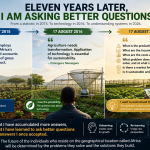
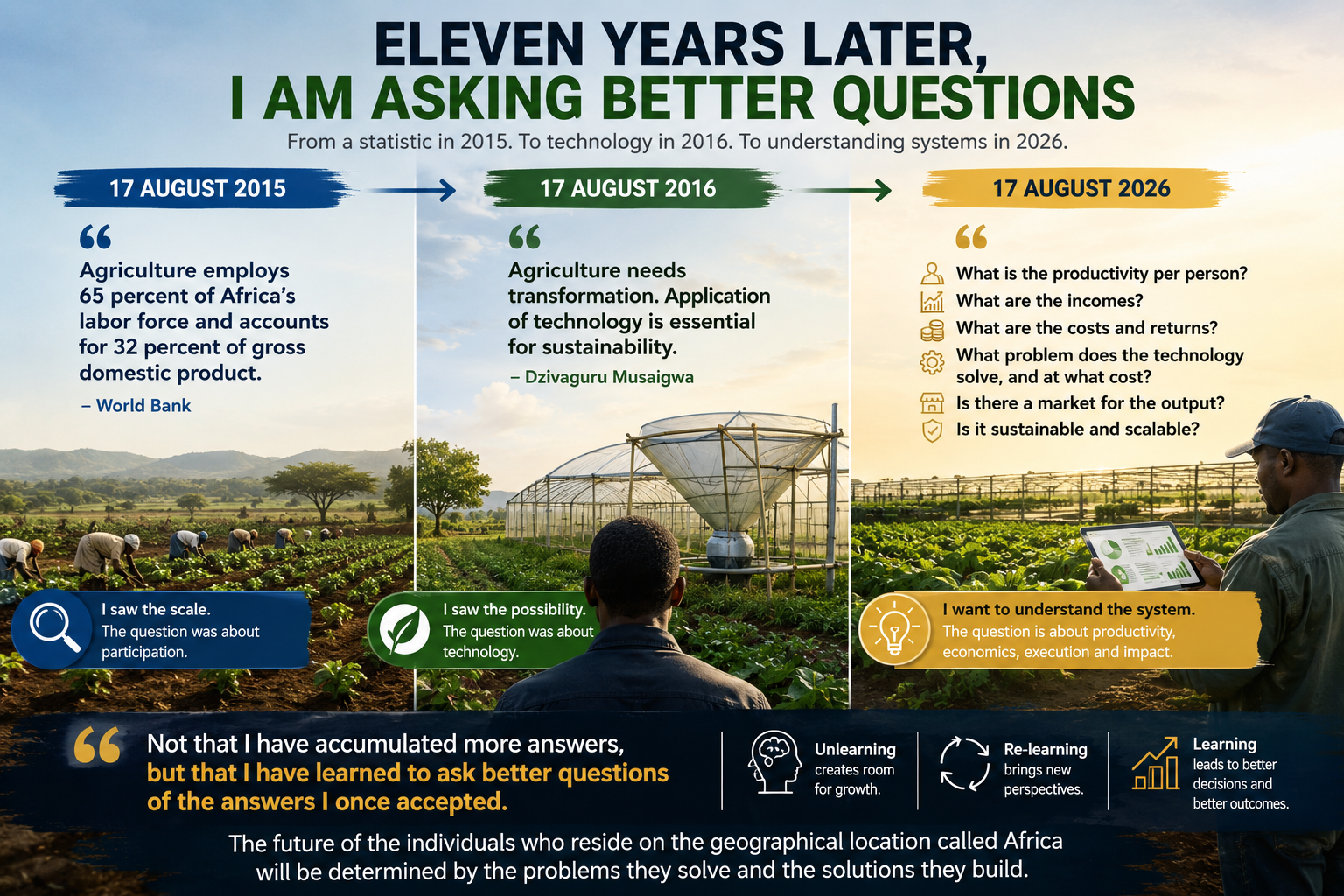
On 17 August 2015, I shared a statistic attributed to the World Bank:
“Agriculture employs 65 percent of Africa’s labour force and accounts for 32 percent of gross domestic product.”
Exactly a year later, on 17 August 2016, I returned to agriculture, this time writing:
“Agriculture needs transformation. Application of technology is essential for sustainability.”
I referred to an Ethiopian innovation involving a greenhouse designed to harvest dew and use the collected water for irrigation.
Today, 17 August 2026, I find myself looking at those two posts again.
What interests me is not that I was writing about agriculture eleven years ago.
It is how differently I interrogate the same subject today.
In 2015, the statistic interested me.
In 2016, technology appeared to offer part of the answer.
In 2026, I am more interested in the questions neither could answer.
What Does the Statistic Really Tell Me?
At first glance, saying that agriculture employed 65 percent of the labour force was compelling because of the sheer number of people involved.
But participation in an economic activity tells me little about the quality of that participation.
What were those individuals earning?
What was their output per person?
How much of what they produced reached formal markets, and how much value did they capture?
How resilient were their livelihoods to drought, changing input costs, infrastructure deficiencies and market volatility?
The statistic measured participation.
It did not necessarily measure productivity, prosperity or resilience.
That distinction matters.
If millions of individuals participate in an economic activity but remain poor, increasing participation alone cannot be the measure of progress.
The better question becomes:
What is happening to the productive capacity and economic condition of the human beings represented by the statistic?
That is not a question I remember asking in 2015.
I ask it now.
Then I Saw Technology
By 2016, my thinking had moved from observing agriculture’s scale to considering how production could be transformed.
The greenhouse caught my attention because it addressed a constraint.
Water scarcity limits production. If technology can capture water that would otherwise be unavailable and deploy it productively, it expands what is possible.
That reasoning still holds.
But today, the existence of the technology would be the beginning of my inquiry rather than its conclusion.
I would want to understand its cost, productive capacity, maintenance requirements and expected lifespan. I would want to know which crops justify its use, what skills are necessary to operate it and whether the resulting production can compete commercially.
Most importantly, I would want to understand whether the value created justifies the capital committed.
The photograph of an innovative greenhouse can inspire.
The economics determine whether it can endure.
That distinction represents part of my own intellectual evolution: moving from being fascinated by what technology can do to interrogating whether its application produces a sustainable outcome.
Possibility Is Not Viability
This distinction extends beyond the greenhouse.
What is technically possible is not necessarily economically viable.
A crop may grow successfully under controlled conditions while its selling price fails to cover the cost of producing it.
Technology may increase yields dramatically while the market remains incapable of absorbing the additional output profitably.
An engineering solution may function exactly as designed and still fail commercially.
Conversely, a relatively simple technology applied to the right constraint, at an appropriate cost and connected to a viable market may create considerable value.
This is why I increasingly find the relationship between production, technology, capital and markets more interesting than any one of them in isolation.
The question is not merely whether something can be done.
It is whether it can be done productively, sustainably and economically.
Better Questions Change the Meaning of Old Answers
This is perhaps what these two old posts have taught me most.
Learning is not simply the accumulation of answers.
Sometimes evidence of learning is discovering that an answer which once satisfied you is no longer sufficient.
In 2015, knowing that agriculture employed a large proportion of people seemed significant.
It was.
Today, I want to understand the economic condition of those people.
In 2016, knowing that technology could overcome agricultural constraints seemed significant.
It was.
Today, I want to understand the economics surrounding its application.
Neither means that the earlier observation was wrong.
It means that the questions have become better.
And better questions reveal dimensions of a problem that simpler questions can conceal.
Learning From What Works
There is another consequence of asking better questions.
When I encounter an agricultural innovation in Ethiopia, Kenya, the Netherlands, Brazil or elsewhere today, my first instinct should not be simply to ask whether it can be replicated.
Replication without understanding can become expensive imitation.
The more useful inquiry is to understand why something works where it works.
What problem was it designed to solve?
What conditions made it viable?
What knowledge supports it?
What infrastructure surrounds it?
What assumptions underpin its economics?
Which of those conditions exist elsewhere, and which would have to be created?
This transforms learning from copying visible outcomes into understanding the systems that produced them.
That principle extends well beyond agriculture.
Eleven Years of Unlearning, Re-learning and Learning
Looking at the two posts side by side has therefore become an unexpected audit of my own thinking.
The 2015 version of me saw significance in scale.
The 2016 version saw possibility in technology.
The 2026 version wants to understand what determines whether possibility becomes a productive and sustainable outcome.
There is little intellectual value in returning to something written eleven years ago merely to say:
I said this before.
The more useful question is:
What do I understand today that I did not understand when I wrote it?
That question requires me to interrogate my own thinking.
Some ideas survive examination.
Others require refinement.
Some assumptions must be abandoned altogether.
That is the purpose of unlearning, re-learning and learning.
Unlearning creates room to challenge what experience has shown to be inadequate.
Re-learning allows an old subject to be examined through new knowledge and experience.
Learning produces a better basis from which to act.
An Old Post Should Not Become an Old Mind
There is a danger in documenting one’s thoughts publicly.
Past statements can become positions to defend rather than ideas to interrogate.
But yesterday’s words should never become a prison.
I can agree with what I wrote in 2015 while asking harder questions about what the statistic actually meant.
I can agree with what I wrote in 2016 while demanding more evidence before concluding that a technology represents a viable solution.
The objective is not consistency for its own sake.
The objective is better understanding.
Eleven years later, I remain interested in agriculture.
But I am less impressed by the size of a statistic.
Less impressed by the novelty of a technology.
More interested in what lies beneath both.
Productivity.
Economics.
Execution.
Evidence.
And whether an idea survives contact with reality.
Perhaps that is one measure of learning:
Not that I have accumulated more answers, but that I have learned to ask better questions of the answers I once accepted.
The posts from 2015 and 2016 tell me what I was thinking then.
The questions I ask of them in 2026 tell me something about what I have learned since.
And eleven years from now, I should be willing to subject what I believe today to the same interrogation.
Otherwise, I will have grown older without necessarily having learned.
Over the years, I have found it challenging to define myself solely by an academic qualification, trade, or occupation. My eagerness to learn, especially about how to build and deploy capital, has allowed me to accumulate diverse experiences in a short span of time. Through this journey, I have discovered that at my core, I am a storyteller. I tell the stories of corporations, their heritage, and the individuals who act in their name. I explore the role of these institutions in fulfilling the promise of a better Africa, and, most importantly, the causal link between the rule of law and economic development. As a fellow believer in Africa’s potential, can I count on you to be a point of light in securing our continent’s future?



