



Leadership & Governance
Institutions Matter, But People Act: Revisiting a 2019 Conversation on Women, Agency and the Rule of Law

Published
2 months agoon
By Tinashe T. T. Mpasiri | 8 August 2026
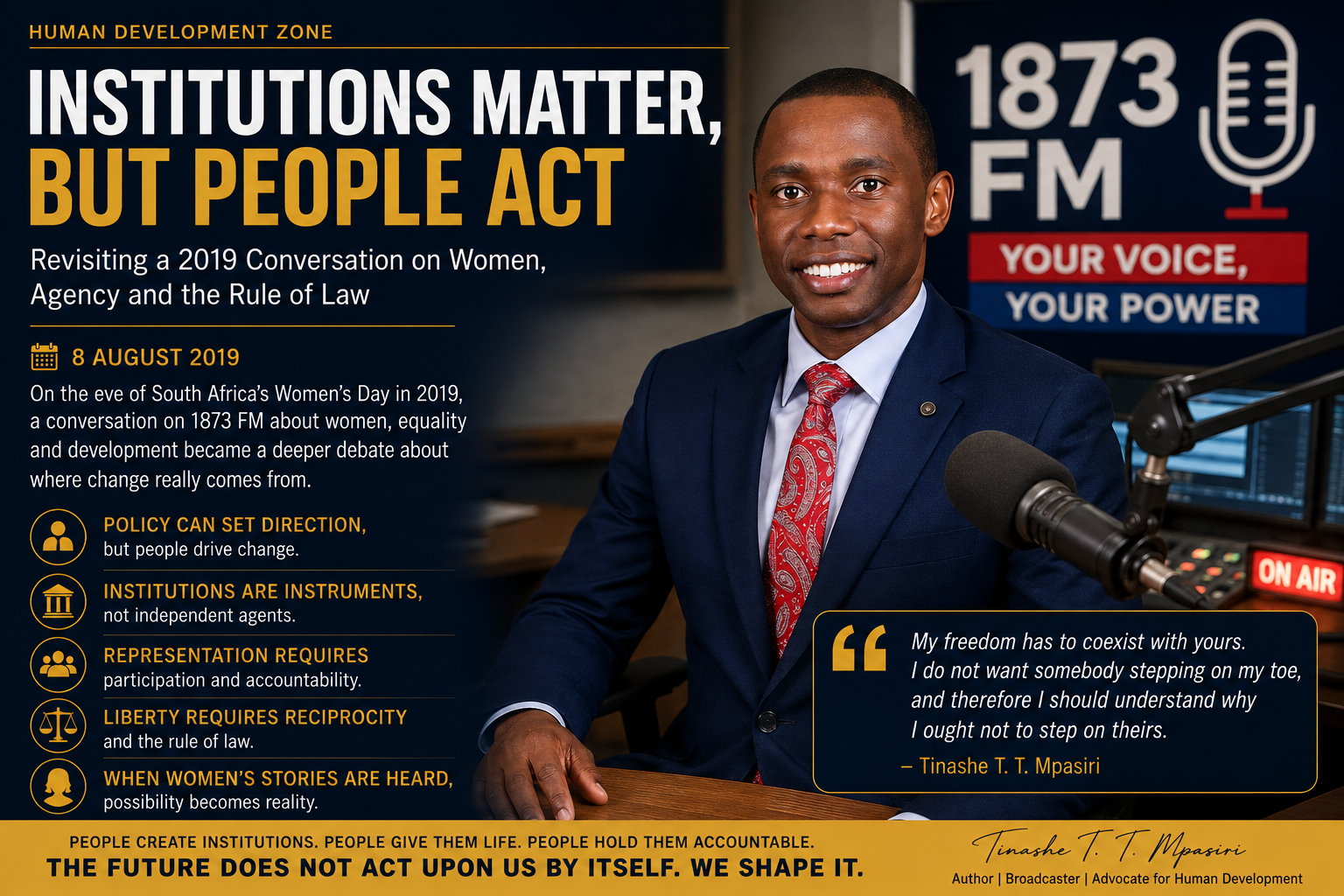
On 8 August 2019, on the eve of South Africa’s Women’s Day, I participated in a conversation on the Human Development Zone about women, economic participation, public policy and the role individuals can play in advancing equality.
Seven years later, the conversation is worth revisiting.
Not because every proposition advanced that day was perfectly expressed. In fact, some of the most interesting parts of the discussion emerged precisely because the interviewer challenged my assertions.
What began as a Women’s Month conversation gradually became something much bigger: a debate about where change actually comes from.
Does change begin with government?
Does it begin with policy?
Does it begin with institutions?
Or does it ultimately begin with people?
From Celebrating Women to Asking Who Creates Change
The initial question was straightforward, as a man, what was I doing to advance equality and women’s participation in the economy?
At the time, I hosted a morning programme on 1873 FM. Part of what we sought to do was create platforms for people from different walks of life to tell their stories.
Women in agriculture.
Women in construction.
Women in mining.
Women in finance.
My proposition was that when women who were already participating in economic life were given platforms to tell their stories, another young woman or girl could encounter not merely an abstract message about empowerment, but evidence of possibility.
As I put it during the conversation, these women could explain how they had moved “from the valley to the mountaintop”, allowing a girl child to see that if somebody else had done it, she too could imagine doing it.
There was an important idea buried inside that answer.
Visibility can expand the boundaries of what people believe is possible.
But the interviewer pushed the conversation further.
What If You Were the Minister?
I was asked what I would do if appointed Minister responsible for women.
My response was deliberately provocative: I said I would probably become “the most useless person”, because without ministerial office I was more accessible to ordinary people.
Taken literally, that statement is obviously contestable. Ministers possess powers, budgets, institutional machinery and access to policymaking that ordinary citizens do not.
But beneath the provocation was a question that has remained central to my thinking:
Does a title create agency, or does an individual bring agency to a title?
A ministerial office does not think.
A ministry does not wake up in the morning.
A policy document does not implement itself.
A budget does not allocate itself.
A parliament does not deliberate by itself.
Behind every institution are human beings exercising judgment, making decisions, allocating resources and either acting or failing to act.
That distinction matters.
Policy on Paper Is Not Change on the Ground
The interviewer then asked whether policy could advance women’s empowerment.
My criticism was that societies frequently produce policies that look impressive on paper but fail to translate into practical outcomes.
Seven years later, I would refine the proposition.
The problem is not policy.
The problem is believing that policy is the outcome rather than an instrument for producing an outcome.
A policy can establish direction.
A law can protect rights.
A budget can provide resources.
An institution can coordinate action.
But none of these instruments possesses independent agency.
Someone must act.
That person might be a minister implementing a programme, a public servant processing an application, an entrepreneur employing another person, an investor deploying capital, a teacher opening a student’s imagination, or a citizen holding an elected representative accountable.
Policy matters.
Institutions matter.
But people act.
Do We Need Ministries at All?
This became the most contentious part of the 2019 conversation.
I argued that we did not need all these ministries and invoked the proposition that human beings are created equal and possess rights to life, liberty and the pursuit of happiness.
The interviewer immediately exposed the weakness in taking that proposition too far.
If everything comes down to individuals, what happens when collective action is required?
Millions of people cannot individually occupy Parliament. They cannot all attend the same international summit. They cannot personally administer every public institution.
Society therefore requires organisation, representation and governance.
And during the conversation, I acknowledged precisely that: individuals need to organise themselves to secure the future they collectively desire.
That exchange produced, perhaps unintentionally, the more complete proposition.
Institutions are necessary precisely because individuals need mechanisms through which they can organise collective action.
The institution, however, remains an instrument.
Human beings remain the agents.
Who Is an Institution?
Consider a company.
We casually say,
“The company invested.”
“The bank refused.”
“The government decided.”
“The university developed.”
“The country failed.”
But what exactly are we describing?
Behind each of those statements are identifiable human beings acting under particular authorities, responsibilities, incentives and constraints.
A company cannot sign a contract. A natural person authorised to represent it signs.
A board does not deliberate without directors.
A government department cannot implement a programme without public officials.
Even artificial legal personality ultimately requires human agency to produce consequences in the physical world.
This is why institutional literacy matters.
The existence of an institution should never obscure the responsibility of the people entrusted with its powers.
Representation Is Delegated Agency
The interviewer raised another important challenge.
If everyone cannot participate directly in every decision, we need representatives.
I agreed.
Individuals come together around certain shared values and interests, negotiate their differences and ultimately select people to represent them within institutions such as Parliament.
That is representation.
But representation does not extinguish the agency of the represented.
Electing somebody does not mean outsourcing citizenship for five years.
I argued during the discussion that individuals still have a responsibility to remain active citizens and hold their representatives accountable.
That principle extends beyond politics.
Shareholders appoint directors.
Directors appoint executives.
Citizens elect representatives.
Members appoint office bearers.
In each case, authority is entrusted to particular human beings for particular purposes.
The existence of the structure does not eliminate individual responsibility.
It organises it.
Then Came the Rule of Law
The interviewer recognised where my argument could become dangerous if left unresolved.
If everyone possesses individual agency, and everyone has different values, what prevents society from becoming a collection of people simply doing whatever they please?
He asked me directly whether I believed in the rule of law.
That question took the conversation to its philosophical core.
Freedom cannot mean that my agency extinguishes yours.
If I claim liberty for myself, I must recognise your claim to liberty.
If I claim protection of my property, I must recognise yours.
If I demand that my dignity be respected, I cannot construct a society in which your dignity depends upon my discretion.
Individual agency therefore requires an organising principle.
That is where rules, institutions and ultimately the rule of law enter the equation.
Liberty Requires Reciprocity
Towards the end of the conversation, the interviewer used the Ten Commandments as an illustration of why societies require rules. Without some agreed normative framework, he argued, individual freedom could descend into chaos.
My response was essentially reciprocal:
I do not want somebody stepping on my toe, and therefore I should understand why I ought not to step on theirs.
It sounds simple.
Yet much of civilisation rests upon that proposition.
My rights matter because your rights matter too.
The rule of law is therefore not the enemy of individual agency.
Properly constituted, it is what allows millions of individuals possessing different ambitions, identities, beliefs and interests to exercise agency without reducing society to the rule of the strongest.
And What Does This Mean for Women?
This brings us back to where the conversation began.
Women’s empowerment cannot merely be something written into a policy document.
Nor should women be reduced to passive recipients waiting for institutions to deliver empowerment to them.
Women are entrepreneurs.
Women are professionals.
Women are workers.
Women are investors.
Women are innovators.
Women are citizens.
They possess agency.
The role of a just society should therefore include removing artificial barriers that prevent that agency from being exercised while ensuring equality before the law and access to institutions capable of protecting rights.
But there is another responsibility.
Those who already possess platforms can open them.
Those who possess capital can invest.
Those who employ can create opportunities.
Those who teach can transfer knowledge.
Those who occupy public office can administer their responsibilities fairly.
And those women who have climbed from the valley to the mountaintop can tell the story of the journey so that another girl can see a mountain that she too might climb.
That was what I was trying to do through those conversations on 1873 FM in 2019.
Seven Years Later
Revisiting the conversation of 8 August 2019, I would phrase the argument differently today.
I would not begin by saying institutions do not matter.
They do.
I would say:
Institutions matter because people matter.
People create institutions to organise collective action.
People create laws to establish rules.
People establish companies to aggregate capital, labour, ideas and enterprise.
People elect governments to administer common affairs.
People create universities to organise the pursuit and transmission of knowledge.
And people establish organisations to advance causes they believe deserve collective effort.
But once those institutions exist, we should never make the mistake of granting them imaginary human agency.
Behind every functioning institution are people.
Behind every failed institution are people.
Behind every policy implemented or neglected are people.
Behind every enterprise built, every investment made, every opportunity created and every right defended are people making choices.
Perhaps that is the enduring lesson from a Women’s Day conversation published seven years ago.
We need good institutions.
We need sound policies.
We need effective governance.
We need the rule of law.
But ultimately, the future does not act upon us by itself.
People shape it.
And each of us must decide what part we intend to play.
Over the years, I have found it challenging to define myself solely by an academic qualification, trade, or occupation. My eagerness to learn, especially about how to build and deploy capital, has allowed me to accumulate diverse experiences in a short span of time. Through this journey, I have discovered that at my core, I am a storyteller. I tell the stories of corporations, their heritage, and the individuals who act in their name. I explore the role of these institutions in fulfilling the promise of a better Africa, and, most importantly, the causal link between the rule of law and economic development. As a fellow believer in Africa’s potential, can I count on you to be a point of light in securing our continent’s future?



