

Corporate Heritage
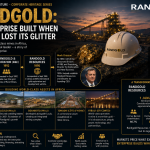
Randgold: The Enterprise Built When Gold Had Lost Its Glitter

Published
2 months agoon
By Tinashe T. T. Mpasiri | 7 August 2026
Inspired by a Facebook post I shared on 7 August 2015.
On 7 August 2015, I recorded an observation by Randgold Resources chairman Chris Coleman that deserves another look eleven years later.
Coleman reminded those present that Randgold had been formed almost exactly twenty years earlier, when the gold price was at what he described as a virtual all-time low.
It raises an intriguing enterprise question.
Who establishes a gold-mining business when confidence in gold is weak?
The easy answer is Mark Bristow.
But the corporate history is more interesting than that.
Before Randgold Resources
Randgold Resources did not simply appear through the actions of one entrepreneur.
Its ancestry stretched back into South Africa’s mining establishment.
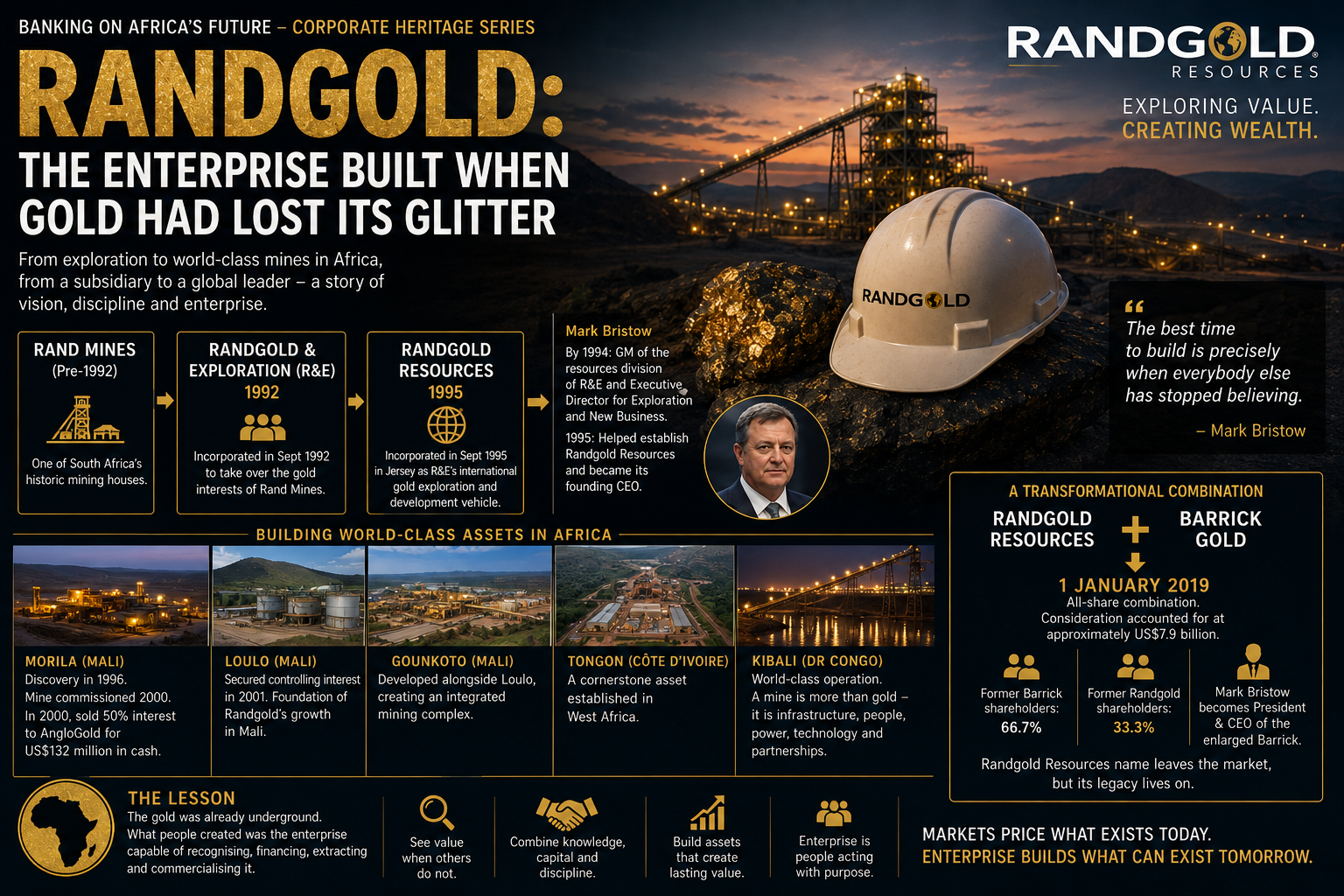
In 1992, Randgold & Exploration Company Limited (R&E) was incorporated to take over the gold interests of the historic Rand Mines group.
Into this institution stepped geologist Mark Bristow.
By 1994, Bristow was general manager of the resources division of Randgold & Exploration and subsequently became an executive director responsible for exploration and new business.
That distinction is important.
He was not general manager of Randgold Resources in 1994.
Randgold Resources did not yet exist.
Its corporate genealogy can therefore be understood as,
Rand Mines → Randgold & Exploration → Randgold Resources.
The birth of Randgold Resources
In August 1995, Randgold Resources Limited was incorporated in Jersey as an international vehicle focused on exploring and developing gold deposits in sub-Saharan Africa.
Bristow played a pivotal entrepreneurial role in establishing the new company and became its founding chief executive.
So it is too simplistic to say that Bristow alone “founded Randgold Resources.”
A more accurate account is that Randgold Resources emerged from Randgold & Exploration, with Bristow becoming the entrepreneurial and operational force behind the new enterprise.
This distinction teaches us something important about entrepreneurship.
Not every entrepreneur begins in a garage.
Sometimes an institution provides the platform, assets, relationships and capital from which an individual identifies and develops a new opportunity.
Institutions provide platforms. People exercise agency.
Why build when gold had lost its glitter?
This brings us back to Coleman’s 2015 observation.
Commodity markets move in cycles.
When prices are rising, capital floods into an industry. Assets become expensive. Exploration accelerates and optimism spreads.
When prices fall, investment contracts. Exploration budgets are cut. Investors become cautious and marginal projects are abandoned.
But something does not disappear when the price falls, the geology.
A gold deposit does not know the gold price.
It remains underground whether investors are euphoric or pessimistic.
Randgold’s proposition was therefore more sophisticated than simply betting that gold prices would eventually rise. It sought high-quality deposits that could be developed into profitable mines capable of surviving commodity cycles.
That required geological knowledge, capital discipline and patience.
Africa had the gold. People had to build the enterprise.
This is where the Randgold story becomes particularly relevant to the African development conversation.
We frequently hear that Africa is rich in natural resources.
It is.
But resources cannot mobilise themselves.
Gold cannot conduct geological surveys.
It cannot drill itself, prepare a feasibility study, raise capital, construct a processing plant, generate electricity, recruit engineers, negotiate mining rights or manage relationships with surrounding communities.
People do those things.
Africa is the location.
People are the actors.
Natural-resource abundance therefore represents potential, not automatically prosperity.
The more important question is not simply,
What resources do we possess?
It is,
Do we possess the people, institutions, knowledge and capital capable of transforming those resources into productive enterprises?
Randgold became an extraordinary case study in doing precisely that.
Morila changes everything
The breakthrough came quickly.
In December 1996, Randgold discovered the Morila gold deposit in Mali.
Finding gold, however, is not the same as owning an economically viable gold mine.
Exploration has to establish the quantity and quality of mineralisation. Engineers must determine whether it can be extracted economically. Processing, infrastructure, environmental requirements and financing all have to be considered.
This explains an important distinction in mining, a mineral resource is not automatically a mineral reserve.
Gold can exist underground without constituting economically recoverable wealth.
Human knowledge and enterprise bridge that gap.
Morila demonstrated that Randgold could make that transition.
In 2000, the company sold half of its interest in Morila, together with an associated shareholder loan, to AngloGold for approximately US$132 million in cash.
Consider what had happened.
Exploration produced knowledge.
Knowledge produced discovery.
Discovery produced an asset.
And the asset attracted capital.
The gold had always existed. The value-creation mechanism had not.
From Morila to a mining powerhouse
Randgold continued developing its African portfolio.
It established a major position at Loulo in Mali, subsequently developed Gounkoto, built Tongon in Côte d’Ivoire, and became operator of the enormous Kibali gold operation in the Democratic Republic of Congo.
Kibali particularly demonstrates what building a mine actually means.
A major mine is an industrial ecosystem.
It requires power, roads, processing facilities, logistics, technology, skilled labour, financing, community relationships and functioning agreements with governments.
In other words, extracting a natural resource often requires creating productive infrastructure around it.
Randgold’s competitive advantage therefore wasn’t simply possessing gold deposits.
It was developing the organisational capability to find, finance, build and operate mines.
Capital and discipline
Mining also teaches another lesson about enterprise.
A company cannot control the international gold price.
But management can influence which deposits it develops, how much it pays for assets, how efficiently mines operate and where capital is allocated.
During commodity booms, poor decisions can temporarily look intelligent.
When prices decline, weak projects are exposed.
Randgold consequently developed a reputation for focusing on high-quality assets and maintaining capital discipline rather than assuming ever-rising gold prices would rescue mediocre investments.
That distinction separates enterprise from speculation.
Speculation asks,
What will gold cost tomorrow?
Enterprise asks,
Can we build something capable of surviving if tomorrow disappoints us?
The subsidiary that grew up
There is another fascinating feature of Randgold’s history.
Remember where it began.
Randgold Resources emerged from Randgold & Exploration.
Yet the international subsidiary eventually became an enormous enterprise in its own right.
It accessed international capital markets, developed mines across several African jurisdictions and created substantial shareholder value.
This offers another corporate-literacy lesson.
A subsidiary is not necessarily destined to remain a small appendage of its parent.
Today’s subsidiary can become tomorrow’s multinational.
And Randgold was heading towards an even larger corporate transformation.
Randgold meets Barrick
In September 2018, Randgold Resources and Canadian mining giant Barrick Gold announced an all-share combination.
Under the transaction, former Barrick shareholders would own approximately 66.7% of the combined company and former Randgold shareholders approximately 33.3%.
The consideration was subsequently accounted for at approximately US$7.9 billion.
The combination became effective at the beginning of 2019.
Legally and for accounting purposes, Barrick was the acquirer.
Randgold Resources disappeared as an independently listed corporate identity.
But something remarkable happened.
Mark Bristow became president and chief executive of the enlarged Barrick.
And Barrick adopted GOLD as its ticker on the New York Stock Exchange, the ticker previously associated with Randgold’s American depositary shares.
The Randgold name disappeared.
Much of its organisational influence did not.
That is why mergers cannot be understood merely by asking whose name survives.
Sometimes the better question is,
Whose organisational DNA survives?
What was Randgold really banking on?
Now we can return to the deeper question.
Was Randgold banking on gold?
Certainly.
But gold had existed beneath African soil for millions of years.
Randgold was banking on something more powerful, the capacity of people to recognise value, organise capital around it and transform geological possibility into productive enterprise.
It was banking on geological knowledge.
It was banking on disciplined capital allocation.
It was banking on technology.
It was banking on institutions.
It was banking on people.
And ultimately, it was banking on enterprise.
Eleven years later
That brings me back to my Facebook post of 7 August 2015.
Coleman’s observation caught my attention because there was something counterintuitive about it.
Randgold Resources had been established when confidence in gold was weak.
Yet the enterprise went on to discover and develop major African gold assets, access international capital, grow into a formidable mining company and ultimately combine with one of the world’s largest gold producers.
The story also corrects an assumption we often make about natural resources.
The gold was already underground.
Randgold did not create it.
Randgold & Exploration did not create it.
Mark Bristow did not create it.
What people created was the enterprise capable of finding, financing, extracting and commercialising it.
That distinction should matter enormously for how we think about Africa’s future.
We can spend another generation celebrating what lies beneath our feet.
Or we can concentrate on developing the people and institutions capable of transforming what lies beneath our feet into productive enterprises above them.
Resources represent possibility.
People convert possibility into value.
And perhaps that is the enduring lesson of the enterprise built when gold had lost its glitter:
Markets price what they can see today. Enterprise begins when people organise themselves around what they believe can exist tomorrow.
#CorporateHeritage #CorporateLiteracy #TheAfricaIWant #BOAF
Over the years, I have found it challenging to define myself solely by an academic qualification, trade, or occupation. My eagerness to learn, especially about how to build and deploy capital, has allowed me to accumulate diverse experiences in a short span of time. Through this journey, I have discovered that at my core, I am a storyteller. I tell the stories of corporations, their heritage, and the individuals who act in their name. I explore the role of these institutions in fulfilling the promise of a better Africa, and, most importantly, the causal link between the rule of law and economic development. As a fellow believer in Africa’s potential, can I count on you to be a point of light in securing our continent’s future?



