



International Relations
South Africa May Be Outside the G20 Room. It Cannot Afford to Be Outside the Conversation.

Published
2 months agoon
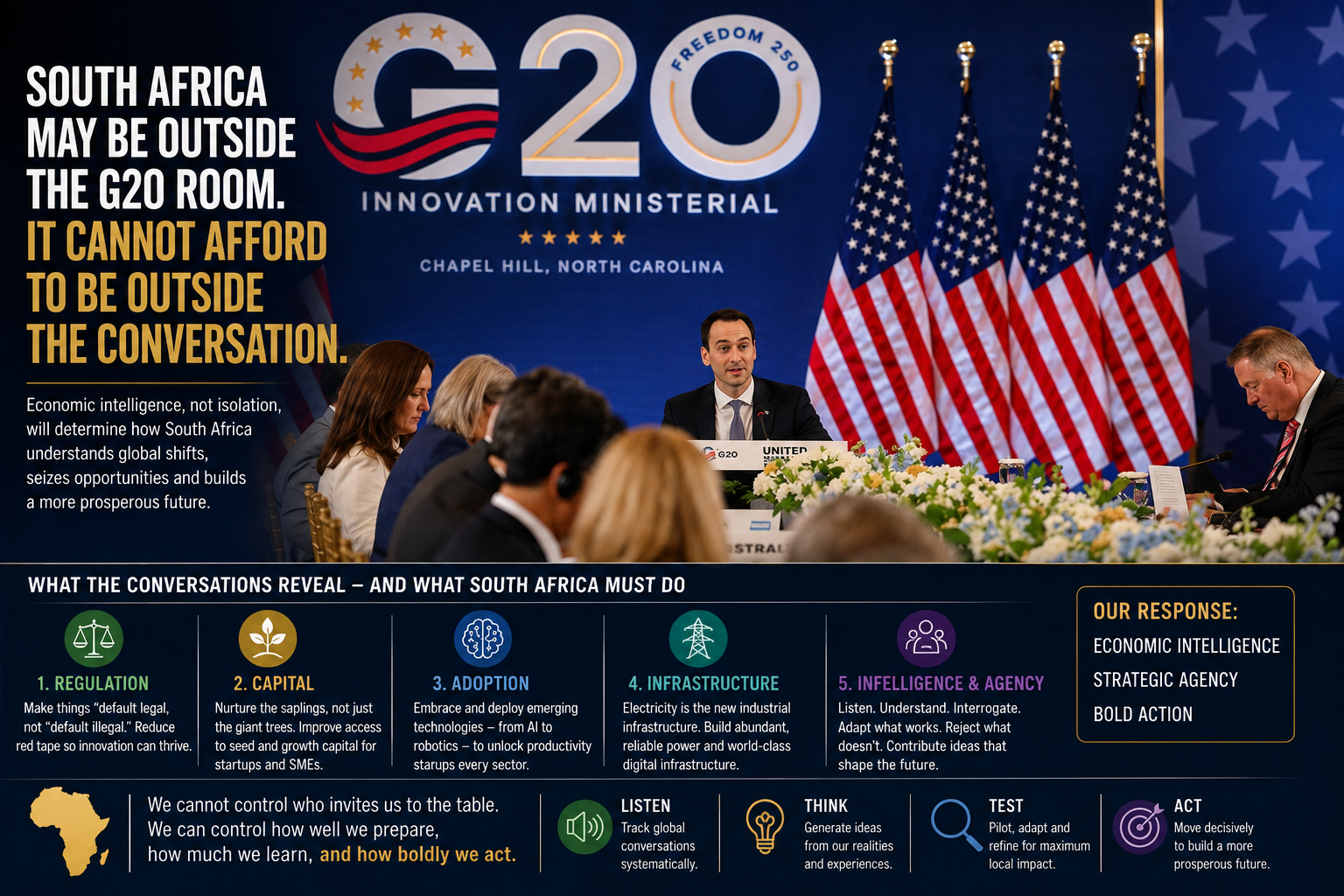
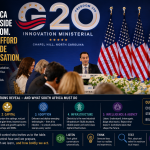
South Africa’s exclusion from certain G20 engagements under the United States presidency raises an important diplomatic question. But there is an even more consequential economic question:
How does South Africa remain abreast of conversations shaping the future of economic growth when its representatives are not sitting in the room?
A recent discussion between US officials and Elon Musk provides a useful case study.
Musk, chief executive of Tesla and SpaceX, participated in a discussion centred on economic growth, technological innovation and the conditions under which new technologies move from invention to commercial deployment.
The significance lies less in who spoke than in what was being discussed.
Beneath predictions about artificial intelligence, humanoid robots and autonomous vehicles was a much older economic question:
What conditions enable human beings to conceive ideas, mobilise capital, establish enterprises, deploy technology and increase productivity?
Musk’s argument can broadly be reduced to four interconnected factors: regulation, capital, technological adoption and infrastructure.
Each deserves examination from a South African perspective.
When Permission Becomes an Economic Variable
One of Musk’s most provocative propositions was that new activities should generally be “default legal” rather than “default illegal.”
His argument is that innovation slows when individuals must first establish that government permits something before experimenting with it.
That should not be confused with an argument for the absence of regulation. Regulation can protect people, property and markets from genuine harm.
The better question is whether a particular regulation produces greater public value than the economic activity it prevents, delays or makes more expensive.
For South Africa, this reaches far beyond artificial intelligence. It touches mining licences, electricity generation, construction approvals, telecommunications, financial technology, transport, agriculture, municipal approvals and the movement of people possessing scarce skills.
Every regulatory requirement carries an economic cost.
A useful regulatory test therefore becomes:
What problem is being solved, what does compliance cost, how long does approval take, and what productive activity is delayed in the process?
Regulatory efficiency is part of economic competitiveness.
The Sapling and the Established Tree
Musk offered another useful analogy: new enterprises are like saplings growing among established trees.
Large corporations generally possess lawyers, accountants, compliance departments, banking relationships, collateral, institutional memory and access to decision-makers.
A newly established enterprise may possess little more than an idea, the knowledge of its founders and limited capital.
Identical regulatory requirements can therefore produce radically unequal economic consequences.
A compliance obligation costing R500,000 may barely register in the accounts of a multinational corporation. For a startup, it may consume the capital required to employ its first workers, develop a prototype or enter the market.
A regulatory system can consequently treat enterprises equally in law while favouring incumbents in economic reality.
That distinction matters in a country where entrepreneurship and SMEs occupy considerable space in public policy.
Supporting entrepreneurship cannot merely mean creating programmes carrying the word “entrepreneurship.”
The conditions under which an enterprise must survive matter more.
Ideas Require Capital
An idea does not automatically become an enterprise.
Knowledge may identify a problem. Imagination may conceive a solution. Technical competence may produce a prototype.
Commercial deployment usually requires capital.
South Africa should therefore examine what happens between the conception of an economically useful idea and its commercialisation.
Can an entrepreneur obtain seed capital? Can a promising enterprise secure growth capital? Can intellectual property attract investment? Can university research become commercial enterprise? Can a South African technology company raise substantial expansion capital without relocating its economic centre elsewhere?
Training entrepreneurs without developing functioning capital pathways risks producing people capable of identifying opportunities but unable to finance their exploitation.
Entrepreneurship policy and capital formation cannot be separated.
Adoption May Matter More Than Invention
Another important part of the discussion concerned technological adoption.
A country does not have to invent every transformative technology to benefit from technological progress. It needs the capacity to recognise useful technologies, acquire them and deploy them productively.
Artificial intelligence illustrates the point.
South Africa does not need to produce an indigenous equivalent of every frontier AI model before deriving economic value from AI.
The immediate question is whether accountants, engineers, farmers, manufacturers, miners, banks, logistics businesses, hospitals, universities and public institutions can use increasingly capable systems to produce greater value from available knowledge, labour, capital and time.
Musk predicts enormous increases in global economic output from AI and, eventually, humanoid robotics. Those figures are forecasts rather than established facts.
The precise numbers matter less than the underlying economic development.
AI is increasingly becoming productive capital.
The South African question therefore extends beyond whether artificial intelligence will displace particular forms of employment.
It must also include:
What additional productive capacity can South Africans create by deploying it intelligently?
Electricity Is Becoming Digital Industrial Infrastructure
Perhaps the most consequential part of the discussion for South Africa concerned electricity.
Musk argued that rapid expansion of AI infrastructure is beginning to encounter electricity constraints.
That changes the economic significance of power generation.
Electricity remains indispensable to households, mines, factories, farms and transport systems. But abundant, reliable and competitively priced electricity is increasingly also an input into compute.
As artificial intelligence expands, so does the physical infrastructure required to train and operate increasingly capable systems.
Countries may therefore find themselves competing not merely for factories, mines and manufacturing plants, but for data centres and computational infrastructure.
Power availability, electricity prices, grid reliability, fibre connectivity, land, water, cooling capacity, regulatory certainty and political stability can influence where that infrastructure is located.
South Africa’s energy reforms should consequently be understood within a wider economic framework.
Additional generation capacity is not merely about eliminating load-shedding.
It may influence whether South Africa becomes a meaningful location for infrastructure underpinning the emerging AI economy.
What Happens When South Africa Is Not in the Room?
This returns the discussion to the G20.
South Africa remains active internationally. BRICS, the African Union, World Bank, International Monetary Fund, World Trade Organization and bilateral relationships provide other channels through which consequential economic conversations occur.
But alternative diplomatic platforms do not entirely resolve the problem.
There is a distinction between diplomatic participation and economic intelligence.
Foreign economic policy cannot concern itself only with who receives an invitation or occupies a chair. It must include the systematic acquisition, interpretation and transmission of economically useful knowledge.
If governments are debating AI regulation, South African policymakers should understand the competing approaches.
If investors identify electricity as a constraint on data-centre expansion, the implications should enter domestic energy and investment thinking.
If venture capital is becoming increasingly important to technological competitiveness, the country’s capital architecture should be interrogated.
If robotics begins altering manufacturing economics, industrial policy should not discover the transformation after competitors have reorganised production.
None of this requires agreement with Musk, the United States government or anybody else.
Listening is not agreement.
Understanding what consequential actors are thinking, where capital is moving, which technologies are emerging and how competing jurisdictions are responding is simply economic intelligence.
Intelligence Must Not Become Intellectual Dependence
There is, however, another danger.
South Africa cannot define being “abreast of the conversation” merely as listening carefully to conversations originating in Washington, Beijing, Brussels or elsewhere.
That would replace exclusion with intellectual dependence.
Economic intelligence should enable South Africans to interrogate ideas rather than merely import them.
Some propositions developed elsewhere will apply. Others will not. Some may require adaptation. Others should be rejected altogether.
South Africa must therefore possess institutions, enterprises, universities, investors and thinkers capable not only of receiving global economic intelligence but of producing original propositions from local knowledge and experience.
The objective is not to discover what powerful countries think and imitate them.
It is to understand the global environment sufficiently well to make better South African decisions — and, where necessary, contribute ideas that others may eventually adopt.
That is the difference between following a conversation and participating intellectually in shaping it.
From G20 Participation to G20 Intelligence
South Africa held the G20 presidency in 2025.
It therefore possesses recent institutional knowledge of the machinery through which G20 conversations occur: working groups, ministerial engagements, business forums, think tanks, technical discussions and private-sector interactions.
That knowledge should not become dormant because political relations with Washington have deteriorated.
If access to a particular room is denied, another capability becomes more important:
the capacity to know what is happening inside it.
South Africa should systematically follow major G20 discussions, interrogate emerging policy propositions and compare them with developments within BRICS, the African Union, IMF, World Bank, WTO and other centres of economic thought.
The objective should not be imitation.
It should be intelligence capable of informing action.
Where is capital moving?
Which technologies are approaching commercial maturity?
What constraints are investors encountering?
Which regulatory experiments are working?
What changes in production, energy, finance and technology could affect South African enterprises?
And what ideas can South Africans contribute to those conversations?
These questions remain relevant regardless of diplomatic disagreements.
An Empty Chair Does Not Have to Produce an Information Vacuum
There is an understandable temptation when a country is excluded from an international forum to concentrate on the politics of exclusion.
Diplomacy matters. Representation matters. South Africa is entitled to defend what it considers its legitimate place within multilateral institutions.
But economic competitiveness demands more.
The consequential response is not merely to ask:
Why were South Africans not invited?
It is to ask:
What was discussed, what can be learned, what should be challenged, and what should be done differently as a consequence?
The Musk discussion demonstrates the point.
Behind the spectacular predictions about artificial intelligence and humanoid robots lies a relatively conventional proposition about economic development.
Human beings require sufficient room to experiment.
New enterprises require access to capital.
Useful technologies require adoption.
Digital economies require physical infrastructure.
Institutions require the capacity to observe change, interrogate it and respond before economic opportunity moves elsewhere.
South Africa should listen to the conversations taking place in Washington, Beijing, Brussels, New Delhi and elsewhere.
But it should not merely listen.
It should think, test, originate and act.
South Africa may occasionally find itself outside a particular room.
It cannot afford to be outside the conversation.
Over the years, I have found it challenging to define myself solely by an academic qualification, trade, or occupation. My eagerness to learn, especially about how to build and deploy capital, has allowed me to accumulate diverse experiences in a short span of time. Through this journey, I have discovered that at my core, I am a storyteller. I tell the stories of corporations, their heritage, and the individuals who act in their name. I explore the role of these institutions in fulfilling the promise of a better Africa, and, most importantly, the causal link between the rule of law and economic development. As a fellow believer in Africa’s potential, can I count on you to be a point of light in securing our continent’s future?



