

Corporate Heritage
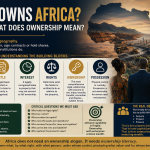
Who Owns Africa? First, What Does Ownership Mean?

Published
2 months agoon
On 13 August 2017, I posed a question:
What is ownership, and what is it not?
Nine years later, the question demands an even more fundamental interrogation.
Across Africa, we speak constantly about ownership: African ownership, indigenous ownership, foreign ownership, ownership of land, mines, businesses and natural resources.
But before asking who should own, perhaps we should first ask:
What is property? What is ownership? And can a geography own anything at all?
Can Africa Own Anything?
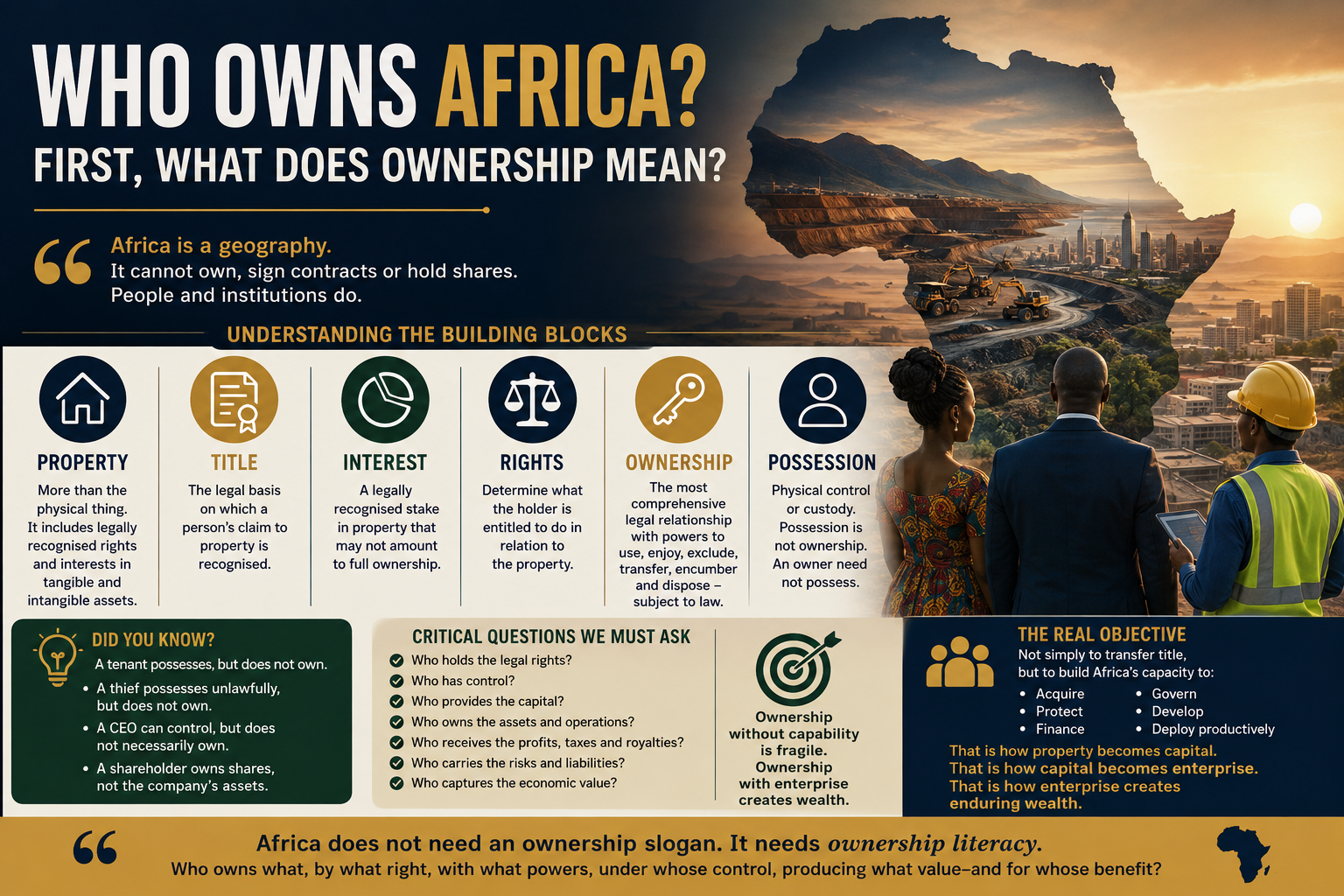
Africa is a geography.
It cannot sign a contract, register a company, hold shares, exercise voting rights, mortgage property, receive dividends or transfer title.
People and legally recognised institutions do those things.
Individuals own. Companies own. States may hold property and rights. Trusts and other legally recognised arrangements may hold assets or interests according to applicable law.
So when we say “Africa owns its resources”, the statement may carry political meaning, but it is legally and economically incomplete.
The immediate question should be:
Who exactly owns what?
That is not semantics.
It is corporate literacy.
Before Ownership Comes Property
We often think of property as the physical thing: a farm, a house, a vehicle, a factory or gold beneath the ground.
But property is more complicated than the physical object. Legal systems recognise rights and interests in both tangible and intangible assets.
A share, for example, is property, yet owning a share does not mean physically possessing a piece of the company.
Intellectual property can have enormous economic value without being a physical object.
Property therefore requires us to distinguish the asset itself from the rights and interests recognised by law in relation to it.
What Is Ownership?
Ownership is not merely having something in your hands.
It is a legally recognised relationship between a person and property, ordinarily carrying extensive powers over that property, subject to law and the rights of others.
The familiar expression “right, title and interest” helps illuminate the architecture, but the concepts are not interchangeable.
Title concerns the legal basis upon which a person’s claim is recognised. An interest can be a legally recognised stake without necessarily constituting full ownership. Rights determine what the holder is entitled to do.
Depending on the property and applicable law, ownership may include powers to possess, use, enjoy, exclude others, derive economic benefit, encumber, transfer or dispose of the property.
Which brings us to an essential distinction:
Possession is not ownership.
Possession, Control and Ownership
A tenant may possess and occupy a house without owning it. A landlord may own that same house without physically possessing it.
Someone who steals a vehicle obtains physical control of it. That does not automatically transfer lawful ownership.
Possession therefore answers one question:
Who has custody or physical control?
Ownership answers another:
Who holds the legally recognised proprietary relationship?
Control must also be distinguished from ownership.
A chief executive may control billions of rands in corporate assets without owning those assets personally. Directors make consequential decisions concerning property belonging to the company.
Therefore:
Possession is not necessarily ownership. Management is not necessarily ownership. Control is not necessarily ownership.
These distinctions are fundamental to understanding economic power.
Shareholders Do Not Own the Company’s Assets
Suppose I acquire 10% of the shares in a company.
Do I own 10% of its factory?
Generally, no.
Can I walk into its bank and withdraw 10% of the company’s cash because I hold 10% of its shares?
Certainly not.
A company is a separate juristic person.
The company owns its assets. The shareholder owns shares in the company.
Those shares carry whatever economic, voting and other rights attach to them under applicable law and the company’s governing instruments.
This may sound technical.
It sits at the centre of understanding modern capitalism.
Then Who Owns Africa’s Minerals?
Now apply the same reasoning to one of Africa’s most repeated economic propositions:
“Africa is rich because it owns vast mineral resources.”
Africa unquestionably contains extraordinary mineral endowments.
But geology is not ownership, and ownership is not automatically economic benefit.
When a valuable mineral deposit is discovered, the serious questions begin.
Who holds the relevant rights under the country’s law? Who receives the right or licence to extract it? Who owns the company holding that right? Who provides the capital? Who controls production? Who owns the extracted mineral at different stages of the value chain? Who processes it? Who receives the profits, taxes and royalties? Who carries the debt and environmental liabilities?
And ultimately:
Who captures the economic value?
Suddenly, saying “Africa owns its minerals” tells us remarkably little about the economic architecture surrounding those minerals.
Ownership Is Not Productive Capacity
This distinction is crucial.
A person can hold title to an asset that produces almost nothing. Another can derive substantial economic benefit from assets they do not own outright.
Land can be owned and remain unproductive.
Mineral rights can be held without the capital or technical capability required to exploit them.
Shares can be inherited without the shareholder understanding the rights attached to them.
A locally owned company can still be poorly governed, undercapitalised and ultimately fail.
Changing ownership changes who owns an asset.
It does not automatically change what that asset produces.
That requires enterprise.
Have We Misdiagnosed the Problem?
For decades, African economic discourse has understandably concentrated on:
Who owns?
But that question is incomplete.
We should also ask:
Who understands what they own? Who finances it? Who governs it? Who develops it? Who protects the rights attached to it? Who transforms it into productive capital? Who captures its economic value? Can that value survive from one generation to the next?
This is why what is frequently described as an African ownership problem may also be an ownership-literacy problem.
If we cannot distinguish property from possession, possession from ownership, ownership from management, management from control, shareholding from corporate property, and resource endowment from productive capital, then our economic debate begins from conceptual confusion.
Ownership matters profoundly. It determines rights, economic participation, wealth accumulation, bargaining power and the capacity to transfer assets across generations.
But ownership without the institutions, capital, skills, governance, technology and markets necessary to sustain productive assets can be fragile.
The objective therefore cannot simply be to transfer title.
It must be to develop people and institutions capable of acquiring, protecting, financing, governing and productively deploying assets.
That is how property becomes capital.
That is how capital becomes enterprise.
And that is how enterprise creates enduring wealth.
Nine Years Later
On 13 August 2017, I asked:
What is ownership, and what is it not?
Nine years later, I would begin one step earlier:
What is property?
Then we can ask what constitutes possession, title, interest, control and ownership—and who is legally capable of exercising them.
Only then should we confront the larger question:
Who owns Africa’s wealth?
Because Africa is a geography.
People build enterprises. People establish institutions. People acquire rights. People allocate capital. People govern companies. People make laws. People exercise ownership.
Our challenge is therefore not to teach a geography how to own.
It is to equip African people and institutions to understand precisely what they own, by what right they own it, how those rights are protected, and how ownership can be transformed into productive and intergenerational wealth.
Africa does not need an ownership slogan.
It needs ownership literacy.
Because the defining question is no longer simply:
Who owns?
It is:
Who owns what, by what right, with what powers, under whose control, producing what value—and for whose benefit?
Over the years, I have found it challenging to define myself solely by an academic qualification, trade, or occupation. My eagerness to learn, especially about how to build and deploy capital, has allowed me to accumulate diverse experiences in a short span of time. Through this journey, I have discovered that at my core, I am a storyteller. I tell the stories of corporations, their heritage, and the individuals who act in their name. I explore the role of these institutions in fulfilling the promise of a better Africa, and, most importantly, the causal link between the rule of law and economic development. As a fellow believer in Africa’s potential, can I count on you to be a point of light in securing our continent’s future?



