


Corporate Literacy
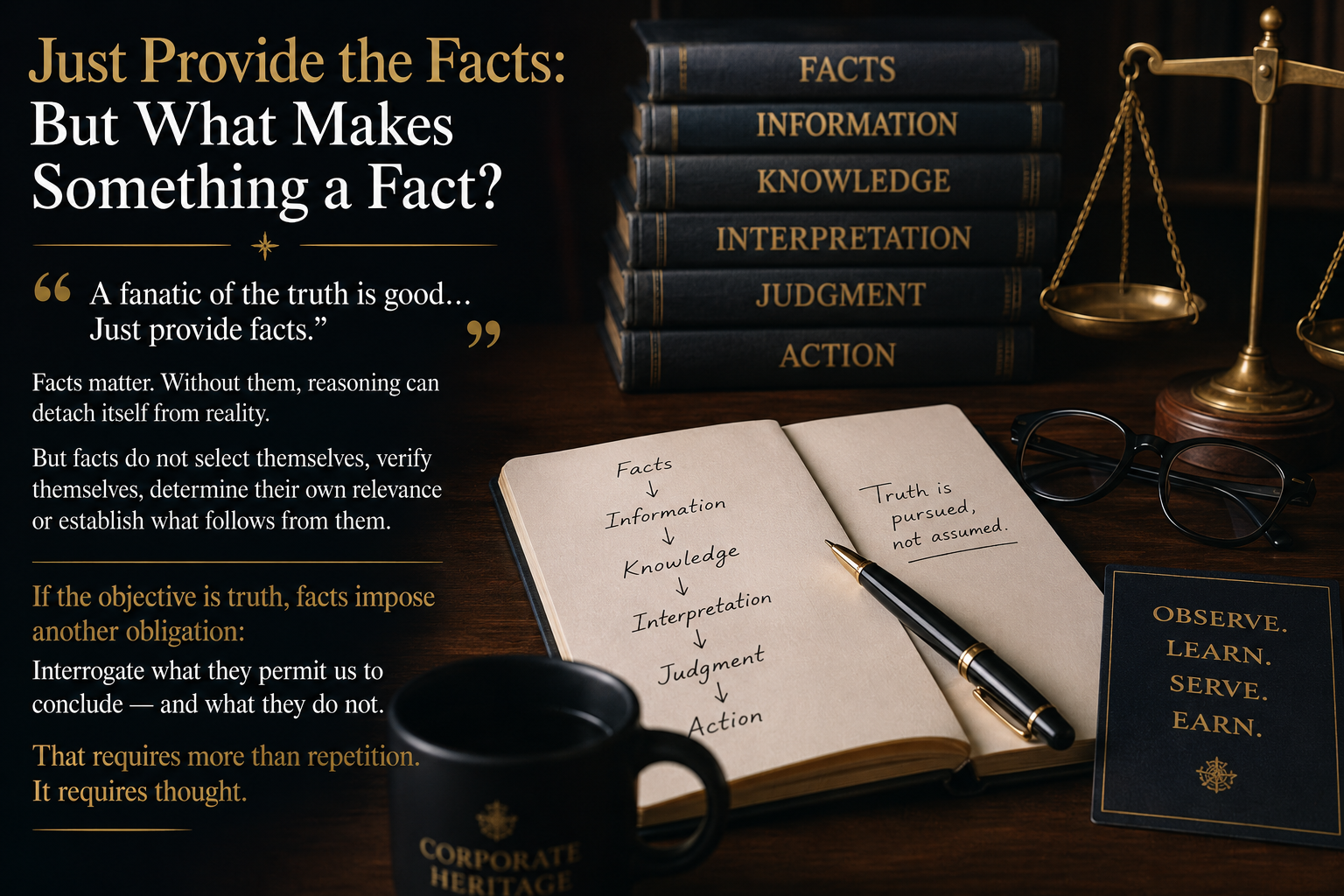
Just Provide the Facts: But What Makes Something a Fact?

Published
2 months agoon
By Tinashe T. T. Mpasiri | 29 August 2026
Following my reflection on knowledge, someone dismissed the exercise as philosophy:
“Bla bla bla… This is philosophy — a lot of bla bla talking meaning absolutely nothing… And at the end of the day there’s nothing tangible you can show for it.”
He compared philosophical conversation to gossip and concluded:
“A fanatic of the truth is good… Just provide facts.”
My response was brief:
“Thank you.”
“You inspire me.”
I meant it.
Contained within the criticism were questions worth interrogating.
If I should “just provide facts,” what exactly is a fact?
If the objective is truth, are facts and truth interchangeable?
If something must be tangible before it has value, what constitutes value?
The criticism had given me something useful: questions.
And questions are often where knowledge begins.
What Is a Fact?
Suppose I say that a company generated US$100 million in revenue during a particular financial year.
Assuming reliable evidence supports the statement, we have a fact.
But is the company profitable? Is revenue growing or declining? Is it generating cash? How much debt does it carry? What did it cost to generate that revenue?
The US$100 million has not changed.
What changes is what a human being may legitimately conclude from it.
A fact can be true and still be insufficient.
This is why facts do not eliminate the need for thought. They provide material upon which thought operates.
Give the same financial statements to an accountant, lender, investor and corporate financier and each may interrogate something different. One considers accounting treatment, another debt-service capacity, another returns, and another capital structure or transaction possibilities.
The document has not decided what matters.
Human beings have brought different questions and accumulated knowledge to the same information.
Facts are indispensable.
Understanding requires more.
Which Facts?
There is another difficulty with the instruction to “just provide facts.”
Which ones?
Consider a corporation that has existed for a century.
Its incorporation date may be a fact. So may the identities of its founders, revenues, acquisitions, disposals, changes in ownership, investments and disputes.
There could be millions of verifiable facts associated with its existence.
No article could contain all of them.
Someone must determine which are relevant.
Selection requires judgment. So does verification.
Suppose three sources provide different dates for the establishment of a company. Further investigation reveals that the enterprise began trading in 1910 but the legal entity was incorporated in 1912.
Which is the founding date?
Before resolving the disagreement, another question becomes necessary:
What do we mean by “founded”?
The disagreement may not concern the underlying evidence at all. Two people may simply be using the same word to describe different events.
Definitions matter because conclusions can change depending upon what our words mean.
And that brings us directly into the territory sometimes dismissed as philosophy.
If Truth Is the Objective
The phrase “a fanatic of the truth” interests me even more.
How does a human being establish that something is true?
A statement does not become a fact merely because someone calls it one.
Claims require evidence. Sources differ in reliability. Evidence can conflict. Words can carry different meanings. New evidence can require earlier conclusions to be revised.
The pursuit of truth therefore demands interrogation:
What is being claimed?
What evidence supports it?
What does the evidence actually establish?
What remains unknown?
Those questions are not distractions from facts.
They are part of determining them.
Is Philosophy Merely Talk?
There is a legitimate warning buried inside the criticism.
Philosophy can become empty.
Human beings can arrange impressive words into elaborate sentences without defining terms, testing assumptions or connecting conclusions to reality.
But that is an argument against poor reasoning, not against reasoning itself.
Consider business.
What constitutes ownership?
What does a contract mean by control?
When has an obligation been performed?
When is revenue earned?
What constitutes default?
These may sound like questions about words until people disagree about the answers.
Then assets, liabilities, ownership rights and sometimes millions of dollars can depend upon precisely what those words mean.
Thinking carefully about language is not necessarily an escape from practical affairs.
Sometimes it determines them.
Must Value Be Tangible?
The criticism also proposed a test: if nothing tangible emerges, what is there to show for the exercise?
But tangibility and value are not synonymous.
I can touch a signed contract. I cannot physically touch the contractual rights it creates.
I can touch a computer. The software operating through it is not equivalent to the physical machine.
Reputation, know-how, intellectual property and commercial relationships can produce economic consequences without existing as physical objects.
A corporation itself provides an illuminating example.
One can touch its factory, enter its offices and use its products.
But none of those things is the corporation.
The corporation is a legal person.
Its physical assets may be tangible. Its legal existence is not therefore imaginary or economically meaningless.
Something does not have to be physically held to have consequences.
Thought Is Not Action
There is nevertheless a boundary worth preserving.
Thinking is not doing.
A carefully reasoned business plan does not establish an enterprise. Understanding capital allocation does not make an investment. Knowing how a transaction could be structured does not complete it.
But tangibility does not prove intelligent action either.
A badly designed bridge is tangible.
A failed investment is tangible.
An uneconomic factory is tangible.
A disastrous acquisition is tangible.
The existence of an observable outcome does not establish the quality of the reasoning that produced it.
The useful question is therefore not whether human beings should think or act.
It is whether the quality of thought influences the quality of action.
Facts and Corporate Heritage
Corporate heritage cannot merely catalogue dates, names and numbers.
Those facts establish the historical record, and accuracy is indispensable.
But the record permits further inquiry.
Why did one corporation survive while another disappeared?
Why was capital allocated in a particular way?
Why did an acquisition create value in one instance and destroy it in another?
What assumptions informed those decisions?
What can another human being learn from the consequences?
Facts establish what happened. Inquiry helps us understand what those facts may mean.
That is why I examine corporate heritage.
Not to manufacture complexity.
Not to sound profound.
But to interrogate propositions about corporations, economics and human action that might otherwise pass without examination.
Thank You. You Inspire Me.
My response to the criticism was:
“Thank you. You inspire me.”
There was no need to fight the comment.
It had already produced something useful.
The dismissal of philosophy raised the question of what separates empty talk from disciplined inquiry.
The demand for something tangible raised the question of whether tangibility determines value.
The invocation of truth raised the question of how a human being establishes what is true.
And the instruction “just provide facts” produced the question underlying this reflection:
What makes something a fact?
Facts matter.
Without them, reasoning can become detached from reality.
But facts do not select themselves, verify themselves, determine their own relevance or establish what follows from them.
A human being must do that.
So I accept the challenge:
Provide the facts.
Certainly.
But if the objective is truth, facts impose another obligation:
Interrogate what they permit us to conclude — and what they do not.
That requires more than repetition.
It requires thought.
Observe. Learn. Serve. Earn.
Corporate Heritage Series | 29 August 2026
Over the years, I have found it challenging to define myself solely by an academic qualification, trade, or occupation. My eagerness to learn, especially about how to build and deploy capital, has allowed me to accumulate diverse experiences in a short span of time. Through this journey, I have discovered that at my core, I am a storyteller. I tell the stories of corporations, their heritage, and the individuals who act in their name. I explore the role of these institutions in fulfilling the promise of a better Africa, and, most importantly, the causal link between the rule of law and economic development. As a fellow believer in Africa’s potential, can I count on you to be a point of light in securing our continent’s future?



