On 16 September 2017, I took part in a discussion on Zimbabwe Today billed as a “battle of ideas” — Rutendo Benson Matinyarare and Mutumwa Mawere debating the untold story of SMM. Four questions framed it: How was SMM acquired, and what role, if any, did political patronage play? What was the basis of the externalisation allegations against Mawere? What led to SMM being placed under reconstruction? And what has become of it since?
Nine years later, I’m returning to those questions, with new ones I can no longer set aside.
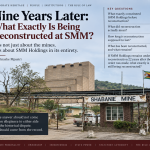
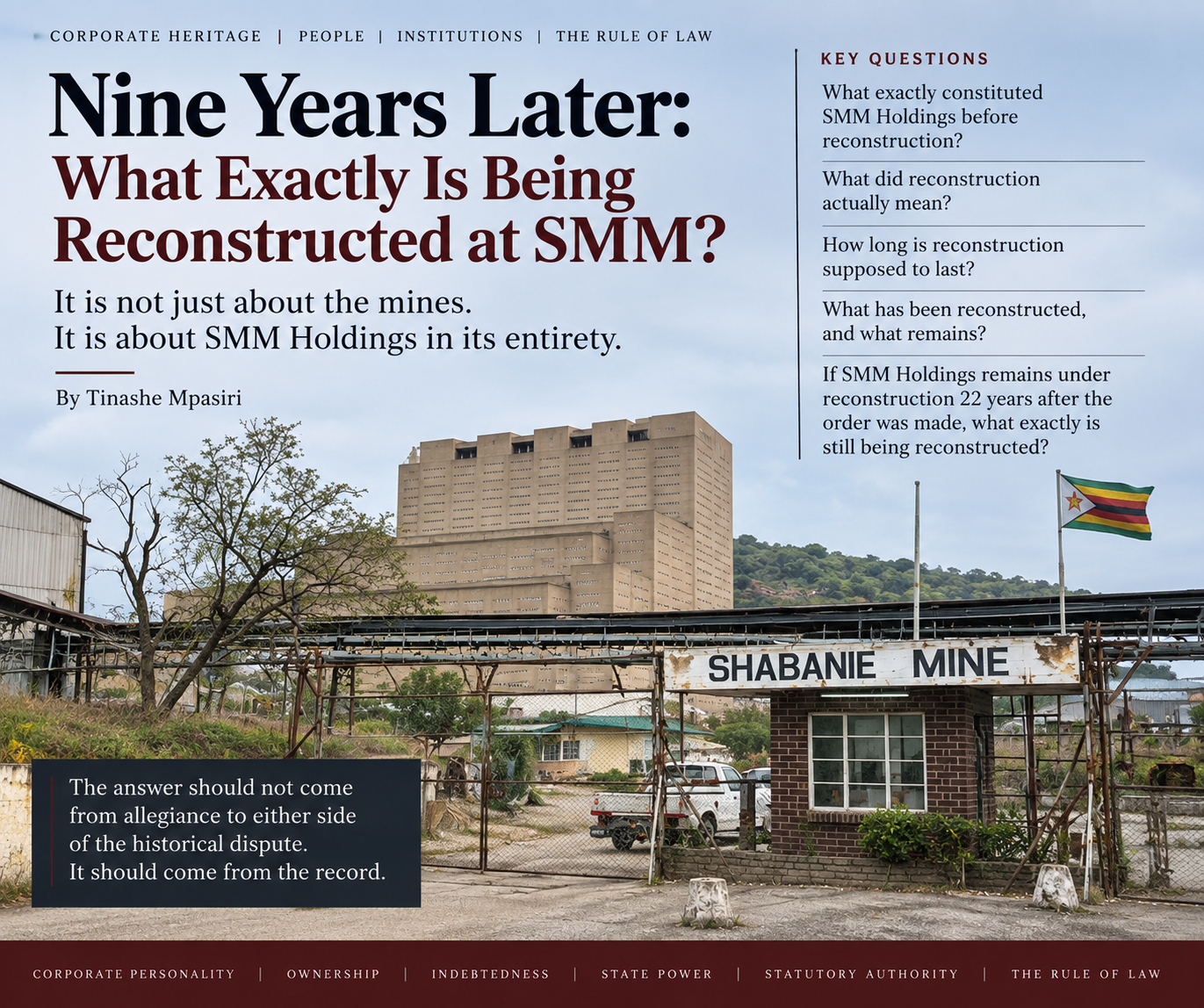
SMM was not merely an asbestos mine
Any serious inquiry has to start by naming its object. “SMM” easily collapses into Shabanie and Mashaba, and from there into asbestos mining alone. But the proper subject is SMM Holdings in its entirety, the full corporate architecture of juristic persons, interests, assets, liabilities and relationships that made up or were associated with the wider enterprise. A mine is not a company, an asset is not its owner, and a shareholder is not the company in which they hold an interest.
The Reconstruction of State-Indebted Insolvent Companies Act itself supports this wider frame: a reconstruction order can extend beyond the named company to associate companies and, in specified circumstances, other connected companies.
So the first question is: what exactly constituted SMM Holdings immediately before reconstruction? Only once that architecture is established can one properly ask what reconstruction changed.
What did reconstruction actually mean?
The word itself deserves scrutiny. Under the Act, a company “under reconstruction” is one subject to an order not yet carried out under an approved scheme. The legislation contemplates an administrator taking control of the company, possession of its assets, and extensive powers over its affairs.
It also points towards a destination. Among the statutory considerations for making a reconstruction order is a reasonable probability that reconstruction will enable the company to meet its obligations and become a successful concern. Reconstruction, in other words, is not the mere act of placing a company under an administrator, it is a process aimed at an outcome.
Which raises a question I didn’t put sharply enough in 2017:
How long is reconstruction supposed to last?
The Act doesn’t set a simple maximum duration, but it does set milestones. Within two months of commencement, the administrator must produce a scheme of reconstruction and present it to a joint meeting of creditors and members; the scheme then goes to the Minister for approval. If no feasible scheme can be formulated under section 25, or the scheme isn’t approved, the order can be cancelled. Section 35 adds another marker, where the administrator advises that reconstruction’s purpose has been fulfilled, or that keeping the order in force is undesirable for any reason, the Minister may cancel it.
So the real question isn’t simply “how many years does the Act permit?” It’s, what is reconstruction supposed to accomplish, and how do we know when that purpose has been fulfilled or can no longer be fulfilled?
Twenty-two years later
SMM Holdings was placed under reconstruction in 2004, and this isn’t just history. On 16 May 2025, the Minister of Justice, Legal and Parliamentary Affairs published General Notice 1007 of 2025, amending the original order (GN 450B of 2004) and appointing Munashe Shava as administrator for a further 24 months.
That notice makes the present-day question unavoidable, in 2026, roughly 22 years after the original order, what exactly remains to be reconstructed?
Not a rhetorical question, and not one whose answer should be assumed. It’s an invitation to examine the record:
- What condition did the original scheme identify as the reason SMM needed reconstruction?
- What objectives were set, and which have been met?
- What happened to the debts and obligations reconstruction was meant to resolve?
- What happened to the companies, assets and interests within or associated with SMM Holdings?
- What has happened to the underlying businesses’ productive capacity?
- What measurable condition must be satisfied before SMM Holdings ceases to be “under reconstruction”?
From personalities to institutions
This is where my view has shifted since 2017. It’s easiest to approach SMM through personalities, Mawere, government officials, administrators, and the competing narratives around them. But personalities can’t substitute for the corporate and legal record.
An allegation isn’t fact merely because an official makes it, nor false merely because the accused denies it. The inquiry has to establish what was alleged, against whom, on what evidence, through what process, with what finding.
The same discipline applies to reconstruction itself. Rather than starting from whether one supports or opposes what happened to SMM, start with the juristic persons, Who owned what? Who owed what to whom? Which companies became subject to reconstruction, and what powers were exercised over them? What was the approved scheme? What has been reconstructed, and what remains?
And after 22 years, what is the endpoint?
A battle of ideas worth continuing
Revisiting that 2017 post, my engagement with SMM didn’t begin with hindsight, the questions were already being asked. What’s changed is the precision with which I now think they should be put.
SMM shouldn’t be reduced to the history of two asbestos mines, or to a dispute between Mutumwa Mawere and the Government of Zimbabwe. It’s an opportunity to study SMM Holdings in full, and through it, the relationship between corporate personality, ownership, indebtedness, state power, statutory authority and the rule of law.
Perhaps the simplest, and most important, question, nine years after that conversation, is this:
If SMM Holdings remains under reconstruction 22 years after the order was made, what exactly is still being reconstructed?
The answer shouldn’t come from allegiance to either side of the historical dispute.
It should come from the record.
That’s where the battle of ideas should continue.