



Corporate Heritage
Ten Years Later: Time + Effort = Value

Published
2 months agoon
Banking On Africa’s Future — Corporate Heritage Series
By Tinashe T. T. Mpasiri | 22 August 2026
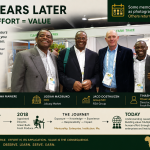
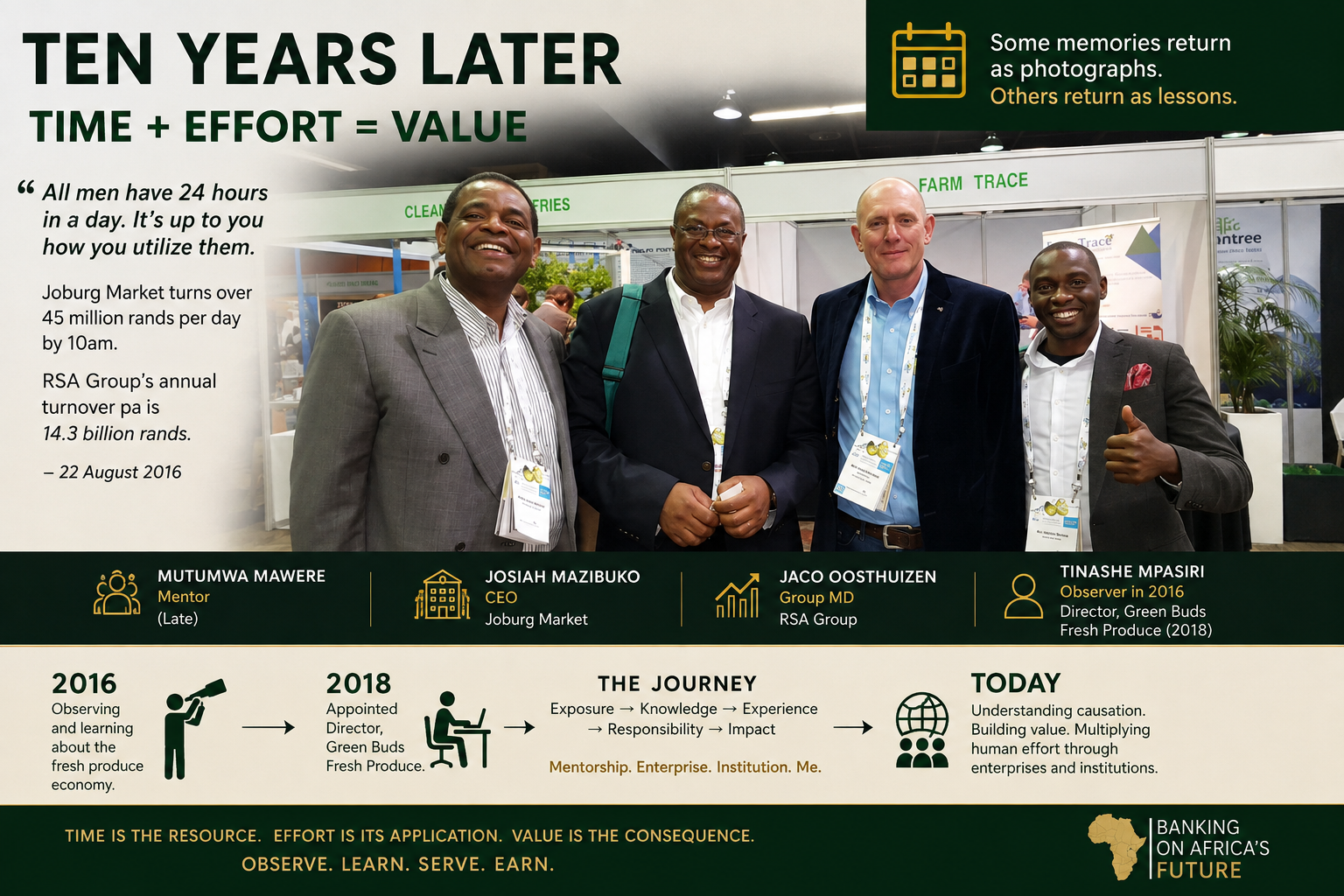
On 22 August 2016, I shared a photograph on Facebook with an observation:
“All men have 24 hours in a day. It’s up to you how you utilize them. Joburg Market turns over 45 million rands per day by 10am. RSA Group’s annual turnover pa is 14.3 billion rands.”
From left to right in that photograph stood the late Mutumwa Mawere, who was my mentor; Josiah Mazibuko, then CEO of Joburg Market; Jaco Oosthuizen of RSA Group; and myself, Tinashe Mpasiri.
Ten years later, Facebook returned the photograph as a memory.
The photograph has not changed.
The mind examining it has.
In 2016, I was fascinated by time and turnover. Today, I am interested in what happens between the two.
My proposition is:
Time + Effort = Value.
And the photograph provides an extraordinary frame through which to examine it.
Twenty-Four Hours Produce Nothing on Their Own
Every human being operates within time, but the passage of time is not itself productive.
A field does not produce tomatoes because 24 hours have passed. A company does not generate revenue simply because another business day has elapsed. Joburg Market did not transact millions of rand by 10am because the clock moved from one hour to another.
Human beings had to act.
Someone had to cultivate produce. Someone had to transport it. A buyer had to make a purchasing decision. Market agents had to connect supply with demand. Employees had to administer transactions and operate the infrastructure through which exchange became possible.
Time provided the opportunity.
Effort produced the activity.
Value emerged from what that activity accomplished.
Time + Effort = Value.
The 24 hours may be constant. What human beings cause to happen within them is not.
RSA and Joburg Market: Enterprise Within an Institution
This is where the relationship between RSA and Joburg Market becomes important.
RSA Market Agents traces its origins to 1984, when Mike Loutfie established a fresh-produce market agency operating at Joburg Market. From that beginning developed a much larger fresh-produce enterprise.
RSA did not create Joburg Market, and RSA is not Joburg Market.
It built an enterprise within a market architecture.
Joburg Market provides the infrastructure through which producers, market agents, buyers and other participants can interact. RSA developed specialised capability within that environment, connecting producers with buyers and facilitating the movement of produce through the market.
The distinction helps explain how economic value scales.
An institution creates architecture.
An enterprise develops capability within that architecture.
Human beings operate both.
Behind the turnover figures that fascinated me in 2016 were thousands of decisions and actions.
Before a tomato appears on the market floor, knowledge and effort have already been applied to land, seed, irrigation, crop management, harvesting, grading, packaging and transportation. The produce must reach a marketplace. Information must be interpreted. Buyers must make decisions. Transactions must occur. Produce must then move onwards through the distribution chain.
Turnover is therefore an outcome.
It tells us that exchange occurred.
But to understand the economy, I have increasingly become interested in the causation behind the outcome.
Enterprise Multiplies Human Effort
One human being has a finite productive capacity.
There are only so many customers one person can serve, negotiations one person can conduct, kilometres one person can drive or decisions one person can execute within 24 hours.
Enterprise changes the scale of what is possible.
When a founder creates an organisation, recruits people, develops systems, acquires assets and coordinates different capabilities around a commercial purpose, individual effort becomes organised effort.
The founder has not acquired more time.
The founder has created a mechanism through which the time and effort of many human beings can be coordinated.
That is organisational leverage.
It is also why RSA’s development matters to this story. What began as a market agency could grow beyond the productive capacity of its founder because human effort became organised through an enterprise.
Joburg Market represents another layer of that principle. It provides an institutional environment in which numerous enterprises and individuals can interact at a scale impossible for an isolated farmer, trader or buyer.
The progression becomes:
Time + Effort = Value
Value + Organisation = Capacity
Capacity + Exchange = Enterprise
Enterprise + Institutional Architecture = Scale
The starting point remains human action.
Four People, Four Dimensions
But the photograph now tells me something the turnover figures could never tell me.
Look again at the four people standing there.
The late Mutumwa Mawere was my mentor.
Josiah Mazibuko represented institutional infrastructure through Joburg Market.
Jaco Oosthuizen represented enterprise through RSA Group.
And then there was me.
I was observing.
I was listening.
I was asking questions.
I was learning.
At the time, I could not know where that accumulated exposure would lead.
Two years later, in 2018, I was appointed a director of Green Buds Fresh Produce.
Suddenly, the photograph acquires another meaning.
I had moved from observing the fresh-produce economy to assuming corporate responsibility within an enterprise participating in that economy.
Exposure had preceded participation.
Learning had preceded governance.
That is why mentorship itself belongs within the equation of value creation.
Experience accumulated by one human being can be transferred to another. A question can alter how someone sees an industry. A conversation can expose a possibility. Access can place an individual inside environments where knowledge that once appeared abstract becomes observable.
The economic value of such moments may not reveal itself immediately.
Sometimes it takes years.
The Photograph Captured a Future I Could Not Yet See
This is perhaps what moves me most when I revisit the photograph ten years later.
In 2016, I thought I was standing beside people from whom I could learn something about business and the fresh-produce industry.
I now realise I was standing inside a lesson about how economies are constructed.
There was mentorship.
There was enterprise.
There was an institution.
And there was a student of all three.
Two years later, that student would become a director in the fresh-produce industry himself.
That does not mean that every hour of effort inevitably produces financial reward. Value can take many forms before it becomes visible economically: knowledge, capability, relationships, experience, judgement and eventually responsibility.
This is why I no longer look at that photograph and see only R45 million by 10am or R14.3 billion in annual turnover.
I ask different questions.
Who caused those outcomes?
What knowledge did they possess?
What problems were being solved?
How was human effort organised?
What institutional architecture allowed that effort to scale?
And what could I learn from it?
Ten Years Later
The young man in that photograph was looking at numbers.
The man examining the photograph ten years later is looking for causation.
That is not a rejection of what I wrote in 2016.
It is evidence of what ten additional years of observing, learning and participating have added to the original thought.
Every human being operates within time.
But time alone creates nothing.
Human beings think. Human beings decide. Human beings act. Human beings organise. Human beings build enterprises and institutions through which their efforts can extend beyond their individual capacity.
And sometimes the value being created today cannot yet be measured by the person creating it.
In 2016, I thought I was standing beside men who could teach me something about an industry.
Ten years later, I realise the photograph captured something larger: mentorship, enterprise and institution standing beside a student of all three.
Two years later, that student would become a director in the fresh-produce industry himself.
Time had passed.
Effort had been applied.
Value had emerged.
Time + Effort = Value.
Observe. Learn. Serve. Earn.
#CorporateHeritage #CorporateLiteracy #TheAfricaIWant #BOAF
Over the years, I have found it challenging to define myself solely by an academic qualification, trade, or occupation. My eagerness to learn, especially about how to build and deploy capital, has allowed me to accumulate diverse experiences in a short span of time. Through this journey, I have discovered that at my core, I am a storyteller. I tell the stories of corporations, their heritage, and the individuals who act in their name. I explore the role of these institutions in fulfilling the promise of a better Africa, and, most importantly, the causal link between the rule of law and economic development. As a fellow believer in Africa’s potential, can I count on you to be a point of light in securing our continent’s future?



